More UK firms are making redundancies than at any point since COVID


Key Points
- More large businesses filed HR1 redundancy notices in the year to March 2026 than in any preceding year since COVID.
- HR1 forms are required when an employer proposes 20 or more redundancies, which means this data reflects the movements of larger companies in the UK.
- In March 2026 alone, the number of employers who filed HR1 redundancy notices rose to 434, the highest non-COVID month on record.
- Growing redundancies paint a precarious economic landscape for workers when combined with the risk of AI replacing jobs across many major sectors.
UK firms are making workers redundant at a record rate, with more large businesses filing redundancy notices in the year to March 2026 than in any year since the COVID pandemic.
ONS data published on 30 April 2026 reveals that as of March 2026, 4,015 UK companies had filed HR1 redundancy notices in the past year. This is the highest rolling 12-month count of employers who filed HR1 redundancies in the dataset’s history, discounting the anomalously high figures during COVID.
HR1 forms are required when an employer proposes 20 or more redundancies, which means that while the data does not capture redundancies at small businesses, it provides an accurate picture of redundancy activity at large-scale companies in the UK.
Comparing the latest data to previous years illustrates a clear trend – the number of UK companies laying off employees is rising. In March 2024, the rolling 12-month count of employers who had filed HR1 redundancy notices was 3,518, and in March 2025 it rose to 3,590.
In the 12-month period ending in March 2026, the number of employers filing HR1 redundancy notices increased by 12% – a significant jump compared to even the increase seen in previous years.
In the month of March 2026 alone, the number of employers who filed HR1 redundancy notices rose to 434, the highest non-COVID month on record. Only seven months recorded a higher number of redundancies in the history of the ONS’s dataset, and all were from the immediate COVID period between May and November 2020.
The first quarter of 2026 saw 1,198 employers file HR1 redundancy notices, and this quarterly figure has also increased every year since the pandemic.
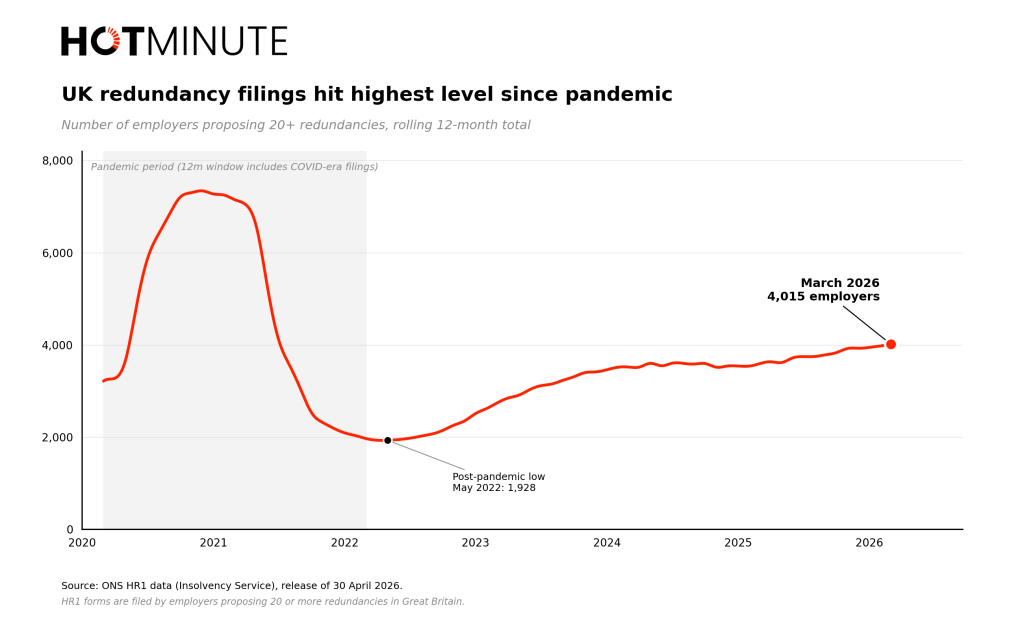
Whichever way you look at the data, it is clear that the number of large companies in the UK making redundancies is growing, pointing to a precarious economic landscape for workers when combined with the risk of AI replacing skilled jobs across major industries.
Jobs at risk due to AI
The record-breaking number of larger companies laying off employees will do little to assuage the concerns of workers in the UK who are already concerned with the advent of AI and its effect on their jobs.
According to a recent report from the Greater London Authority (GLA), one in five people working in London are at risk of being replaced by AI.
The report found that more than 300,000 workers, or 6% of the city’s workforce, faced high levels of exposure and risk of AI automation.
An additional 748,000 London professionals, 14.3% of the total workforce, were in roles where many of their tasks overlap with generative AI capabilities, placing them at potential risk of redundancy.
Administrative roles were found to be at particular risk of being automated by AI, although roles such as software developers, financial advisors, and economists were also exposed to the risks of AI automation.
The broader picture outside of London and further into the future is even more disruptive. A study published last year found that up to 3 million UK-based jobs could disappear by 2035 due to AI and automation.
This research predicted that while these jobs will disappear, the overall labour market would actually continue growing. However, it expected that job growth would likely be confined to professional and associate occupations, with low- and mid-skilled jobs seeing contraction across the board.