Scotland’s top-ranked councils for mobile coverage in 2026


Key Points
- Streetwave tested all four UK mobile operators across 12 Scottish council areas between November 2024 and April 2026 using real-world drive testing, not modelled estimates.
- Glasgow leads with 95.75% Basic Coverage; Argyll and Bute is last at 53.25%, a gap of over 42 percentage points.
- Only four councils, all in the Greater Glasgow area, achieve average Basic Coverage above 80%.
- On the higher Good Coverage measure, The Highlands scores just 28%, meaning fewer than one in three locations can support a video call.
- The data was collected partly via sensors mounted on council bin lorries, capturing live signal from all four operators simultaneously.
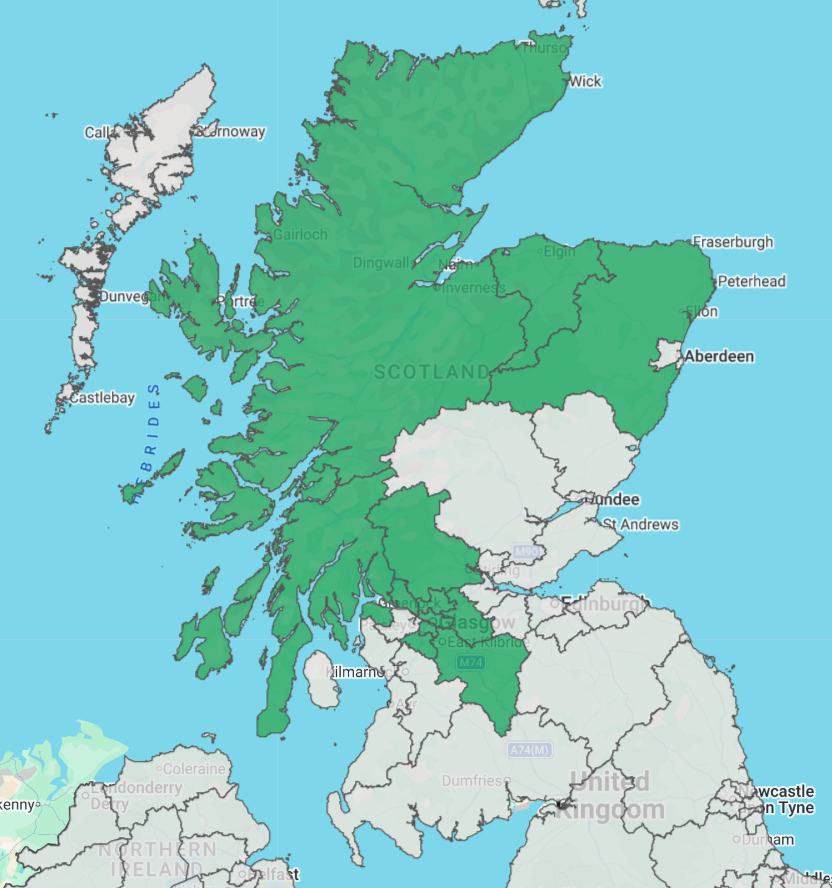
Streetwave has published the most comprehensive independent ranking of mobile coverage across Scotland to date, testing all four national operators across 12 council areas and finding a 42-percentage-point gap between the best and worst performers.
Glasgow leads the table with an average Basic Coverage score of 95.75% across EE, Vodafone, Three, and O2, while Argyll and Bute sits at the bottom at 53.25%.
Only four councils clear the 80% threshold: Glasgow, North Lanarkshire, West Dunbartonshire, and Inverclyde, all within or immediately adjacent to the Greater Glasgow urban area.
What the scores mean
Basic Coverage requires at least 1 Mbps download, 0.5 Mbps upload, and under 100ms latency.
Good Coverage sets a higher bar at 5 Mbps download, 1.5 Mbps upload, and under 50ms latency, supporting video calls, remote working, and higher-quality streaming.
On the Good Coverage measure, Glasgow again leads at 80.5%, but the drop-off is steep.
The Highlands records just 28% and Argyll and Bute 31.75%, meaning fewer than one in three surveyed locations in those areas can support a video call or remote working session.
How Streetwave collected the data
Surveys ran between November 2024 and April 2026 using two methods.
For several councils, Streetwave mounted data collection units on bin lorries, capturing live signal data across road networks as crews completed their usual rounds.
For others, dedicated drive-testing vehicles covered the road network directly.
In all cases, all four operators were measured simultaneously, producing results based on actual performance rather than modelled operator estimates.
Streetwave says the gap between what operators publish on their coverage maps and what users experience on the ground is often significant, particularly in rural and semi-rural areas.
Full Basic Coverage rankings
| Rank | Council | Basic coverage | Good coverage | Notes |
|---|---|---|---|---|
| 1 | Glasgow | 95.75% | 80.5% | Scotland’s largest city; highest infrastructure density |
| 2 | North Lanarkshire | 85.5% | 60% | Within Greater Glasgow urban area |
| 3 | West Dunbartonshire | 81.5% | 49.25% | Adjacent to Greater Glasgow |
| 4 | Inverclyde | 80.75% | 65.5% | Passes 80% threshold; strongest Good Coverage outside Glasgow |
| 5 | East Dunbartonshire | 78.75% | 52.25% | Just below Basic Coverage threshold |
| 6 | Aberdeenshire | 77.5% | 47.25% | Semi-rural; below both thresholds |
| 7 | East Renfrewshire | 76.75% | 54% | Semi-rural; mixed performance |
| 8 | South Lanarkshire | 76.25% | 55.75% | Mixed urban and rural area |
| 9 | Moray | 68.25% | 34.25% | Predominantly rural; below 70% on both measures |
| 10 | The Highlands | 65.25% | 28% | Large rural area; worst Good Coverage score |
| 11 | Stirling | 60.75% | 40.25% | Predominantly rural; second worst Basic Coverage |
| 12 | Argyll and Bute | 53.25% | 31.75% | Lowest Basic Coverage; nearly half of locations lack usable signal |
Basic Coverage: min 1 Mbps download, 0.5 Mbps upload, <100ms latency. Good Coverage: min 5 Mbps download, 1.5 Mbps upload, <50ms latency. Scores are averages across EE, Vodafone, Three, and O2. Source: Streetwave, Nov 2024 – Apr 2026.
A clear urban and rural divide
The four lowest-ranked councils, Moray, The Highlands, Stirling, and Argyll and Bute, are all predominantly rural, scoring between 53% and 68%.
Streetwave describes this as a structural connectivity gap rather than a problem attributable to any single operator.
In areas scoring below 60%, a significant proportion of residents cannot reliably make a data call, load a webpage, or access basic digital services when out and about.
The gap also carries economic weight as rural businesses, farms, tourism operators, and public services rely on mobile connectivity in areas where fixed broadband is often limited or unavailable, meaning poor mobile coverage compounds existing digital disadvantage.