Big numbers behind the UK satellite phone service almost no one is talking about

Key Points
- O2 Satellite reached approximately 1.4% take-up within Virgin Media O2's addressable customer base in March 2026, just six weeks after launch
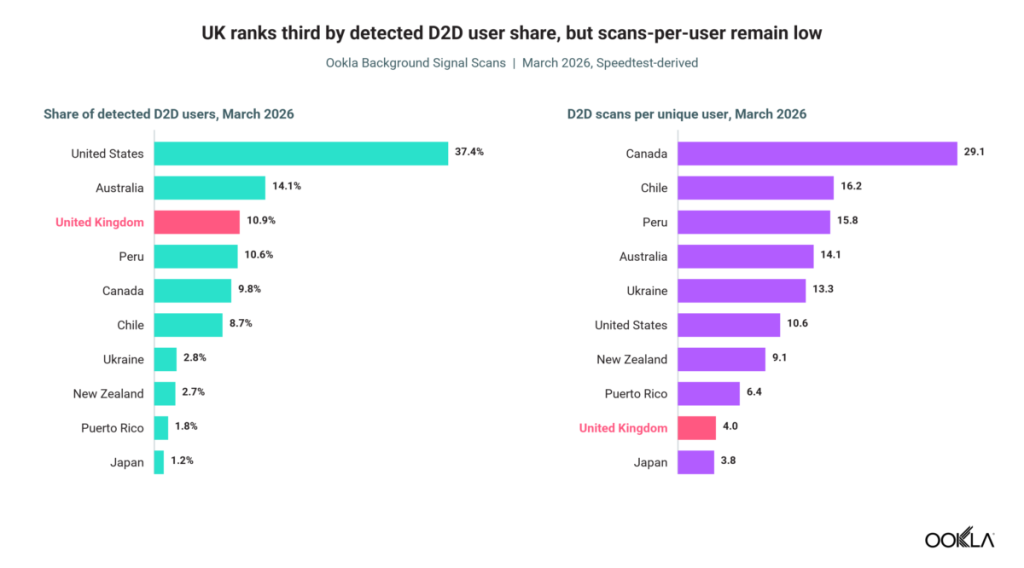
- The UK is now the world's third-largest direct-to-device satellite market by detected users, behind the United States and Australia
- Ookla recorded a 97-fold jump in UK satellite scan activity between Q3 2025 and March 2026
- £3 monthly bolt-on pricing has avoided the user attrition seen in the US and Canada after free trials ended
- VodafoneThree will launch a competing 900 MHz satellite service via AST SpaceMobile by end of 2026
Virgin Media O2 has reached approximately 1.4% take-up of its O2 Satellite service within its addressable customer base just six weeks after launch.
This puts the UK operator broadly in line with more mature direct-to-device markets, according to new analysis from network benchmarking firm Ookla.
The service, which uses SpaceX’s Starlink Mobile constellation over 1800 MHz spectrum and costs £3 per month on Pay Monthly plans or comes free on Ultimate tariffs, went live on 26 February 2026 after Ofcom granted the UK’s first direct-to-device licence variation nine days earlier.
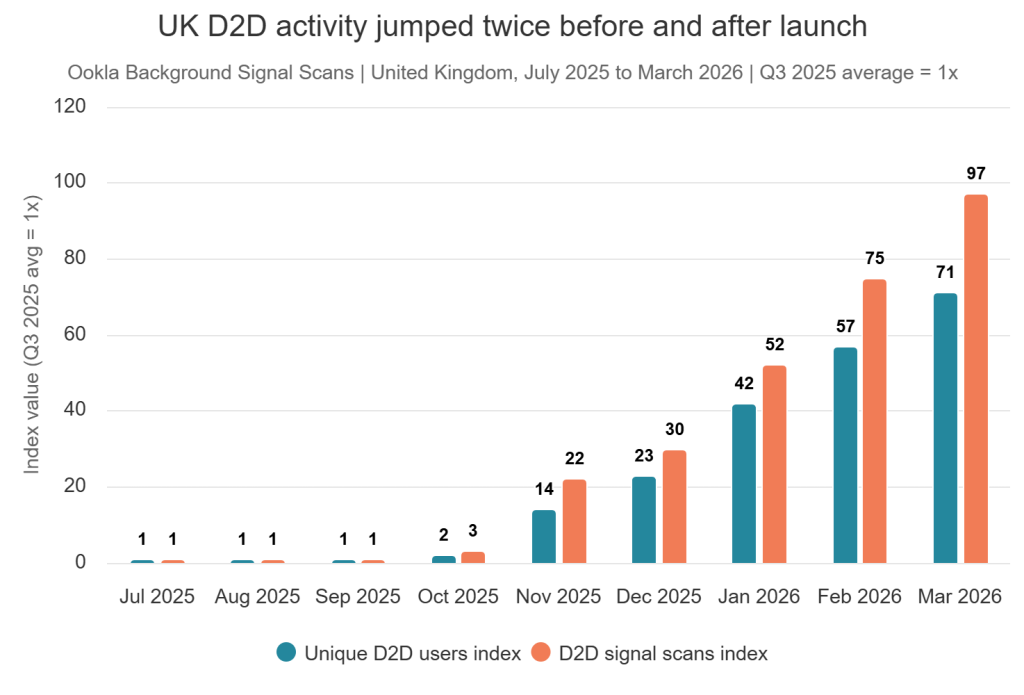
Ookla’s signal scan data covering July 2025 to March 2026 captures the launch from the handset side and shows the UK has vaulted from a rounding error in global direct-to-device usage to the world’s third-largest market by detected users, behind only the United States and Australia.
The 1.4% figure within VMO2’s own customer base contrasts sharply with the 0.30% utilisation rate across the UK mobile market as a whole, which reflects the fact that only VMO2 customers on compatible Samsung flagship handsets can currently use the service.
That broader 0.30% rate matches what the United States achieved nine months into T-Mobile’s Starlink-backed launch, meaning the UK has reached the same penetration milestone in roughly a third of the time.
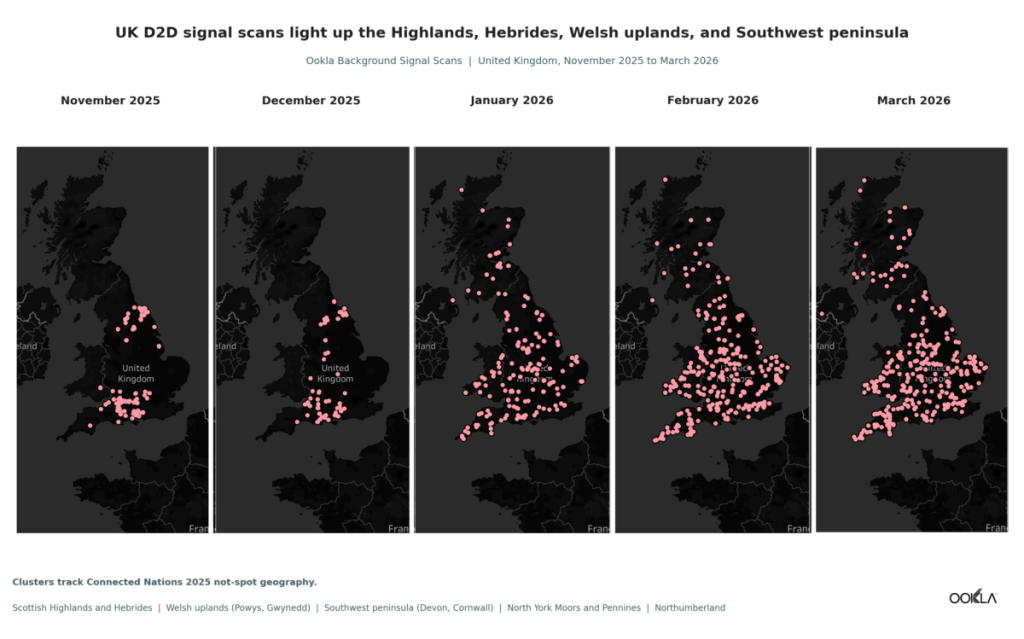
Ookla recorded a 97-fold jump in UK satellite scan activity between the third quarter of 2025 and March 2026, with the steepest inflections landing in November 2025 during VMO2’s internal employee trials and again in February 2026 around the public launch.
A broad but shallow uptake
UK customers are using the service broadly but shallowly, with detected users averaging only four satellite scans per month compared with 29 in Canada.
Ookla characterises this as many users briefly crossing into satellite-eligible conditions rather than remaining on direct-to-device for extended periods.
The firm attributes this to the country’s high urbanisation, narrow handset support limited to recent Samsung flagships, restricted app eligibility, and the requirement for outdoor use with an open sky view.
The UK ranks third globally by unique direct-to-device user count but only eighth by user share and ninth by scans per detected user.
The £3 monthly bolt-on appears to be insulating O2 Satellite from the user attrition hitting mature markets.
Direct-to-device user counts in the United States and Canada have fallen 17% and 48% respectively since summer 2025, declines that coincided with T-Mobile and Rogers ending free trials and shifting to roughly $10 monthly fees gated to high-tier plans.
VMO2 launched with paid pricing from day one and bundled the service free into its Ultimate tariffs, an approach that avoids the cliff-edge transition that has cost rivals subscribers.
Some coverage blackspots
UK usage clusters precisely where Ofcom’s Connected Nations 2025 report identifies coverage blackspots, with detected satellite scans concentrated across the Scottish Highlands, the Outer Hebrides, the Inner Hebrides, Argyll and Bute, and the Northwest Highlands.
Welsh hotspots run through Powys, Gwynedd and mid-Ceredigion, while the Southwest peninsula sees clusters across North Devon, Exmoor, Bodmin Moor and West Cornwall.
The Yorkshire Dales, North York Moors, Northumberland, the Lake District, the East Anglian coast and the Lincolnshire Wolds complete the rural pattern.
These are also the areas the £1.3 billion Shared Rural Network is targeting for terrestrial coverage uplift by January 2027, meaning O2 Satellite is already delivering a first-layer connectivity option in places where the all-operator 4G build-out is years from completion.
Scotland is where most of the work will need to be done.
Ofcom’s latest figures put Scottish 4G coverage at 89% from at least one operator and just 65% from all four, the lowest in the UK, with parts of the Highlands and Islands sitting materially below those averages.
Forty Shared Rural Network sites are now live in Scotland, and Extended Area Service deployments are adding between 0.25% and 1% to UK landmass coverage across operators.
The geographic overlap suggests O2 Satellite is functioning as a partial not-spot fallback rather than a pure wilderness service, with detections appearing on hillwalking routes, coastal roads and visitor-heavy rural areas where O2’s terrestrial network has gaps even when other operators have signal.
Competitors are coming
VMO2’s first-mover position will not last long.
Ofcom granted VodafoneThree the UK’s second direct-to-device licence variation on 15 April on 900 MHz Band 8, paired with AST SpaceMobile’s BlueBird satellites through the Satellite Connect Europe joint venture.
VodafoneThree has said customer trials will begin in summer 2026 with a commercial launch targeted for the end of the year.
It is positioning its proposition around data, voice and SMS, which contrasts with O2’s current app-based data service and absence of standard voice calls.
BT, which runs the UK’s largest mobile network through EE, has taken a different path entirely, announcing a Starlink partnership in early 2026 only for fixed home broadband rather than handset services,
This leaves only EE without a consumer direct-to-device product as its two largest rivals advance.
An awesome service – but it has limitations
The service has clear current limitations that consumers should understand.
O2’s own help page confirms standard voice calls, standard text messages, 999 emergency calls, 999 emergency texts and government emergency alerts are not currently supported on O2 Satellite.
Ofcom’s good-quality 4G definition requires a sustained 2 Mbps downlink and the ability to support a 90-second voice call, neither of which O2 Satellite delivers, meaning the 95% landmass coverage figure is not equivalent to terrestrial mobile coverage.
The service supports messaging, maps, and location apps, with broader application support to follow as Starlink’s second-generation satellites add capacity.