I tried to use Kalshi from the UK in 2026 – Here’s what worked and what didn’t


Key Points
- Kalshi explicitly lists the UK among 50-plus restricted jurisdictions in its Member Agreement, despite October 2025's expansion to 140-plus countries.
- A clean UK signup attempt is blocked at country-of-residence verification, before any KYC document upload.
- A South African VPN server unlocks the homepage and signup form, but the residency declaration is the hard gate, not the IP address.
- Funding routes for international users are narrower than Polymarket: debit card, wire transfer, or crypto only, with ACH, PayPal and Venmo unavailable.
- Kalshi's CFTC-regulated status protects US users but offers no recourse to UK residents using workarounds, and HMRC still treats any crypto leg as a Capital Gains Tax disposal.
Three months after testing Polymarket from London, I tried the same experiment with its larger, more buttoned-up rival Kalshi.
Kalshi is the CFTC-regulated prediction market that processed $11.39 billion of contracts in March 2026 alone.
Having reached a $5 billion valuation in October 2025, the firm opened to 140-plus countries the same month, and now powers prediction market hubs inside Robinhood and Coinbase. The UK, however, sits firmly on the wrong side of the velvet rope.
Where Polymarket geoblocks UK IPs because it lacks a UK Gambling Commission licence, Kalshi’s exclusion is structural.
Kalshi is regulated as a Designated Contract Market by the US Commodity Futures Trading Commission, and its Member Agreement (Section VI) lists the UK alongside Belgium, France, Italy, Poland and others as restricted on regulatory divergence grounds.
So the question for UK readers is not “can I access the markets” but “can I open a real account, fund it, and place a trade”.
I spent an afternoon trying, and the answer is more interesting than I expected.
Why Kalshi blocks the UK in 2026
The short version is that Kalshi has chosen not to seek UK authorisation, and the UK Gambling Commission has signalled it would treat prediction market operators as Betting Intermediaries under the Gambling Act 2005 if they served British residents.
That is the same regulatory gravity that keeps Polymarket out, but Kalshi’s compliance posture is tighter because it is a federally regulated US exchange answerable to the CFTC, not a non-custodial smart contract platform.
Kalshi has more to lose from a sloppy international rollout, so its country gating is enforced at the account level, not just the network level.
In practical terms, that means the front door looks open.
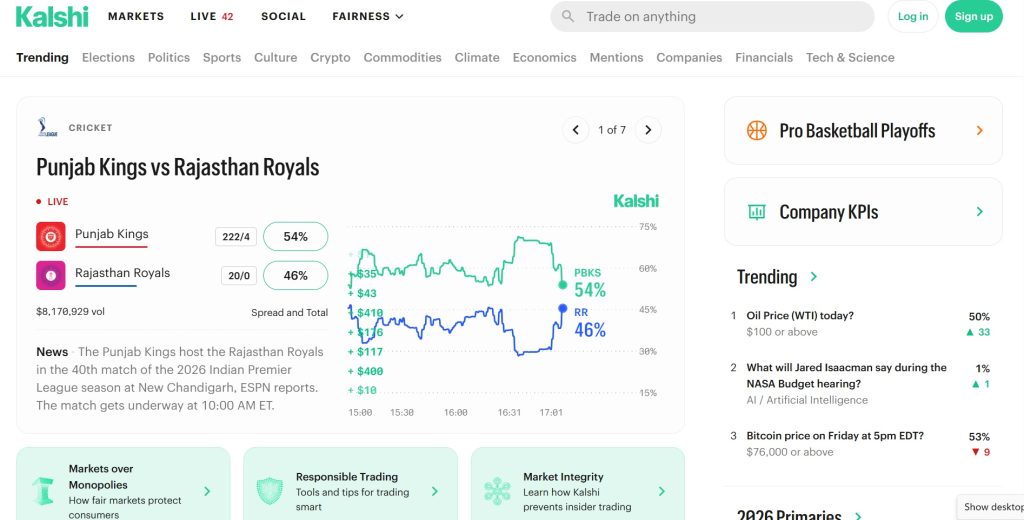
The Kalshi homepage loads from any UK IP address, markets are visible, and the live odds on US presidential approval, Federal Reserve decisions, NFL outcomes and a long list of UK-tagged political markets are all browsable without restriction.
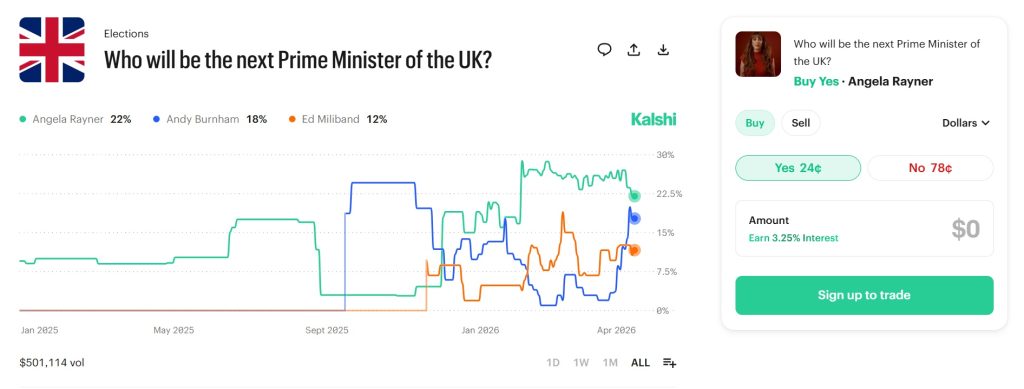
Kalshi even runs markets on UK general election timing and Keir Starmer’s tenure that draw meaningful volume. The wall comes down at signup.
My experiment: Trying to open a Kalshi account from the UK
I started on a clean home connection with no VPN. The Kalshi site loaded normally, I clicked sign up, entered an email and password, and reached the country-of-residence step.
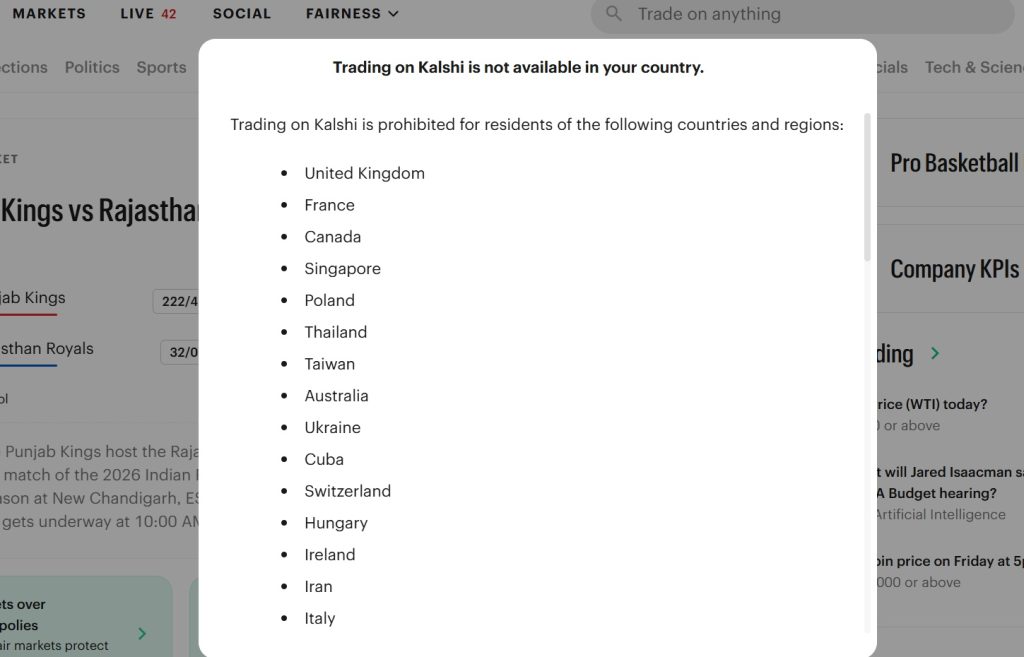
Selecting United Kingdom from the dropdown produced a message confirming Kalshi is unavailable in my region and ended the flow. There was no soft block or partial access, and no view-only account was offered.
I then connected NordVPN to an South African server, cleared cookies, and restarted.
The signup form behaved differently this time: with a South African IP, Kalshi did not pre-flag the session, but the country-of-residence field still required an honest answer.
Selecting South Africa progressed the form to identity verification, where Kalshi requested a passport and proof of address. This is where the experiment stopped.
Submitting a UK passport and a London utility bill against a South African residency declaration would have been straightforward fraud against a CFTC-regulated exchange, with consequences that go beyond a frozen account.
For comparison, US signups require a Social Security Number, a US residential address, and a government-issued photo ID, with Kalshi’s compliance team typically reviewing within 48 hours.
International signups in eligible countries skip the SSN step but still require ID verification matched to the declared country of residence.
In short, the system is designed to catch exactly the workaround a UK user would attempt.
What funding looks like, even if you got past KYC
The funding picture is where Kalshi diverges most sharply from Polymarket. Kalshi is custodial, holds user funds directly in regulated accounts, and offers a narrower set of payment rails to international users.
UK-style bank transfers using Faster Payments are not supported. Kalshi’s own help pages state ACH, PayPal and Venmo are unavailable to international users, leaving debit card, wire transfer, or cryptocurrency as the only routes in.
Crypto is the most plausible workaround on paper, with Kalshi accepting USDC deposits, but two problems compound.
First, a UK debit card or a UK-issued exchange withdrawal carries metadata that Kalshi’s compliance systems can read.
Second, withdrawals for international users are restricted to debit card or crypto, meaning anything that goes in through a flagged route may be difficult to extract cleanly later.
Polymarket’s crypto-native architecture is more permissive at this stage; Kalshi’s regulated structure is not.
Kalshi vs Polymarket from a UK perspective
Both platforms are off-limits, but the type of block being employed is different, which matters if you are weighing the risk.
| Factor | Kalshi | Polymarket | Notes |
|---|---|---|---|
| UK status | Restricted in Member Agreement | Geoblocked, no UK licence | Both unavailable, different mechanisms |
| Gating layer | Country of residence at signup | IP geoblock at signup and deposit | Kalshi is harder to bypass cleanly |
| Funding for non-US | Debit card, wire, crypto | USDC via Polygon | Kalshi has no PayPal, Venmo or ACH |
| Custody | Custodial, CFTC regulated | Non-custodial smart contracts | Different consumer protection profiles |
| KYC | Strict, country matched ID | Lighter, wallet connect possible | Polymarket easier to spoof, riskier overall |
| UK regulator view | Likely Betting Intermediary | Likely Betting Intermediary | UKGC stance applies to both |
| HMRC treatment | Crypto leg is a CGT disposal | Crypto leg is a CGT disposal | Betting winnings tax free only via UKGC operators |
The headline conclusion is that Kalshi is harder to access from the UK than Polymarket and offers fewer plausible workarounds. That cuts both ways.
A user determined to bypass Kalshi has to commit fraud against a regulated US exchange, which is a meaningfully worse legal posture than skirting an unlicensed crypto platform’s terms of service.
What UK users can actually do
The honest answer is “browse, but do not trade”.
Kalshi’s market pages, odds history, resolution rules and category filters are all visible from a UK IP, which makes the platform genuinely useful as a sentiment dashboard for journalists, analysts, and anyone tracking US political and economic risk.
Kalshi’s research arm has also started publishing data partnerships, including an April 2026 deal with ProCap Financial, that will eventually push prediction market signals into mainstream institutional research.
For UK residents who actually want to take a position on event outcomes with real money, the regulated route is Smarkets or Betfair Exchange, both UK Gambling Commission licensed, with political and news markets that overlap meaningfully with Kalshi’s catalogue.
Matchbook, also UKGC licensed, is reportedly building a dedicated UK prediction markets product expected during 2026.
None of these match Kalshi’s depth on US economic data or weather contracts, but they do not require lying to a federal regulator either.
My final take
Kalshi is the more impressive platform technically and commercially, but it is also the harder one to reach from the UK. Polymarket’s crypto backing leaks around the edges; Kalshi’s CFTC compliance does not.
After my Polymarket experiment in February, I stopped short of placing a trade because the deposit flow felt fragile.
With Kalshi I stopped at signup because progressing further would have meant a false residency declaration to a US derivatives exchange, and that is a different category of risk entirely.
The takeaway for UK readers tempted by what they see on Kalshi: the platform is a remarkable real-time view into how priced-in events look to people willing to put money on them, but it is not a UK product, it is not coming to the UK soon, and the workarounds are worse than the wait.