Good news for British Airways flyers using Starlink Wi-Fi
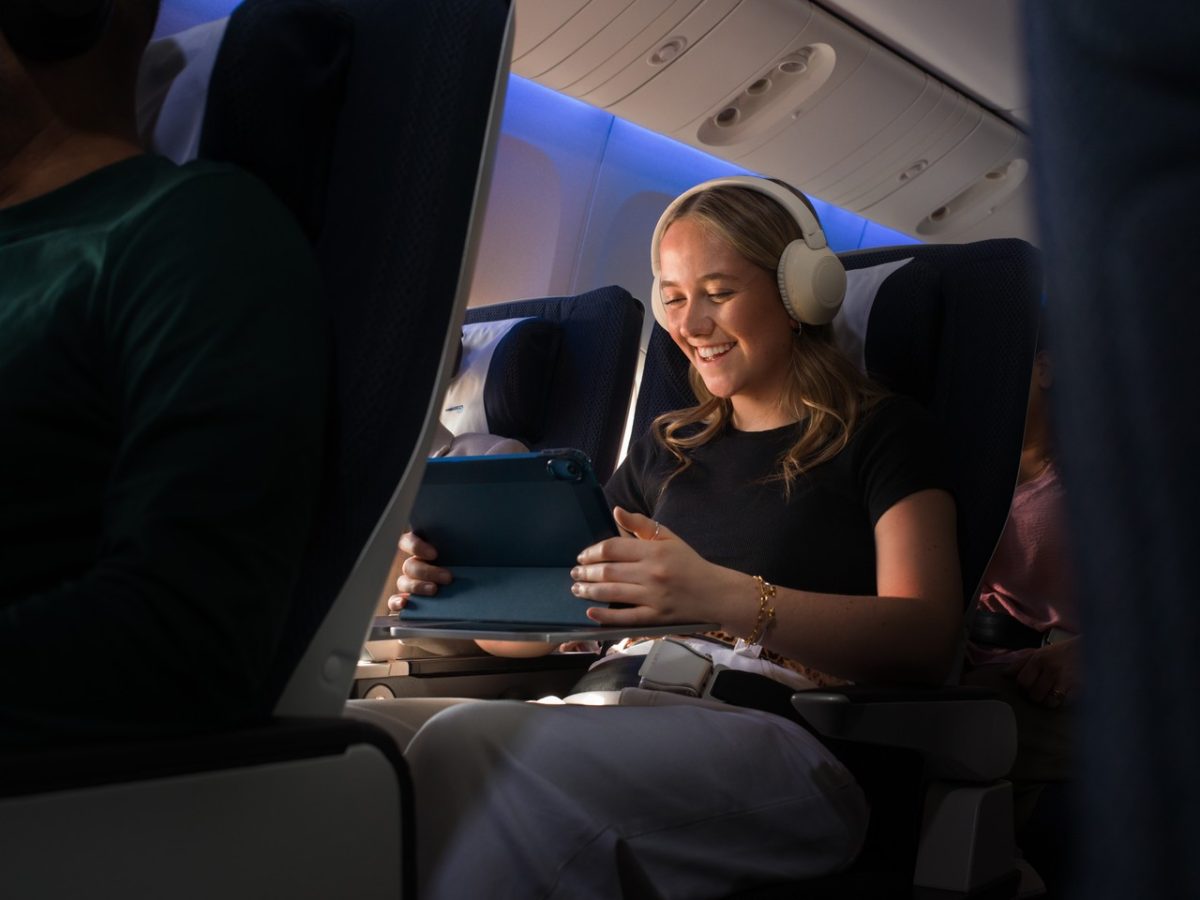

British Airways has joined a growing list of carriers shifting their in-flight Wi-Fi to Starlink, with 25% of its connectivity now running on the low-Earth orbit network, according to Ookla data.
The move places BA alongside United (63.7%), Emirates (53.7%), Southwest (9.2%) and SAS (4.9%) in transitioning fleets toward the satellite service that has rewritten expectations for in-flight connectivity.
By comparison, market leaders airBaltic (98.3%), WestJet (95.8%) and Hawaiian Airlines (95.3%) already run exclusively on Starlink and deliver the most reliable in-flight Wi-Fi measured anywhere.
Starlink captured 47.8% of all commercial airline Speedtest samples by the fourth quarter of 2025, just under two years after Hawaiian Airlines first deployed it in February 2024.
Viasat sits second on 25.1% and Panasonic Avionics third on 12.8%, with Inmarsat (3.2%) and Intelsat (3.0%) trailing.
No airline running Starlink fell below 100 Mbps median download speed, and no rival satellite provider reached triple-digit speeds in the period.
Why the satellite matters
In-flight Wi-Fi quality depends on three connected pieces of kit: the satellite providing the backhaul, the Wi-Fi router inside the cabin, and the specific aircraft carrying both.
Geostationary satellites sit more than 3,000 times higher than a cruising aircraft, while low-Earth orbit satellites like Starlink’s sit just 50 times higher, which explains the speed and latency gap.
Starlink’s slowest 10% of users still pulled 63.71 Mbps download speeds, faster than the average user on any other satellite network, and its bottom-end upload speeds of 11.73 Mbps nearly matched the top 10% of users on Intelsat’s network.
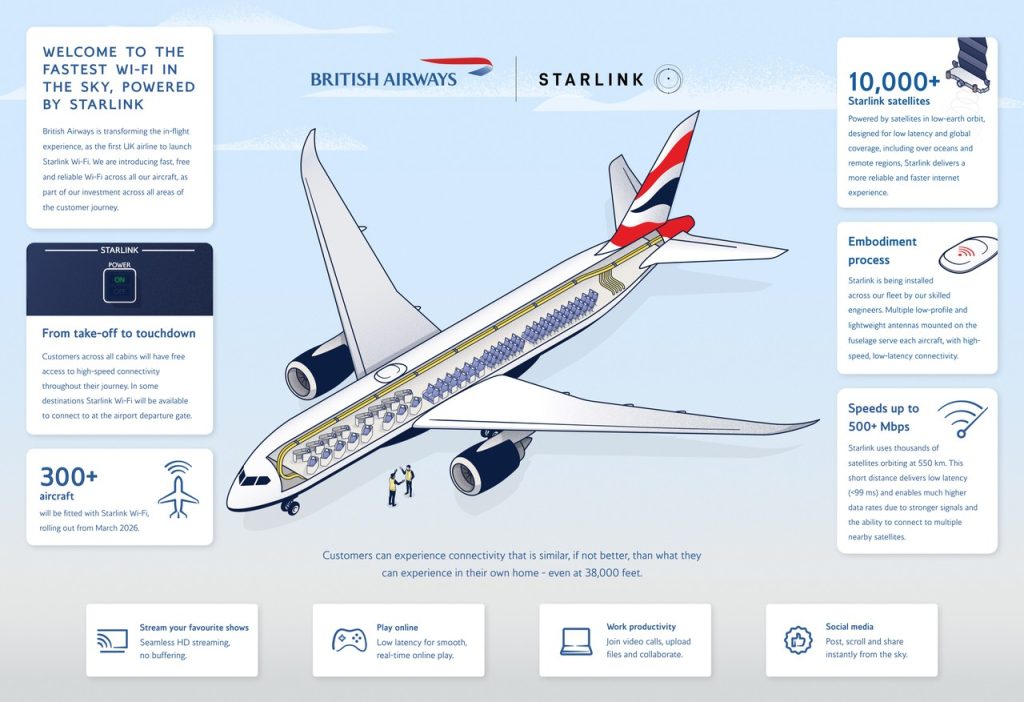
What BA passengers can expect
Performance varies by aircraft because hardware mixes differ within a single airline’s fleet, so a BA flyer’s experience depends on which plane they board.
The wider Starlink picture suggests the upgraded aircraft should deliver a meaningful step up.
Median download speeds across the eight airlines clocking over 100 Mbps were all powered by Starlink, with half of those exceeding 300 Mbps.
By comparison, Viasat managed a median of 56.84 Mbps and Intelsat ranged between 46.99 Mbps and 65.08 Mbps among the top consistent airlines. SITA, Inmarsat, Panasonic Avionics and Deutsche Telekom all performed poorly on the same measure.
| Provider | Median download (Mbps) | 10th percentile download (Mbps) | Notes |
|---|---|---|---|
| Starlink | 300+ on top airlines | 63.71 | Powers all eight airlines above 100 Mbps |
| Viasat | 56.84 | 13.95 | Acquired Inmarsat in 2023; both still appear separately |
| Intelsat | 46.99 to 65.08 | 21.06 | Owned by SES; sole provider for Air Canada |
| Panasonic Avionics | Below 25 Mbps | Not stated | Uses Eutelsat OneWeb and Spacesail partnerships |
| Inmarsat | Below 25 Mbps | Not stated | High share of older Wi-Fi 4 router samples |
The router catch most coverage misses
A faster satellite alone does not guarantee a faster experience for the passenger.
Wi-Fi 5 accounted for 81% of in-flight Speedtest samples in the second half of 2025, with Wi-Fi 6 just over 11% and legacy Wi-Fi 4 still present on nearly 8% of samples.
Wi-Fi 4 dates back to the 3G era, predating the smartphones most passengers now carry.
Median download speeds on Wi-Fi 6 ran more than six times faster than on Wi-Fi 4, median upload speeds more than four times faster, and median latency less than half.
Even on Starlink, moving from Wi-Fi 5 to Wi-Fi 6 lifted median download speeds by roughly 24%, from 140.35 Mbps to 173.86 Mbps.

Why I will now only be flying on BA
In-flight Wi-Fi has shifted from a perk to a question of loyalty.
The American Customer Satisfaction Index 2026 Travel Study scored passenger satisfaction with in-flight Wi-Fi at 79, level with food and drink and ahead of seat comfort at 76.
United ran a Super Bowl advert for “Wi-Fi that actually works,” and the picture across the industry shows airlines treating connectivity as a competitive differentiator.
Amazon Leo, Amazon’s LEO satellite service, is set to challenge Starlink with deals already signed by jetBlue for 2027 and Delta for 2028, both of which currently sit on 3.8% and 2.2% Starlink share respectively.