1 in 5 London workers at risk of being replaced by AI


Key Points
- 1 in 5 people working in London are at risk of having their work mostly or entirely replaced by AI.
- Effects of AI automation are are already being felt in the capital, which is seeing early signs of slowing recruitment for administrative roles, along with expectations of staff cuts.
- London Mayor Sadiq Khan has created a task force to address AI disruption and protect people's jobs or offer them alternative solutions.
More than 1 million professionals working in London will find their positions at risk of being mostly or entirely automated by AI.
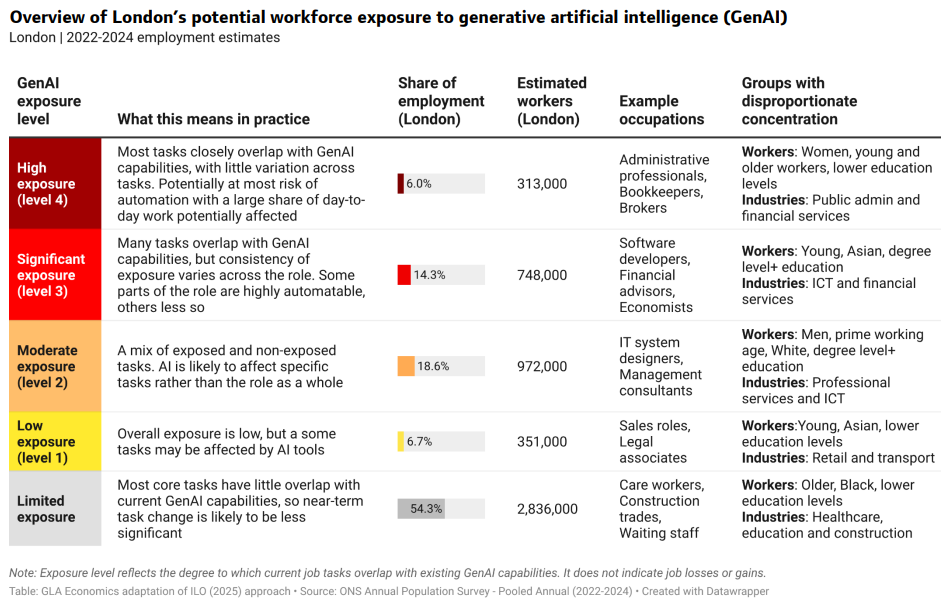
This is according to a new report from the Greater London Authority, which examined the exposure of London’s workforce to generative artificial intelligence. It found that London is especially vulnerable to automation, with at least 46% of the capital’s workforce in roles where AI could automate a share of their tasks.
This is significantly higher than the national average of 38%, which reflects the concentration of exposure to GenAI risks in certain occupations that are more common in the capital.
Exposure does not automatically imply job losses – it could lead to greatly improved task efficiency. But it could also lead to disruption and redundancy caused by reduced demand for roles where AI can automate a share of or all of a person’s work.
Examining the exposure of London’s workforce, the Greater London Authority found that more than 300,000 workers, or 6% of the city’s workforce, faced high levels of exposure and risk of AI automation. These workers are mainly those in administrative roles whose clerical tasks align most closely with the capabilities of generative AI.
However, white-collar professional occupations are also significantly at risk. The report found that 748,000 London professionals, 14.3% of the total workforce, were in roles where many of their tasks overlap with generative AI capabilities. These include software developers, financial advisors, and economists.
Together these two groups that are significantly and highly exposed to automation by AI account for just more than one fifth of London’s total workforce.
Expectations of job cuts and widening inequality
The effects of this exposure are already being felt in the city. There are early signs of slowing recruitment for administrative roles, which may reflect this AI-induced change in demand for skills that can be almost entirely automated.
The report noted that while reported headcount reductions due to AI remain limited for now, employers in London expect that efficiencies delivered by AI will allow the to reduce their workforce over time.
Increased automation of lower-paid administrative roles could also widen inequality in London, with better-paid professionals and the owners of AI models accruing the productivity gains delivered by AI automation.
“AI presents extraordinary opportunities to boost productivity, improve public services and create new, high-quality jobs,” said London Mayor Sadiq Khan.
“But if its adoption is not handled responsibly, it also brings real risks of economic disruption, increased inequality and intense anxiety about what this transition will mean for people’s livelihoods.”
“In many cases, AI is more likely to transform roles than replace them outright, shifting the mix of tasks, skills and judgement required at work. In other cases, where AI poses a genuine threat to jobs, we need to be alert and ready to respond quickly to any adverse impacts on London’s labour market,” he said.
Khan said that in response to the risks created by AI automation, he is creating a taskforce that will bring together workers’ representatives, employers, and researchers to identify where the risks of job losses are the greatest and take appropriate action to protect Londoners.
“London has navigated technological change before. Our strength has always been our people – their creativity, resilience and ability to adapt. My approach to AI is rooted in realism: neither uncritical optimism nor fear-driven pessimism, but a clear-eyed commitment to shaping this revolution in the interests of Londoners.”