Big ISP price hikes for the UK

Key Points
- Major UK Broadband Price Hikes April 2026: BT, EE, Plusnet, Virgin Media, Vodafone and Sky all raised prices, with loyal out-of-contract customers absorbing the biggest increases of up to £4 per month (£48 a year).
- Loyalty Penalty Hits Long-Term Customers Hardest: Out-of-contract households face average 43% tariff jumps and can save £183.60 a year by switching, according to Ofcom and Citizens Advice research.
- Provider Increases at a Glance: BT/EE/Plusnet +£4; Virgin Media £3.50–£4 (higher for recent customers); Vodafone +£3.50; Sky +£3 with 30-day exit window.
- Ofcom Rules Backfire on Cheaper Plans: Flat £4 rises now deliver bigger percentage hikes than old inflation links, adding an estimated £186 million to industry revenues.
- What to Do: Compare deals on uSwitch/Broadband Genie, call retentions with competitor screenshots, or switch via One Touch Switching. Fixed-price altnets (Zen, brsk, Trooli) avoid annual rises where available.
Every major UK broadband provider raised prices in April 2026, and loyal out-of-contract customers are absorbing the biggest hit, often without knowing it.
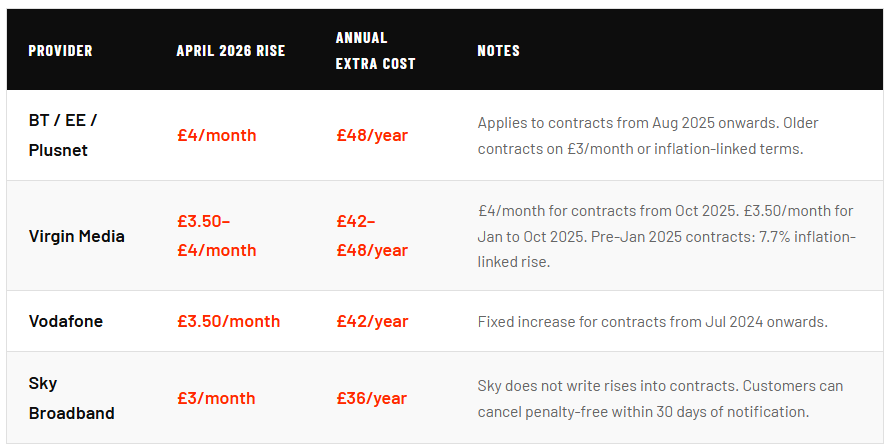
BT, EE and Plusnet led the April increases with a £4/month rise (adding £48 to annual bills) while Vodafone applied £3.50 and Sky added £3, the latter unusually allowing customers a 30-day penalty-free exit window because it does not write fixed rises into its contracts.
Virgin Media’s increase varied between £3.50 and £4 depending on when customers signed up, with those joining from October 2025 onwards facing the full £4, and anyone still on a pre-January 2025 contract hit by a 7.7% inflation-linked rise.
For millions of households, these increases arrived on top of a loyalty penalty that most were not tracking: the gap between what a new customer pays for the same service and what a long-standing out-of-contract customer is being charged.
Citizens Advice research has found loyal customers face an average 43% tariff rise once their minimum contract period ends, while Ofcom’s own 2026 pricing report calculated that the average UK household can save £183.60 a year simply by switching provider when their contract expires.
The Ofcom transparency rules introduced in January 2025 were designed to fix exactly this problem by requiring providers to state increases in pounds and pence at the point of sale rather than linking them to inflation. In practice they have backfired for customers on cheaper plans.
A flat £4/month rise applied to a £22 package represents an 18% increase, steeper than the old inflation-linked formula would have produced, and Broadband Genie estimates providers will collectively pocket an extra £186 million under the new system.
Most customers quietly absorb it, which is precisely what the industry is counting on.
Significant price increases
The April 2026 increases varied by provider and, in Virgin Media’s case, by contract start date.
The table below shows what each major ISP applies and the important caveats that determine whether the headline figure applies to you.
The compounding effect is where real money gets lost. If your introductory discount has also just expired at the same time as the April rise landed, you are absorbing two increases simultaneously: the end of your deal price plus the annual hike on top.
Uswitch pricing data from 2026 shows that Virgin Media’s out-of-contract prices can approach double the initial monthly rate, meaning customers who miss their renewal window and then face the April rise in the same billing cycle can see their monthly bill jump by considerably more than the headline £4 figure suggests.
The phone call your ISP hopes you never make
Every major UK provider maintains a retentions team whose sole purpose is to prevent cancellations, and crucially, they have access to deals that never appear on the public website.
The call is most effective when made around 30 days before your contract ends, with comparison site screenshots in hand showing what a new customer would pay for your speed tier at your postcode.
Call the retentions line directly by searching “(provider) cancellation number” to bypass the standard customer service queue, then name the specific competitor deal you have found rather than asking vaguely for a better price.
If the first agent cannot help, call back another day, as offers vary significantly between agents and some have more authority to discount than others.
- Check comparison sites first. Find the best new-customer rate for your speed at your postcode. Screenshot it.
- Call the retentions line directly. Search “[provider] cancellation number” to skip the main queue.
- Name the competitor deal. “I can get 1Gbps from [provider] for £22/month. Can you match it?”
- Ask about unlisted plans. Some providers have standard plans only available over the phone.
- Try again if the first agent cannot help. Offers vary between agents and days.
Haggling vs switching: when each makes sense
Retention calls work best where there is genuine competition at your address.
In London and other major cities, Community Fibre, Hyperoptic, Vodafone, and Virgin Media are all chasing the same customers, which gives retention desks real authority to move on price.
Outside the major cities that leverage diminishes considerably, and if your ISP is the only full fibre provider on your street, they are under no commercial pressure to match a competitor offer that does not exist at your postcode.
In those cases, switching to whatever alternative is available will almost always deliver a better outcome than haggling, particularly since the One Touch Switching system that launched in September 2024 now means your new provider handles the entire cancellation process, so you do not need to contact your old ISP at all.
ISPs with no mid-contract price rises
A small number of alternative network providers, often called altnets, still lock the price you sign up for across the full contract term, removing the annual negotiation entirely.
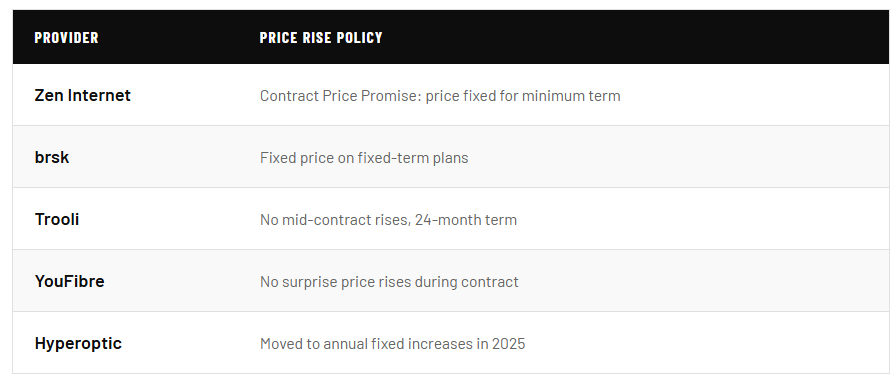
Zen Internet operates a Contract Price Promise that fixes your rate for the minimum term, while brsk, Trooli and YouFibre all market no mid-contract price rises as a core selling point.
The catch is availability as all four cover far fewer postcodes than BT or Virgin Media, and Hyperoptic, long considered one of the better-value altnet options, quietly moved to annual fixed-amount increases for new customers in 2025, aligning itself with the big-brand model.
What to do now?
- Find your contract end date. Your provider must notify you 10 to 40 days before it expires.
- Compare new-customer rates at your postcode on uSwitch, Broadband Genie or Compare Fibre.
- If you are paying £10/month or more above the best available rate, call retentions.
- Give them one chance. If they will not move, switch using One Touch Switching.
- Consider altnets if you want to escape the annual April cycle entirely, as a fixed-price contract removes the negotiation for the duration of your term.
The loyalty penalty is not accidental. It is structural, and providers rely on the fact that most customers will not check, will not call, and will not switch. The ones who do consistently pay less.