Global prices will take some time to return to normal: IMF Director
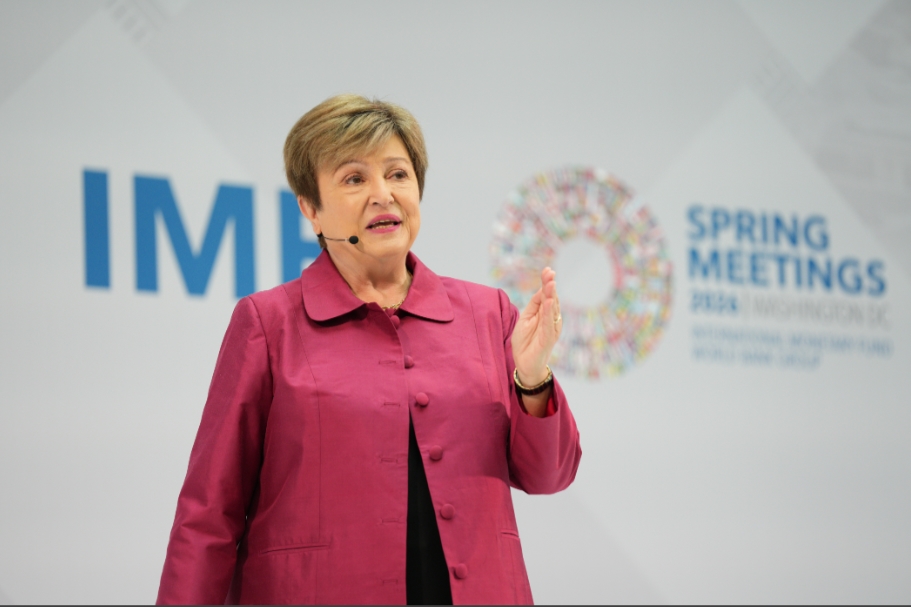

Global prices will take time to come down to levels seen before the US-Israeli war with Iran even if a ceasefire holds, warns International Monetary Fund Managing Director Kristalina Georgieva.
“It will take some time, yes, and it will take more time for locations that are experiencing higher degree of disruption,” Georgieva said in comments aired Sunday on CBS’s Face the Nation ahead of this week’s spring meetings of the IMF and the World Bank. “That’s why we need to remember the asymmetry of this shock.”
Georgieva reiterated that the IMF will lower its global growth forecast as a result of the war in Iran.
“We are going to have a downgrade, and the size of this downgrade will depend on these two things, duration and speed with which everything can come back to the same level of production that we had before,” she said.
The remarks come as uncertainty swirls around a fragile two-week ceasefire agreed earlier this month. Hours before Georgieva’s interview aired, US President Donald Trump announced that the US would begin a full naval blockade of the strategic Strait of Hormuz and threatened retaliation in the event of Iranian resistance.
Trump’s announcement followed the collapse of direct US-Iran talks in Pakistan, casting fresh doubt on whether the ceasefire, which included commitments to reopen the vital shipping chokepoint, would hold or lead to a permanent end to the conflict that began in late February.
Lasting scars on the global economy
The IMF chief’s warning underscores the deep and uneven economic damage already inflicted by the roughly six-week conflict. Energy prices spiked as disruptions hit oil flows through the Strait of Hormuz, a critical artery carrying about one-fifth of global oil trade.
Supply chains for everything from fuel to food and fertilizers have been strained, feeding into broader inflationary pressures at a time when many economies were still recovering from earlier shocks.
Georgieva has repeatedly warned that “all roads lead to higher prices and slower growth,” even in the most optimistic scenarios. Before the war erupted, the IMF had been preparing to upgrade its 2026 global growth outlook.
Instead, it now plans a downgrade when updated forecasts are released during the spring meetings in Washington this week.
Countries heavily reliant on imported energy, particularly in sub-Saharan Africa and among small island developing states, face the sharpest pain. Infrastructure damage, lost production capacity, and eroded market confidence mean that a simple return to pre-war output levels will not happen overnight, if at all in some sectors.
Earlier this month, Georgieva noted that the world economy is “ill-equipped” to handle these layered risks, with limited fiscal space in many nations and central banks wary of reigniting inflation spirals.
Markets on edge as ceasefire frays
Oil prices had eased somewhat after the initial ceasefire announcement, but fresh tensions, including Trump’s blockade threat, risk pushing them higher again.
Benchmark Brent crude had climbed above $100 per barrel at points during the conflict, contributing to higher gasoline prices in the US and feeding into global consumer costs.
The IMF, World Bank, and World Food Programme have jointly warned that rising energy and fertiliser costs, combined with transport bottlenecks, could worsen food insecurity for tens of millions of people.
Georgieva said policymakers must prepare for prolonged disruption rather than a quick snapback.
“Even in a best case, there will be no neat and clean return to the status quo ante,” she has cautioned in recent remarks.