Poll: More than half of Brits think Keir Starmer never tells the truth

A new Ipsos poll has delivered a harsh verdict on Prime Minister Keir Starmer’s credibility, finding that more than half of Britons believe he rarely or never tells the truth amid a broader collapse in public confidence in the Labour government’s competence and integrity.
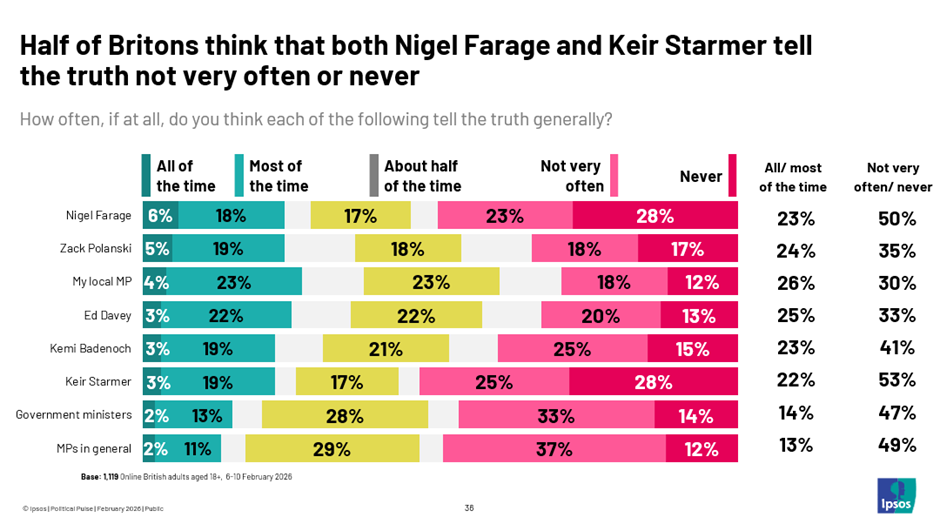
The survey, conducted in the second week of February, reveals that 53% of respondents think Starmer tells the truth ‘not very often’ or ‘never’. That’s a figure in line with, or slightly worse than, perceptions of his immediate Conservative predecessors: 47% said the same of Rishi Sunak in August 2023, while 60% felt that way about Boris Johnson in February 2023.
The poll comes against a backdrop of political turbulence for Starmer’s administration. Fieldwork overlapped with revelations involving former US Ambassador Peter Mandelson and the resignation of Starmer’s former chief of staff, Morgan McSweeney, events that appear to have further eroded public trust.
Overall, skepticism toward political honesty runs deep. Half of Britons (50%) say Reform UK leader Nigel Farage tells the truth not very often or never, a similar share to Starmer, while 49% apply the same view to MPs in general.
Government ministers fare little better, with 47% believing they rarely or never tell the truth. Local MPs receive somewhat less cynicism, with 30% holding the negative view.
A lack of confidence in governance
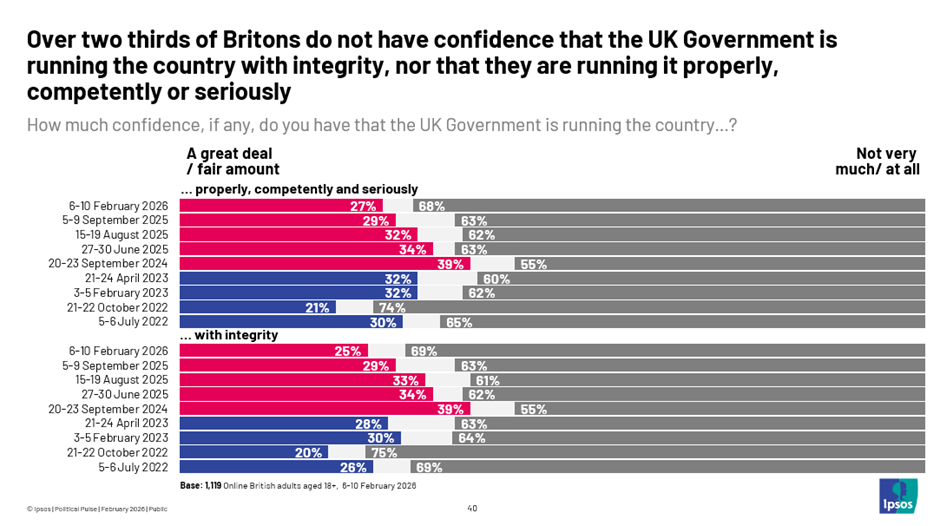
Confidence in the government’s basic ability to govern has also plunged. More than two-thirds of Britons (68%) lack confidence that the UK is being run with integrity, while 69% doubt it is being managed properly, competently, or seriously.
Both figures are up from 63% in September 2025, signaling a worsening trend less than two years into Labour’s term after its landslide victory in 2024.
Starmer’s personal ratings remain deeply underwater. His net favourability stands at -44 (17% favourable, 61% unfavourable), a slight dip from -42 the previous month. In hypothetical preferred-prime-minister matchups, he trails figures like Andy Burnham (30% to 16%) and ties or narrowly leads others such as Nigel Farage (32% each) and Kemi Badenoch (27% each).
The findings underscore a broader crisis of trust in British politics, where low confidence spans the spectrum. Public sentiment reflects widespread disillusionment, with Labour failing to escape the low trust levels that plagued the final Conservative government it replaced.
For Starmer, who campaigned in 2024 on promises of integrity and renewal, the numbers represent a major challenge as his administration grapples with economic pressures, policy controversies, and internal strains. Rebuilding faith in his leadership, and in government more broadly, will likely be central to any hopes of political recovery ahead of future electoral tests.