Good news for buy-to-let investors in Britain


Key Points
- Cooling housing demand in Britain has provided a great opportunity for buy-to-let investors, who are increasingly more likely to make offers below asking price.
- The proportion of purchases made by landlords is rising, and they are also more likely to ask for 10% or more off the seller's asking price.
- For most first-time buyers and home movers, making an ambitious offer is less likely, as these buyers typically have less leverage and are dependent on a mortgage.
- Flat owners are the most likely to receive offers under their asking price, as demand for flats has fallen substantially more than for houses.
A cooling housing market offers a prime opportunity for buy-to-let investors, according to a new analysis by property firm Hamptons.
The analysis, which is based on Connells Group data, found that landlords accounted for an increasing proportion of home purchases in Great Britain last month.
In July 2026, 14.1% of all home purchases were made by landlords, up from 12.4%, which is the year-to-date average.
While overall demand for houses is slowing, those with the reserves available are able to scoop up properties at well below asking price.
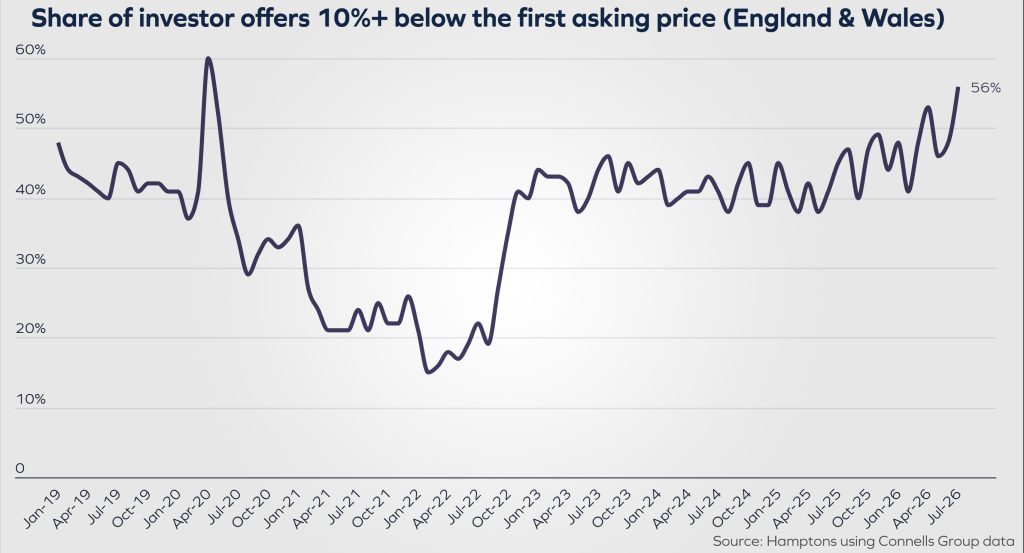
Landlords who are looking to expand their portfolio have been pushing harder with more aggressive offers. The average landlord paid just 88.7% of the initial asking price in July, and more than half of the offers from landlords were at least 10% below sellers’ asking prices.
This is the highest proportion of offers at least 10% below asking price since April 2020, and has increased substantially since June.
Landlords buying more properties in cash are enjoying an even better opportunity, with 63% of cash offers in England and Wales now at least 10% below asking price.
Good for landlords, not so much for homebuyers
The current state of the housing market might present an attractive opportunity for buy-to-let landlords looking to expand their investment, but those aiming to live in the homes they are seeking to buy are not so capable of capitalising on it.
Hamptons noted that owner-occupiers have been far less ambitious with their officers, with only 27% of offers from home movers coming in more than 10% below asking price. This dropped to just 25% of offers from first-time buyers.
Unlike buy-to-let landlords, these buyers typically have less leverage and are less able to pay in cash, more likely dependent on a mortgage.
The cooling housing market does mean that more sellers are accepting lower offers, however. 27% of lowball (>10% below asking) offers were accepted in July 2026, which is a marked increased from 18% the same time last year.
This is particularly true for flat owners, with sellers of leasehold properties far more likely to discount their homes than those who owned houses.
Shares of offers 10% or more under asking that were accepted were the highest in areas where house prices are seeing the weakest growth, or even decline.
In the South East, 70% of investor offers came in at 10% below asking price, with the South West at 60% of offers.