New data shows just how worse-off Gen Z is in the UK


Key Points
- Young people in the UK today face stagnant wages, a struggling labour market, and unaffordable house prices compared to earlier generations.
- Research from the IFS shows that more young people than ever are living with their parents, and they are now less likely to be employed.
- The data shows that after the 2008 financial crisis, wages have stagnated and property prices have steadily climbed, leaving young people today behind compared to the growth earlier generations enjoyed.
Young adults in Britain are far less likely to be employed or own a home than previous generations, and they face a stagnant economy where they are treading water.
New research published by the Institute for Fiscal Studies shows that young adults aged around 25 in the UK today are facing a tough situation compared to previous cohorts.
The study used household survey data to compare the employment, wages, living situations, and housing costs of young people across generations, presenting results in 2024/25 prices adjusted for inflation.
The starkest contrast in intergenerational inequality can be seen in home ownership rates. Of people born between 1957 and 1961, 43% were homeowners when they were 25 years old and just 25% were living with their parents.
Of those born in 1997-2001, just 15% were homeowners at 25 years old and 42% were still living with their parents. There has also been a steady trend towards private renting over homeownership. More than a third of 25-year-olds born in 1997-2001 were renters, while of those born in 1957-61, just 10% were private renters at 25.
When Boomers were 25, they were four-times more likely to own a home than rent privately. For Gen Z, they are twice as likely to rent privately than own a home, and even more likely to still be living with their parents.
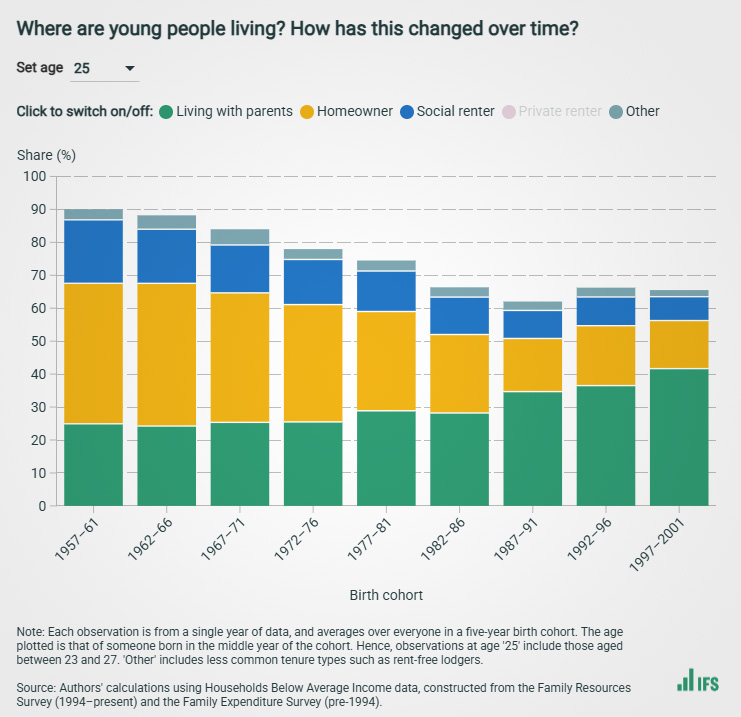
Looking at the increasingly few number of young people who are living on their own, their housing costs are higher than for any previous generation, and substantially higher than those faced by older generations at the same stage of life.
The median share of family income spent on housing costs has stayed at the historically high levels first encountered by young people in the 1980s, with no sign of decline in the burden of housing costs for young adults in sight.
Earnings and employment
As highlighted in the Milburn Review, Britain faces a serious problem with youth unemployment. Almost 1 million 16- to 24-year-olds in Britain are not in education, employment or training (NEET), with the report identifying rising ill health, limited vocational education, a hands-off benefits system and a weak labour market as the main drivers.
This trend is apparent in the IFS data, too, with the employment rate of 25-year-olds broadly stable in recent years but dropping sharply for the latest cohort.
When looking at median earnings, it is apparent that growth has stalled for young people’s earnings since the 2008 financial crisis. Before 2008, successive cohorts of 25-year-olds saw their median wages grow compared to the generation before, account for inflation.
However, median wages have stagnated since the crisis, with 25-year-olds today having a similar level of real wages to those born two decades earlier. The same is true for disposable income.
It is clear that while median earnings have not necessarily declined for young people today – they have similar outcomes to those born up to two decades before them – their living and working situations have changed dramatically.
The data paints a picture of stalled progress, particularly in the labour market, combined skyrocketing property prices forcing more young people to stay at home for longer. Earlier generations of 25-year-olds could expect the labour market to improve, to be likely to own their own home before 30, and for their earnings to grow.
For Gen Z and future generations of young people in Britain, the data shows they can expect stagnant wages, a slow labour market, and to stay at home with their parents until later and later in life as housing becomes increasingly out of reach.