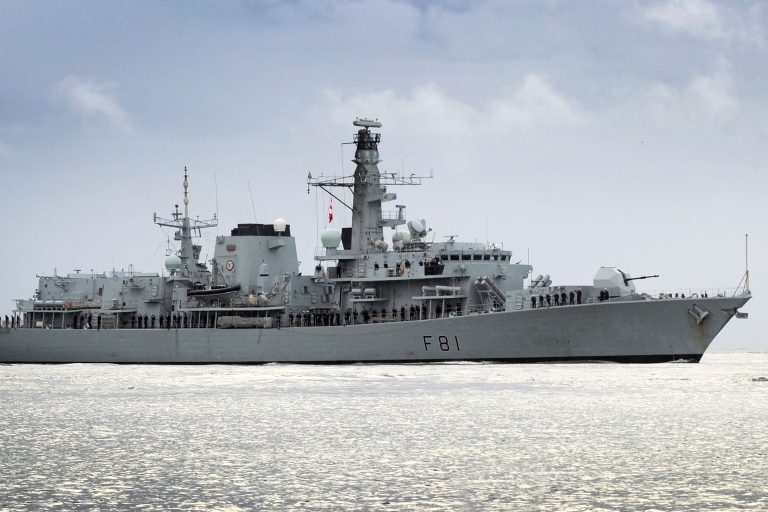
Royal Navy says it can no longer defend the Atlantic with crewed ships

Key Points
- First Sea Lord says crewed warships alone can no longer defend the Atlantic
- Royal Navy building "Hybrid Navy" of uncrewed escorts, drones and autonomous sensors
- Three Atlantic Series programmes cover undersea defence, missile defence and long-range strike
- Uncrewed flotillas to stay on station for months, controllable by allied warships
- Six Hybrid Navy command ships and 13 frigates on order
First Sea Lord General Sir Gwyn Jenkins said the Royal Navy will build a fleet of uncrewed escorts, drones and autonomous sensors because crewed warships alone can no longer defend the Atlantic.
Jenkins delivered the speech at Admiralty House on Wednesday (16 September) at a symposium organised by the Department for Naval Research.
“It is no longer possible to defend a vast, contested ocean with crewed warships alone,” said Jenkins, First Sea Lord and Chief of the Naval Staff. “A ship operating alone is now vulnerable.”
He said a warship commanding a network of large uncrewed escorts, drones and autonomous sensors is “a different proposition”, and that the Navy must blend crewed and uncrewed platforms into a single connected force.
The Ministry of Defence calls this the Hybrid Navy, which Jenkins described as the most radical reform the service is currently undertaking.
He said the change will make the fleet bigger, harder to target and harder to knock out of a fight, while allowing it to adapt faster than an adversary.
“Yes it is radical, yes we are early adopters, and yes there are sceptics,” said Jenkins. “But let me be clear: the Hybrid Navy is not optional.”
The Navy is building the new force around three programmes it calls the Atlantic Series.
Atlantic Bastion is a defensive net across the North Atlantic made up of crewed and uncrewed ships, drones, sensors, artificial intelligence and weapons operating above, on and below the sea to detect and neutralise hostile activity.
Atlantic Shield covers air and missile defence against drones, hypersonic weapons and ballistic missiles, and Atlantic Strike covers long-range strike capability.
Jenkins said uncrewed flotillas of ships and sensors will stay on station in the Atlantic for months at a time, with allied warships able to take control of them from British vessels.
He cited a scenario in which a Danish frigate takes over from a British warship mid-deployment and assumes command of the uncrewed ships and sensors left in position.
That arrangement forms part of a new Northern Navies agreement with the ten-nation Joint Expeditionary Force, which Jenkins said will be finalised this year and will include shared digital networks, common doctrine and a joint British and Norwegian frigate force.
He pointed to Ukraine’s campaign in the Black Sea, where uncrewed systems and long-range strikes destroyed much of a Russian fleet, and to drone and missile attacks on shipping in the Gulf and Red Sea, as evidence of how fast maritime warfare is changing.
Jenkins said the Navy’s procurement, testing and adoption cycles must move at the speed of the threat, with software able to change a system overnight and commercial technology reaching the battlefield in days.
“That means more experimentation, more courage to fail quickly, and the ability to scale what works,” he said.
The speech listed the ships on order alongside the uncrewed programme, including 13 new frigates, six command ships for the Hybrid Navy, four amphibious transport ships, two Astute-class and four Dreadnought-class submarines, and up to 12 next-generation attack submarines.
Jenkins said the Royal Navy now deploys two warships a week on average to monitor Russian vessels and the shadow fleet, and named Russia as the greatest threat to UK security.