£1,849: The bombshell figure energy suppliers think your July bill is about to become


Key Points
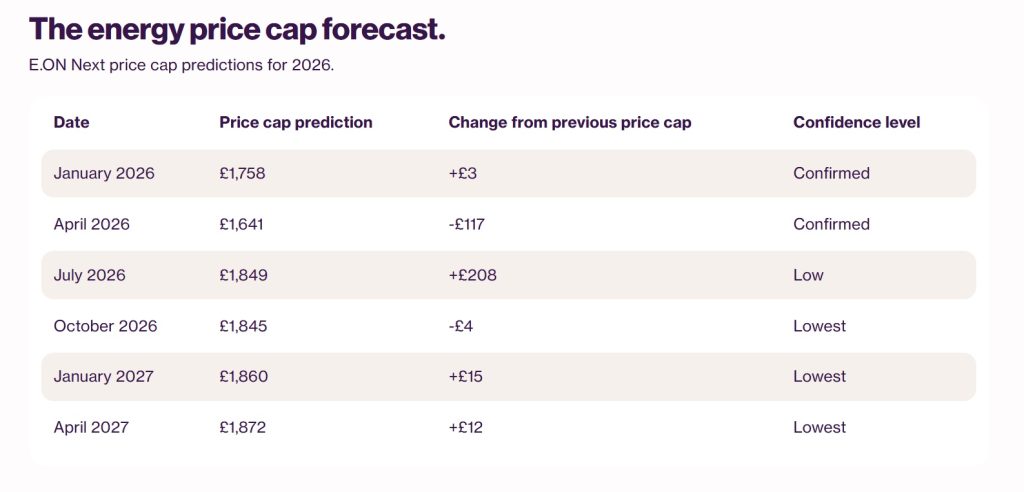
- E.ON Next forecasts the July 2026 energy price cap will rise to £1,849, a £208 jump on the current £1,641
- Cornwall Insight (£1,929) and EDF (£1,937) sit higher in the forecast range, suggesting the supplier figure may be optimistic
- The driver is Middle East volatility and Strait of Hormuz shipping disruption hitting global LNG flows
- Ofgem confirms the new cap on 27 May 2026, taking effect from 1 July
- Cheap fixed deals are being withdrawn; Martin Lewis's rule of thumb says any fix up to around £1,952 a year is likely to beat staying on the cap
E.ON Next forecasts that the typical UK household will be paying £1,849 a year for gas and electricity from July, a £208 jump on today’s £1,641 cap.
E.ON Next, one of the Big Five domestic suppliers, runs its own price-cap model in parallel with Ofgem’s, using the same typical-use household the regulator uses: 2,700 kWh of electricity and 11,500 kWh of gas a year, paid by direct debit.
Its latest forecast pegs the July to September quarter at £1,849. That’s a 12.7% rise on the cap that took effect on 1 April, and it pushes the average household bill £91 above where it sat back in January, before the brief April reprieve.
Your bill could be even higher
Cornwall Insight, the energy market consultancy whose forecasts have hugged Ofgem’s announcements unnervingly closely in recent quarters, has the typical bill at £1,929 in its early May central forecast, with a working range of £1,640 to £2,100 depending on what wholesale markets do through May and June.
EDF’s mid-March model came in at £1,937. So E.ON Next’s £1,849 isn’t the bombshell ceiling, it’s the optimistic supplier voice. The real number Ofgem announces on 27 May could be considerably worse.
The Strait of Hormuz is now setting your gas bill
The trigger is the Middle East. Craig Lowrey, principal consultant at Cornwall Insight, called the volatility “the kind not seen since 2022” and pointed to infrastructure damage and continued disruption to marine traffic through the Strait of Hormuz as the wholesale market’s anchor weight.
Roughly a fifth of global LNG passes through Hormuz on its way to Europe. Britain doesn’t take most of that directly, but it doesn’t need to.
The wholesale price is set globally, and the UK’s electricity market still uses gas as its marginal price-setter on most days, which means even a household on a 100% renewable tariff pays whatever gas-fired generation costs at the moment of peak demand.
The system is wired so that an Iranian frigate’s manoeuvres in the Persian Gulf eventually settle on a Sheffield household’s December bill.
Fixed deals are vanishing faster than households can switch
Suppliers have been quietly pulling cheap fixes off the market for weeks. Martin Lewis, Founder of MoneySavingExpert, flagged it back on 3 March, warning standard-variable customers to “urgently” consider a fix before the market priced in the full Middle East shock.
His current rule of thumb holds that any fix priced up to about 11% above January’s £1,758 cap, roughly £1,952 a year, is likely to beat staying on the cap over twelve months. Above that, you’re paying for the supplier’s risk premium, not your own.
Reeves has bigger fires to put out
Chancellor Rachel Reeves spent much of this week defending the government’s economic strategy against speculation that Wes Streeting or Angela Rayner could mount a leadership challenge if growth wobbles further.
Energy bills walking back up by £200 to £300 per household on her watch, with Ofgem’s confirmation due in twelve days, is precisely the backdrop she does not want.
Lowrey noted in his March commentary that the October cap is when “the question of government support for households is likely to be revisited.”
By the time that question reaches a Treasury desk, the political weather may have moved on without her.
Until Ofgem rings the bell on 27 May, £1,849 is the cheerful end of the forecast range. Anyone with a meter would do well to treat it as the floor, not the ceiling.