America is spending its way to an AI miracle – Britain is paying the bill


Key Points
- EY cuts UK GDP forecast to 0.8% for 2026 and 1.2% for 2027 after Middle East conflict shuts the Strait of Hormuz
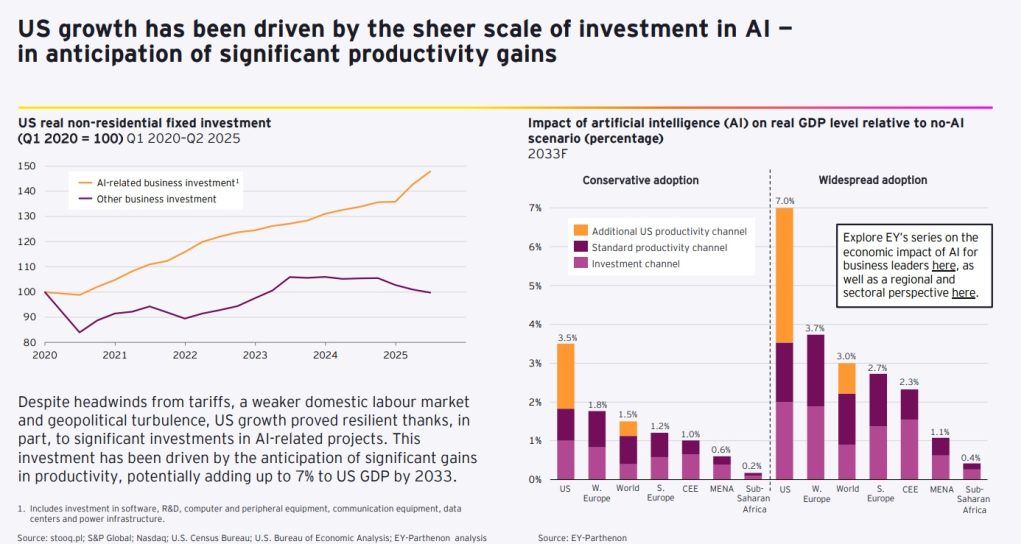
- US AI-related investment could add up to 7% to American GDP by 2033, while Western Europe sees a maximum 3.7% boost
- UK inflation set to climb back above 4% by year-end, delaying Bank of England rate cuts until spring 2027
- UK business investment will flatline at 0.0% growth in 2026, down from 4.3% last year
- Energy-intensive UK industries have already cost the economy £30bn since 2019 thanks to Europe's highest power prices
The US economy is being supercharged by a multi-billion-dollar bet on AI, while Britain stares down another energy price shock that’s about to torch its recovery.
That’s the brutal takeaway running through EY’s Spring 2026 UK Economic Outlook, and it makes for grim reading if you’re sitting on this side of the Atlantic.
Across the pond, real non-residential fixed investment has rocketed roughly 40% above its early-2020 baseline, almost entirely driven by AI-related spending on software, data centres, chips and the power infrastructure to keep it all humming.
The result is an American economy that keeps beating expectations even as tariff wars rattle global trade and a Supreme Court ruling tears up the White House’s executive tariff regime.
EY now reckons AI could add as much as 7% to US GDP by 2033 under widespread adoption, with a more conservative 3.5% on the table even if the rollout slows. Western Europe gets a more modest 1.8% to 3.7% boost in the same scenarios. The gap isn’t subtle. It’s structural.
Meanwhile, in Britain
Britain was, briefly, having a moment. GDP grew 0.5% on a three-month basis in February. Retail sales were finally clawing back ground after years of stagnation. Inflation was easing. Rate cuts were on the horizon. The vibes, to use a technical term, were improving.
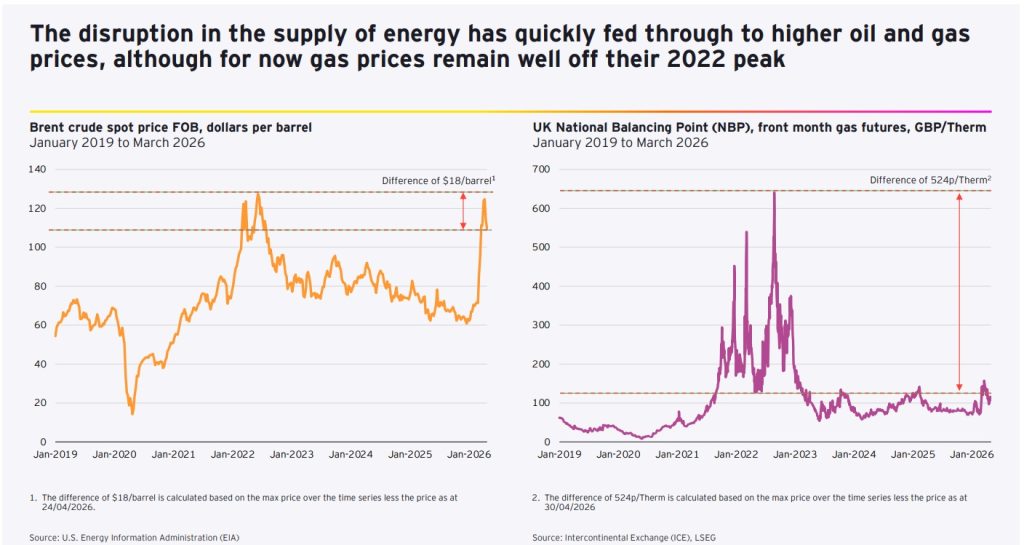
Then conflict in the Middle East shut down the Strait of Hormuz, the chokepoint that carries 20% of global oil exports and a similar share of LNG supply, and the recovery story collapsed.
EY has slashed its UK growth forecast to just 0.8% for 2026 and 1.2% for 2027, down from 1.3% and 1.4% in the pre-conflict baseline. Inflation is now expected to climb back above 4% by year-end.
The Bank of England base rate cut markets had been pricing in? Gone. Don’t expect another move until spring 2027 at the earliest.
Investment hits the brakes
Here’s where it gets ugly. UK business investment is forecast to flatline at exactly 0.0% growth in 2026, down from 4.3% last year.
While American CEOs are signing off on multi-billion-dollar AI data centre builds, their British counterparts are quietly shelving expansion plans, mothballing capex, and bracing for higher borrowing costs as gilt yields stay elevated.
UK 10-year yields are now the highest in the G7, which is a polite way of saying international markets want a premium to lend to Britain. Every basis point feeds through to mortgages, corporate debt, and government borrowing costs.
The energy problem nobody wants to fix
The deeper issue is that Britain was already losing this race before the latest shock.
UK industrial energy prices have pulled away from European peers since 2019, leaving British manufacturers paying more for power than competitors in Germany, France, or Spain. Output from energy-intensive industries has fallen 8% in that time, while the rest of the economy grew 6%.
If that sector had simply kept pace with the wider economy, UK GDP would be £30bn larger today, according to EY. That’s roughly the entire annual budget of the Department for Transport, vapourised by an energy market that hardwires gas prices into electricity bills.
The contrast is starting to feel civilisational.
America is buying its way into the next productivity wave. Britain is paying the bill for the last energy crisis, and now bracing for the next one.
Households will spend less, businesses will invest less, and the rate cut you were counting on for your remortgage isn’t coming.
EY’s message to UK business leaders is blunt: model the downside. The adverse scenario, where the Strait stays closed through 2026, has inflation peaking above 7% and growth grinding to a halt.
If you’re a household, start saving. Again.