UK house prices flatline as Iran war pushes up rates


Key Points
- The inflationary pressure caused by the recent conflict in Iran has hamstrung the growth of the UK housing market.
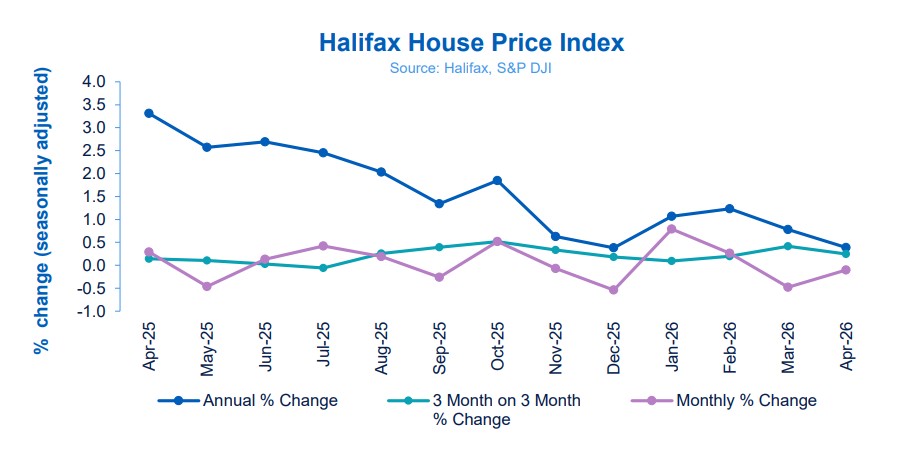
- House prices grew by just 0.4% year-on-year, failing to bounce back from a monthly drop of 0.5% in March.
- Borrowing costs have risen for buyers, bringing prices down as their affordability is stretched, especially in London and the South of England.
House price growth in the United Kingdom has stalled thanks to the conflict in Iran feeding inflation and driving up interest rates.
According to the latest data from Halifax, average house prices in the country grew by just 0.4% year-on-year, half of the annual growth recorded last month.
Month-on-month, the average house price in the UK fell by 0.1% and now sits at £299,313, failing to bounce back after last month’s drop of 0.5%.
Halifax attributed the hamstrung growth of housing in the UK to economic pressure caused by the recent conflict in Iran, which has driven up energy prices and is expected to result in high levels of inflation in the country.
Higher inflation causes interest rates to rise, which raises the cost of borrowing for new buyers and reduces the amount they are able to spend.
“After a strong start to the year, recent global developments have added a greater degree of uncertainty to the outlook,” said Halifax Head of Mortgages Amanda Bryden.
“In particular, higher energy prices have fed into inflation expectations, prompting markets to reassess the path for interest rates – a shift that has already pushed up borrowing costs for many buyers.”
“This understandably leads to more caution among some households, with the cost-of-living once again front of mind and extra thought being given to planned property moves,” Bryden said.
Regional variance and market resilience
It is important to note that house prices and market behaviour varies greatly by region in the United Kingdom, with the North generally seeing stronger house price growth and the more expensive South being more subdued as affordability is stretched.
Northern Ireland, for example, saw average prices increase by 7.6% over the past year, and the average house in Scotland rose in value by 4% annually.
The North East and North West of England also saw healthy house price growth at 3.4% and 4.5%, respectively.
In the South of England, however, the market is in decline. In the South East, the average price of a house has fallen by 2% compared to last year, and in London average prices have dropped by 1.4%.
Despite generally subdued growth across the country due to the Iran conflict, Halifax remains confident in the resilience of the market.
“While activity is likely to cool in the near term, the underlying picture remains one of relative stability, supported by wage growth that continues to outpace house price inflation,” Bryden said.
“Another important factor is that the majority of existing homeowners are on fixed-rate mortgages, meaning they are largely insulated from short term changes in interest rates.”
“A slower pace of house price growth may be disappointing news for existing homeowners. However, for those looking to step onto the property ladder, stable prices are helpful, even if higher mortgage rates mean affordability remains stretched,” Bryden said.