Right to Buy waiting period jumps from 3 to 10 years


Key Points
- Extended eligibility period: The UK government is increasing the minimum tenancy requirement for England's Right to Buy scheme from 3 years to 10 years to help protect social housing stock while still offering a route to homeownership for long-term tenants.
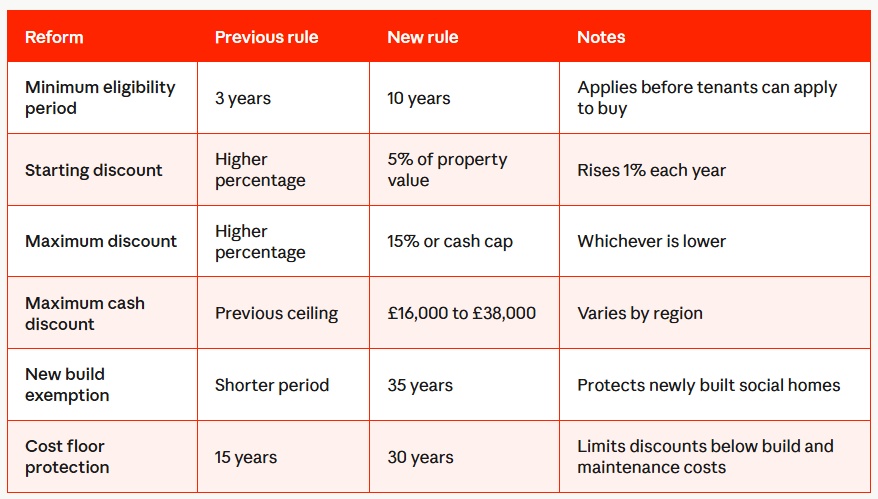
- Revised discount structure: Discounts will now start at 5% of the property value, rising by 1% per year up to a maximum of 15% (or the regional cash cap of £16,000–£38,000, whichever is lower), following earlier cuts to maximum cash discounts.
- Stronger protections for new builds: Newly constructed council homes will be exempt from Right to Buy for 35 years, with the cost floor protection (preventing sales below build/maintenance costs) already extended to 30 years to encourage new social housing investment.
- Additional reforms: Councils will retain all sales receipts to fund replacements, alongside new fraud prevention measures and a review of the scheme's operation in rural areas where replacement housing is challenging.
- Implementation: The changes, welcomed by the Chartered Institute of Housing for addressing the imbalance between homes sold and replaced, will be introduced when parliamentary time allows.
The government has confirmed sweeping reforms to England’s Right to Buy scheme.
Housing Secretary Steve Reed and Housing Minister Matthew Pennycook announced on Tuesday (28 April) that the minimum eligibility period will rise from three years to ten years before council tenants can apply to purchase their home.
The Ministry of Housing, Communities and Local Government said the overhaul aims to protect depleted social housing stock while preserving a route into homeownership for longstanding tenants.
Discount rules are also being rewritten. Under the new structure, discounts will start at 5% of the property value and rise by 1% each year, capped at a maximum of 15% of the property value or the regional cash cap, whichever is lower.
The government has already cut maximum cash discounts to between £16,000 and £38,000 depending on the area, a significant reduction from the previous ceiling that critics argued was draining council housing reserves faster than replacements could be built.
Protection for new builds
New build social homes will receive even stronger protection.
A 35-year exemption period means newly constructed council properties cannot be sold under Right to Buy for more than three decades after completion, giving councils long-term certainty when investing in new stock.
The cost floor protection, which prevents sale prices from falling below what councils have spent building and maintaining a property, has already been extended from 15 to 30 years, with further reforms under review.
The government is also developing additional fraud prevention measures to stop vulnerable tenants being pressured into purchases by third parties, and is reviewing how Right to Buy operates in rural areas where replacement housing is harder to deliver.
Councils now retain all sales receipts and can combine them with grant funding to build and acquire replacement homes, a change ministers say is already giving local authorities greater confidence to expand social housing delivery.
Gavin Smart, chief executive of the Chartered Institute of Housing, welcomed the announcement, saying the reforms recognise the long-standing imbalance between homes sold and those replaced. The changes will be introduced when Parliamentary time allows.
Key changes at a glance