3 years in and there’s no sign of AI taking UK jobs yet: think tank


Three years after the launch of ChatGPT in late 2022 sparked widespread fears of mass job displacement, a new report from the think tank British Progress finds no clear evidence that AI has replaced jobs at scale in the UK labour market.
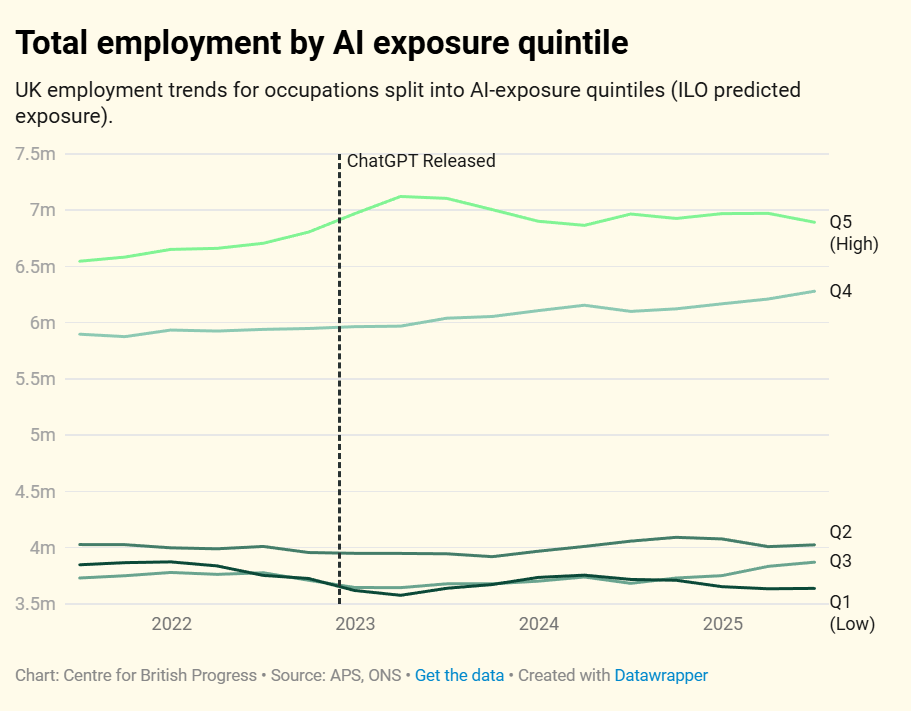
The report analyses employment, wage, and hours data up to 2025. It concludes that aggregate employment in AI-exposed occupations has remained stable or shown marginally positive trends, with no detectable “fingerprint” of large-scale disruption from generative AI.
“Despite widespread concerns about the negative impact of AI on employment, we find no evidence that it has replaced jobs at scale in the UK,” the group said. “Three years after generative AI reached the market, there is no sign of that disruption in UK employment data yet.”
Narrow adoption limits impact
The analysis draws on multiple data sources, including the Annual Population Survey and Labour Force Survey for occupation-level employment, the Annual Survey of Hours and Earnings for wages and hours, and the Anthropic Economic Index for revealed AI usage patterns mapped to UK occupations.
It shows that AI adoption remains narrow and task-specific. While predictive models suggested high exposure for many knowledge-work roles, actual usage is concentrated in roughly the top 20% of tasks, which account for about 63% of total AI interactions. Only a small fraction of tasks (around 2.1%) show measurable AI usage in the UK.
This limited, selective deployment means AI is acting more as a complement to human labour than a substitute in most cases. Usage patterns show task iteration at 29%, directive use at 28%, and learning at 24%, with low levels of independent operation.
The report notes that predicted exposure metrics (such as those from the ILO or GPT-4-based studies) tend to overstate real-world adoption, particularly in professional and managerial roles. There is a “fat left tail” of under-adoption even in highly exposed occupations.
Employment and wage trends
The data shows that high AI-exposure occupations show no significant negative divergence from low-exposure ones.
Some exposed roles, such as IT business analysts (+38%) and programmers (+18% since 2021), have grown.
Offsetting contractions have occurred in areas like certain administrative or call-centre roles, but overall patterns align more with pre-existing trends or sector dynamics than AI-driven replacement.
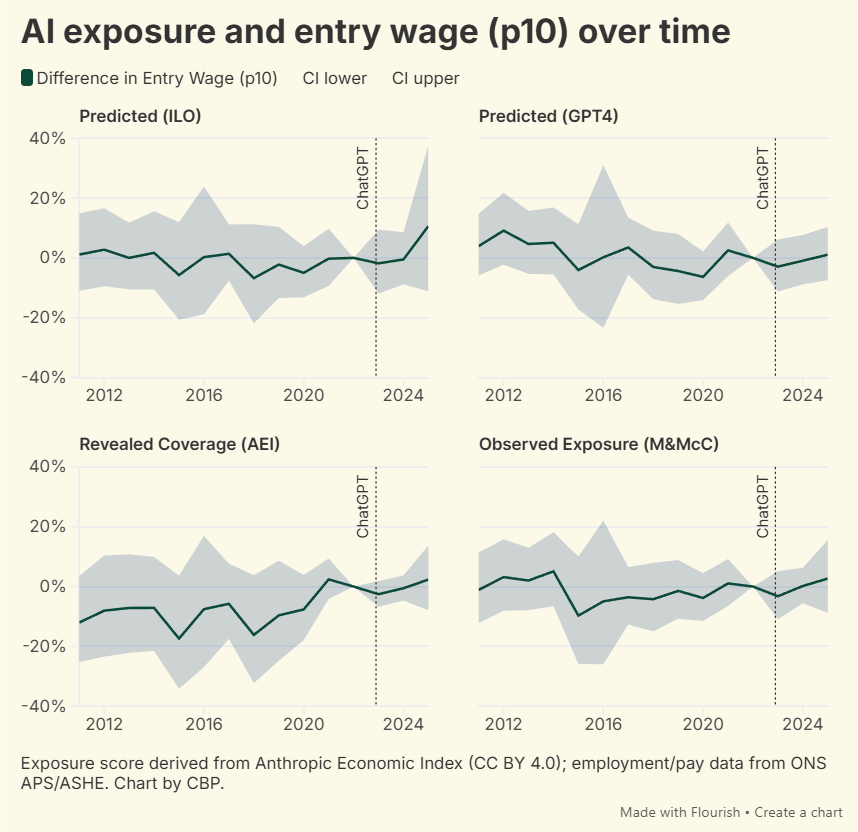
Notably, wage growth in high-exposure occupations has been slower than in low-exposure ones since 2019, but this divergence began before ChatGPT and appears structural rather than AI-induced.
The report did find modest increases hours worked in high-exposure roles, consistent with AI boosting demand for workers by enhancing productivity on specific tasks.
Sectorally, high-exposure areas like finance and professional services have seen employment growth alongside lower-exposure sectors.
In software, a bellwether for AI impact, employment rose 18% from 2019–2025, with output growing even faster (36%), suggesting elastic demand that has absorbed productivity gains without net job losses so programmer and finance analyst roles have expanded, while some administrative positions have contracted, highlighting that outcomes depend on whether a job’s structure lends itself to augmentation or replacement.
There is still some variation being seen, however. Programmer and finance analyst roles have expanded, while some administrative positions have contracted, highlighting that outcomes depend on whether a job’s structure lends itself to augmentation or replacement.
Looking historically
The report draws parallels with past technologies, noting that electricity took decades to reshape productivity statistics meaningfully.
It adds that AI may follow a similar path, with organisational changes, complementary investments, and broader adoption needed before large effects materialise.
The think tank also noted that there are data limitations. National statistics lag rapid technological change, surveys have constraints, and occupational classifications have shifted.
The report does not claim AI will never displace jobs, only that no such effect is visible yet at current usage levels.
Notably, expert predictions of rapid transformation, such as Sam Altman’s statements that ‘jobs are definitely going to go away’, have so far outpaced observed impacts.