Wealthy voters who backed Labour say they now regret it, citing graduate unemployment and tax hikes


A new survey of UK high-net-worth individuals reveals growing disillusionment among affluent voters who supported the Labour Party in the 2024 general election, with many now expressing regret over their choice.
The February 2026 edition of the Saltus Wealth Index, published by wealth manager Saltus, highlights a sharp decline in confidence driven by persistent tax pressures and emerging economic concerns, including a notable ‘collapse in employment prospects for university graduates’.
The report, based on a survey of 2,002 UK respondents aged 18+ with at least £250,000 in investible assets, shows the overall Wealth Index falling to 61.3 from 64.7 in August 2025. Confidence in the UK economy dropped to 59% from 66%, while personal financial confidence eased to 87% from 92%.
Respondents described the current environment as a persistent ‘grind’, marked by reduced consumption, material sacrifices, and heightened vigilance amid policy uncertainty, geopolitical risks, and subdued growth expectations.
A decline in support for Labour
Among the wealthiest cohort, support for Labour has eroded significantly. While 41% of high-net-worth individuals (HNWIs) voted for Labour in the last election, only 30% would do so again today. The report notes that 11% explicitly regret their decision, contributing to a broader softening of support.
Labour’s backing among this group has fallen from 42% to 30% over the past year, with gains instead flowing to Reform UK (up from 13% to 18%, and reaching 30% among those aged 55+).
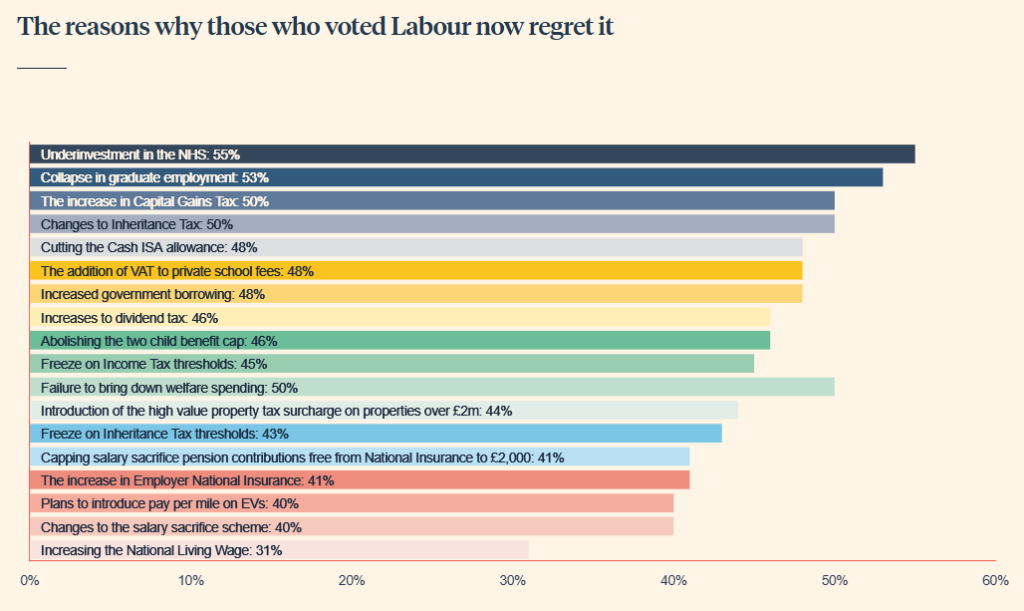
The reasons for regret are multifaceted but center on fiscal policies and social outcomes perceived as damaging to both personal wealth and broader economic health. Top-cited factors include:
- Underinvestment in the NHS (55%)
- Increases to Capital Gains Tax and changes to Inheritance Tax (50% each)
- Rising government borrowing (48%)
- Extension of VAT to private school fees (48%)
- Cuts to Cash ISA allowances (48%)
- Increases to dividend tax (46%)
- Abolition of the two-child benefit cap (46%)
- Freezes on Inheritance Tax thresholds (43%)
Collapse in employment is a major concern
One of the key findings is that 53% of Labour-voting HNWIs pointed to the ‘collapse in employment prospects for university graduates’ as a key driver of their disillusionment. The report highlights this as a fresh addition to more predictable grievances around taxation.
“Many of our respondents had voted for Labour at the last election, but substantial numbers now regret that decision,” Saltus said. “Many predictable concerns are cited for this softening of support, but they are joined by a new one: the collapse in employment prospects for university graduates.”
Taxation remains the dominant theme. Nearly half (49%) of HNWIs now feel they pay too much tax, a shift from previous perceptions that the burden was appropriate. Inflation (51%) and tax changes (45%) rank as the top perceived risks to personal wealth in 2026.
Respondents particularly criticise higher rates of Income Tax (40% and 45% bands), Inheritance Tax, and Council Tax as “unreasonably high,” while viewing various levies – including Employer National Insurance and Corporation Tax – as holding back economic growth.