How safe is London? The reality behind knife crime and phone snatching


Sir Sadiq Khan has been one of the most politically successful mayors in London’s recent history, but he is also constantly embattled by criticisms over his record on public safety.
The mayor, who has held his post since 2016, is the subject of fierce online debate among those who believe he has presided over soaring knife crime, phone snatching, and other crimes in the capital.
US President Donald Trump is a frequent critic of Khan’s tenure, last year stating that the mayor was a ‘nasty person’ who was doing a ‘terrible job’.
A proportion of the criticism over the mayor stems from Islamophobia. Last year, a report by Hope Not Hate found that posts referring to the mayor using Islamophobic phrases more than doubled, with Khan criticising Elon Musk for exacerbating online abuse through a lack of moderation on the social media platform, X.
Beyond criticism of the mayor himself, many people in the UK, and on social media around the world, believe that crime in London is becoming worse.
Laila Cunningham, the Reform UK candidate for London Mayor, made public safety the central focus of her platform during the announcement of her candidacy.
She said she planned to restore London to its ‘former glory’, citing the safety she felt growing up in the city, and pledged to crack down on knife crime, drugs, and robbery – launching an ‘all-out war’ on crime.
But what is the reality of crime in London today? Among the most-cited issues by Londoners on social media are knife crime and phone snatching.
Let’s look at the data behind homicides and knife crime, as well as for mobile phone thefts in London.
Knife crime and homicides
The Metropolitan Police publishes regular updates on knife crime and other violent crimes in the capital, as well as more in-depth reports.
According to its data from January to November 2025, knife-enabled crime was lower across the city than during the year before. Instances of knife-enabled crime dropped across all boroughs of London last year.
The Met Police also compared knife-enabled crimes on a yearly basis from 2015 to 2025, showing that while there has been an increase in the 10-year average, instances are now trending down.
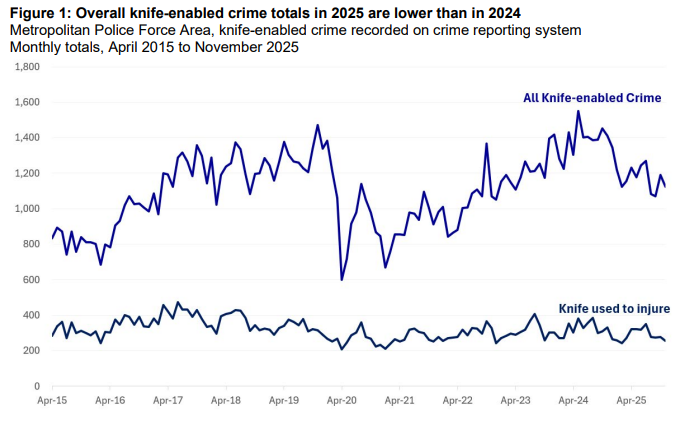
What is immediately apparent from examining crime figures over the past decade is the collapse of criminal activity during the Covid-19 pandemic and the subsequent resurgence after lockdowns were lifted.
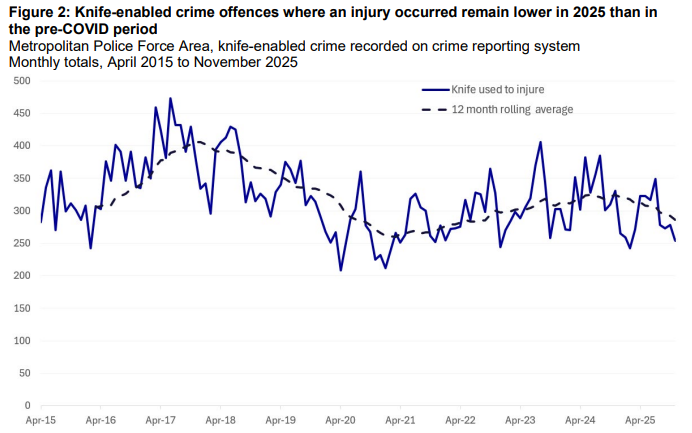
It should also be noted that the number of crimes where a knife was used to injure someone has remained stable over the past decade, despite an increase in London’s population.
Turning to violent crime and homicide, the recent downtrend is even more apparent.
Violent crime seen a decline, with London’s homicide rate per capita at its lowest since records began 11 years ago.
97 homicides were recorded in 2025, an 11% reduction on 2024 (109). This represents the lowest total since 2014, despite London’s population having risen by more than half a million since then.
Last year, London also recorded the fewest number of homicides of victims aged under 25 this century.
In 2025, the homicide rate in London stood at 1.1 per 100,000 people.
This is lower than many other major cities such as Berlin, Milan, and Toronto, and ten-times lower than US cities including Houston, Chicago, and Philadelphia.
Mayor Sadiq Khan has attributed this decline and that in the number of homicides of young people partly to the establishment of his Violence Reduction Unit (VRU), an early intervention initiative to address the causes of violent crime.
Since the VRU was set up in 2019, the number of homicides of young people has fallen to a third of what it was, and hospital admissions of young people for knife assault has falled by almost half.
A continued decline in the knife crime rate could see this figure quickly return to 2015 levels in the next one or two years, despite the population of London having grown significantly over this time.
Mobile phone snatching
Mobile phone theft has become a scourge in certain areas in London, especially in hotspots such as Oxford Street, where visitors might be milling around outside tube stations with their phones in hand, or checking for directions while standing on the pavement.
Phones are often snatched by e-bike riders, who are able to quickly swoop in and grab phones from pedestrians’ hands and escape without being impeded by traffic.
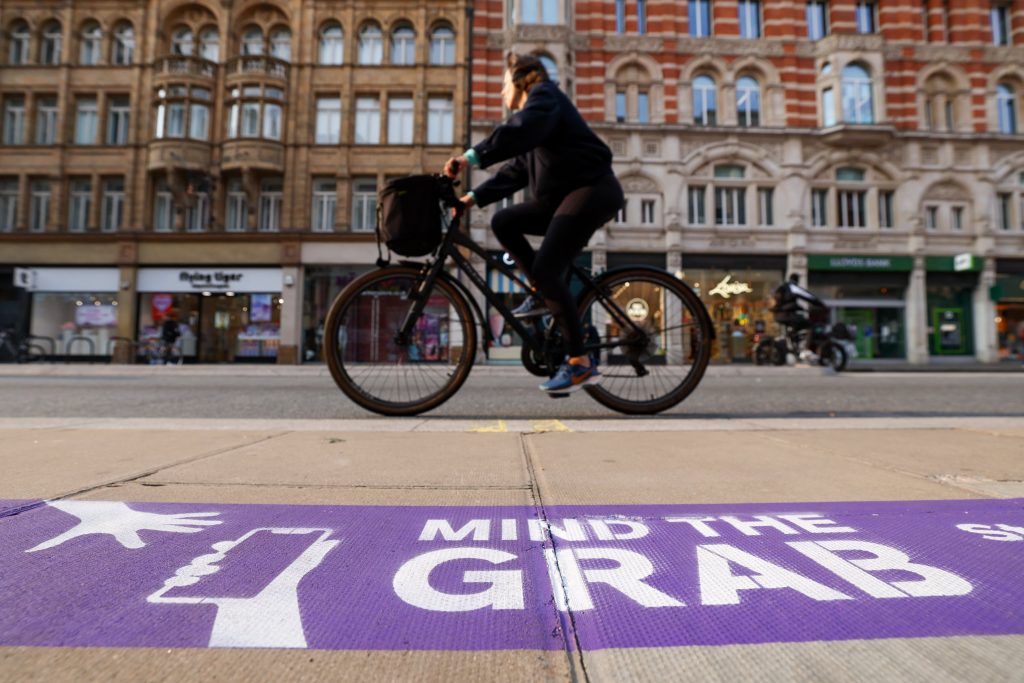
The problem has become so significant as to prompt a campaign created by Currys and supported by the Met, which saw the pavement on Oxford Street painted with purple ‘Mind the Grab’ warnings to alert pedestrians of the danger.
Historical mobile phone theft data shows a similar pattern to other crime statistics, dropping precipituously during the Covid-19 pandemic and rebounding back at higher levels than before the lockdowns.
According to a freedom of information request filed in 2025, the Met recorded the following annual mobile phone theft figures from 2019 until 2024:
- 2019 – 91,481
- 2020 – 55,820
- 2021 – 63,777
- 2022 – 90,810
- 2023 – 115,261
- 2024 – 117,211
Since 2024, the Met has moved to a new recording system, called Connect, which records data differently. As a result, the data above is not directly comparable with data following 2024.
However, the latest data from the Met shows that mobile thefts in London are also declining.
The Met Police’s updated data using its new recording system said there were 81,365 mobile phone thefts in 2024.
In 2025, this number had dropped to 71,391 – a significant reduction of around 12.3%, mirroring the fall in knife and other crimes in the city.
The Met attributes this drop to its biggest ever coordinated effort to crack down on mobile phone snatching.

As smartphone thieves often use e-bikes, police are also increasingly using their own e-bikes (Surron Ultra Bees) to catch them, as well as drones to track phone snatchers and recover stolen devices.
The Met also said that in the West End, a phone-snatching hotspot, it is using more pre-emptive tactics to identify suspects before they commit offences.
While the falling number of phone thefts and action by Met may comfort Londoners, the capital of the UK remains the epicentre of mobile phone theft in Europe.
A study by insurance firm Squaretrade last year found that nearly 2 in 5 phones thefts in Europe occur in the UK, with 42% of UK phone thefts occurring in London.
The Metropolitan Police have are having a positive impact on the issue, but it would still be wise to ‘Mind the Grab’ and be wary when walking around busy parts of the city, as you are still far more likely to have your phone grabbed in London than in other European capitals.
A positive trend for safety in London
While it is true that on the whole, almost all crime in London increased since the Covid-19 pandemic, the broader picture over time is far less depressing.
The average increase in some crimes in the past 10 years, even when considering the increase in population, is a concern to many in the city.
But do these figures warrant the outrage levelled at the capital and it’s mayor on social media, often from those outside the city or the UK?
Homicide rates are at record lows, and while both mobile phone snatching and knife-related have increased since the pandemic, they are now falling significantly.
All the data points to the expectation that London, already listed among the safest major cities to in the world by Population Review, will at the very least continue to hold its position – above New York, Los Angeles, Zurich, and Hong Kong.