Northern Ireland’s mobile networks fail a third of the time on the road


New data from network testing firm Streetwave shows that Northern Ireland has a clear urban and rural divide when it comes to mobile network performance, with a third (34%) of all measured locations not even able to offer basic performance.
The data is based on drive tests covering over 20,000 km of Northern Ireland’s roads. Each vehicle carried four smartphones with modern chipsets, one on each of EE, O2, Vodafone and Three, so every network was tested at the same place and the same moment, using Streetwave’s own Android app.
The team used standard consumer SIM cards with no data limits or speed caps, and none had traffic prioritisation. Roaming was switched off for the whole campaign, because the study set out to measure UK networks only. The results cover roads only and do not include homes, workplaces or land away from the road.
Based on the collected data:
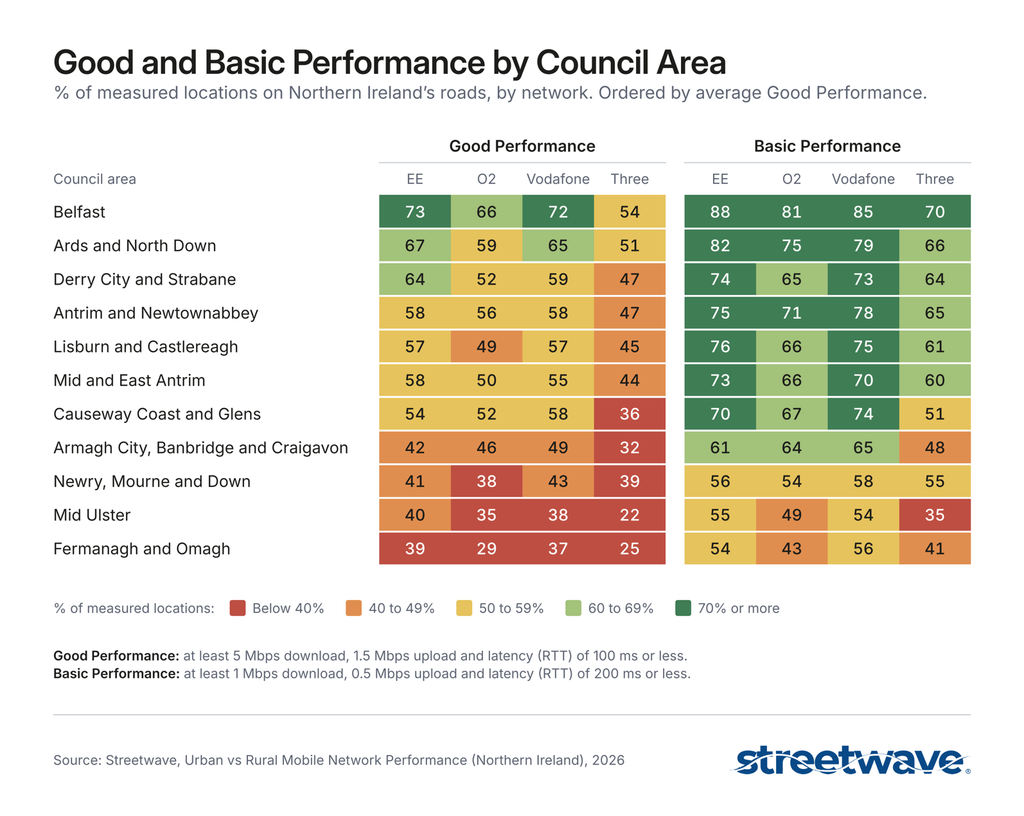
- Good Performance means at least 5 Mbps down, 1.5 Mbps up and a latency of 100 ms or less.
- Basic Performance applies the same test at 1 Mbps, 0.5 Mbps and 200 ms.
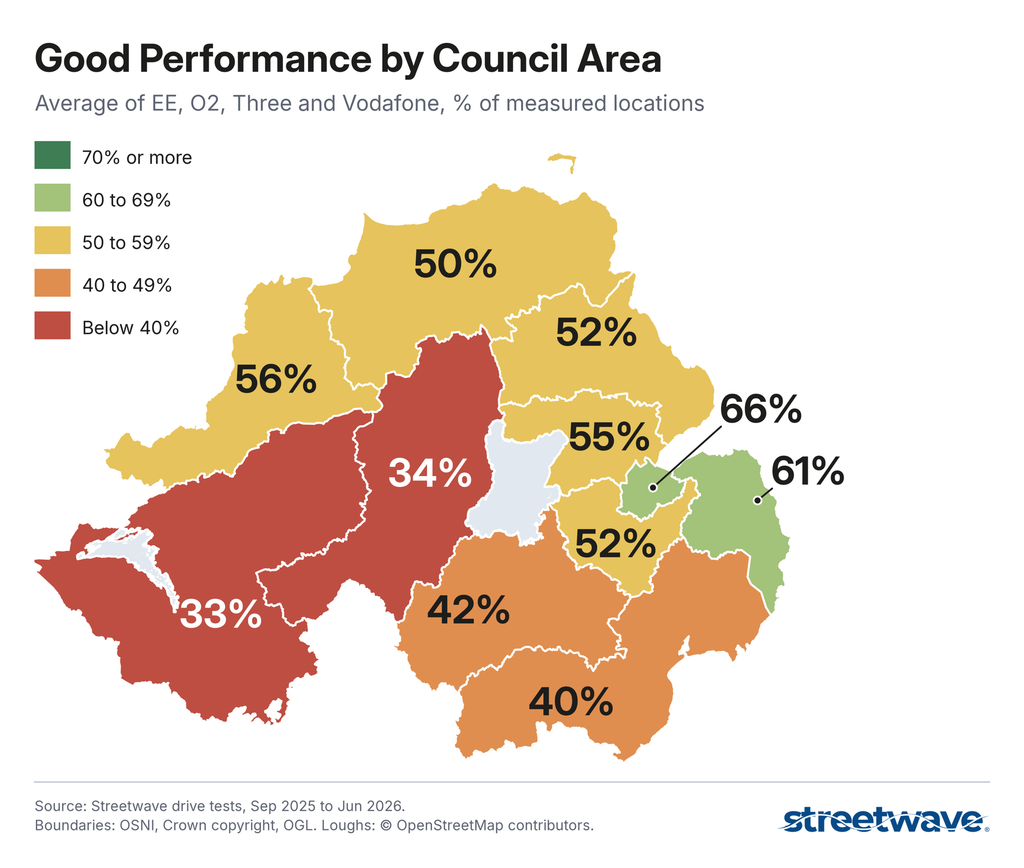
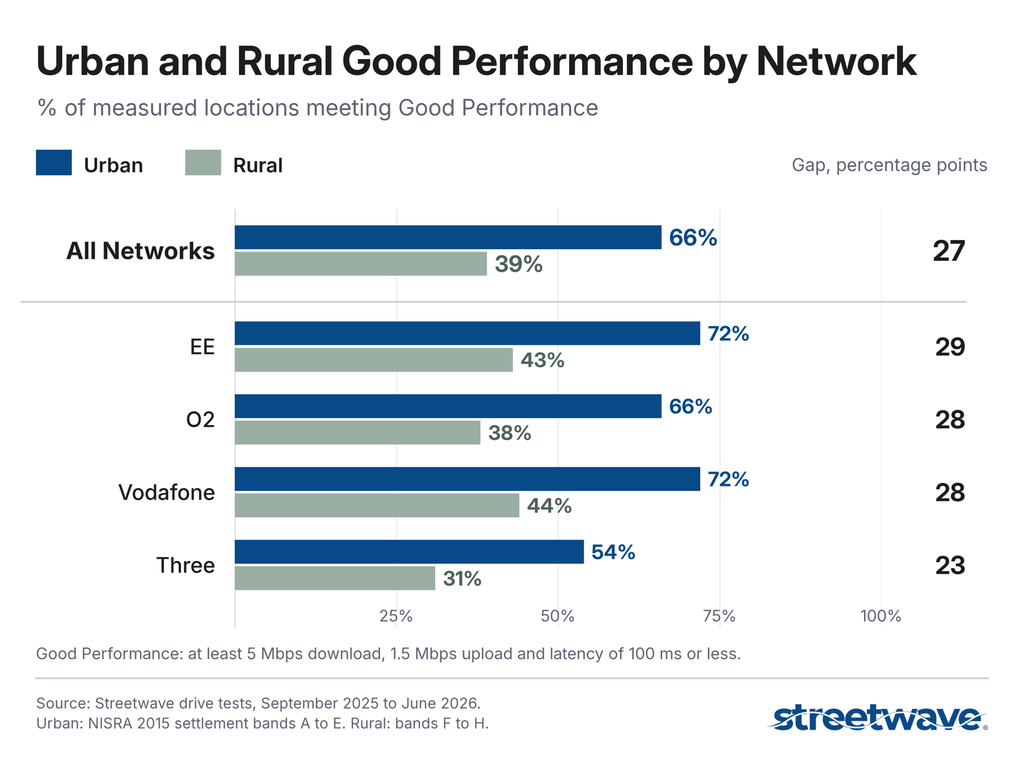
Averaged across the four networks, 66% of measured urban locations reach Good Performance, against only 39% of rural ones, a gap of 27 percentage points. The divide appears on every network, at 23 to 29 points.
Somewhat shockingly, every network missed Basic Performance at 34% or more of measured locations. On rural roads, networks missed it at 39% to 54% of measured locations.
Fermanagh and Omagh and Mid Ulster, where urban areas cover 3% of the land or less, have the two lowest results on every network. Belfast leads on all four.
EE and Vodafone each reached Good Performance at 49% of measured locations, against 36% for Three. Three’s median upload, 0.95 Mbps, was the lowest of the four.
EE recorded the fastest median download speed at 11.05Mbps and the lowest median latency at 54 milliseconds. Vodafone posted the fastest median upload at 2.21Mbps.