Watch: British soldiers test how much tech their heads can carry

Key Points
- Dstl is trialling head-mounted kit with soldiers from four British Army regiments.
- The HEADS UP project runs with the University of Chichester and QinetiQ.
- Soldiers wear a rig simulating different head loads during military tasks.
- Researchers are tracking muscle activity, metabolic cost, cognition and eye movement.
- Findings will shape how the Ministry of Defence designs and adopts new kit.
The Defence Science and Technology Laboratory (Dstl) has put soldiers from four British Army regiments through a trial of head-mounted kit.
Dstl said its HEADS UP project takes a human-centred approach to designing new capabilities that soldiers wear or carry, with the aim of improving performance and reducing the risk of long-term injury.
The trial, run with the University of Chichester and defence firm QinetiQ, involves serving soldiers from the Queen’s Royal Hussars, the Princess of Wales’s Royal Regiment, the Royal Dragoon Guards and the Royal Engineers.
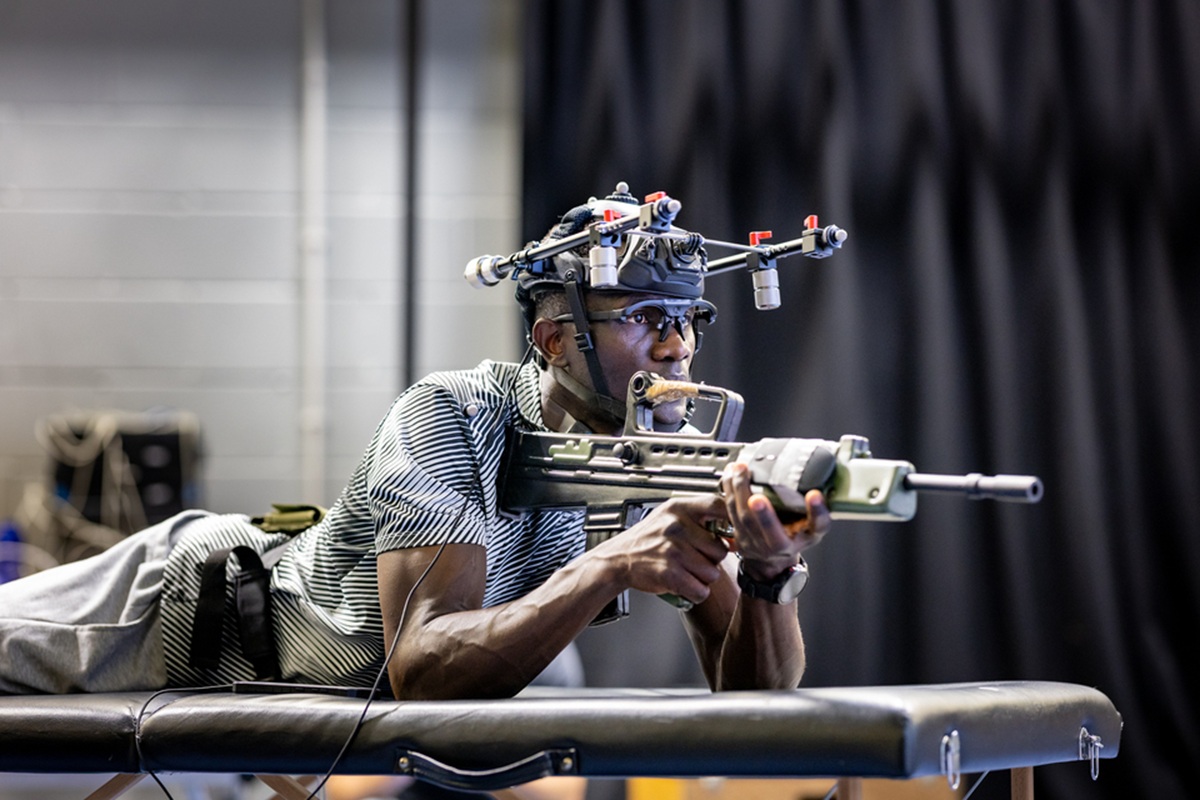
Participants wear a custom-designed rig that simulates different head-mounted load configurations while they carry out a range of representative military tasks.
Soldiers today carry more equipment than ever, much of it mounted on the head, including night vision goggles and a growing number of virtual reality and augmented reality systems.
Dstl said extra mass on the head increases metabolic and thermal demands, adds biomechanical load and muscle strain to the neck, and raises attentional and cognitive demands, all of which could hurt performance.
“The trial puts the soldier at the centre of new equipment design. By reducing the negative effect of equipment, such as fatigue, we can improve performance and effectiveness. This will improve the soldier’s lethality, agility, and resilience,” said Matt, Dstl lead on the Human Augmentation project.
The researchers are collecting a broad range of physiological, biomechanical and cognitive data, including movement speed, muscle activity, motion capture, metabolic cost, cognitive performance and eye-tracking.
Dstl said these measures together give an interdisciplinary picture of how head-mounted equipment affects soldier performance.
“For this particular project we have brought together a multidisciplinary team of researchers from the University of Chichester and QinetiQ to investigate the effects of carrying additional load mass on the physical and cognitive aspects of soldier performance,” said Sam Blacker, professor at the University of Chichester’s Occupational Performance Research Group.
Blacker said the group specialises in improving health and performance in physically demanding occupations, particularly the military, with work ranging from field data collection to studies in its sport and exercise science laboratories.
Dstl said the findings will support the development and adoption of new capabilities across the Ministry of Defence.