London Underground 4G and 5G coverage: How strong the signal is on each Tube line

Key Points
- Median 4G signal on Tube platforms is -96 dBm, matching London's street-level median of -98 dBm
- 19.8% of below-ground connections are on 5G, ahead of the 16.5% citywide above-ground share
- Chancery Lane has the strongest station signal at -80 dBm; Warwick Avenue the weakest at -105 dBm
- The Jubilee line pilot section remains 4G-only, with 5G share as low as 4.2% at Southwark
- Over 60% of 121 below-ground stations are live, with full coverage due by the end of 2026
Mobile signal on London Underground platforms now matches the street above, with 19.8% of below-ground connections already on 5G, according to more than 50 million signal scans analysed by network testing firm Ookla.
Ookla collected the measurements across Greater London between 25 March and 30 April 2026 from Android phones running its app in the background, and reported only the scans its model classified as below ground with high confidence.
The firm said median 4G signal strength on below-ground platforms was -96 dBm, compared with -98 dBm at street level across the whole of London.
Signal strength is measured in dBm, and readings closer to zero mean a stronger connection, so -80 dBm is excellent, -95 dBm is comfortable and around -110 dBm the connection struggles.
A stricter comparison of below-ground and surface scans within the same small areas showed the street still winning by 2 to 3 dB, which Ookla said reflected how strong central London’s surface network is rather than any weakness underground.
The network is being built by neutral host Boldyn Networks under a 20-year concession awarded by Transport for London (TfL) in June 2021, and all four UK operators lease capacity from it.
As of August 2026, more than 60% of the 121 below-ground stations were live, with the remainder due by the end of the year.
Signal strength by station
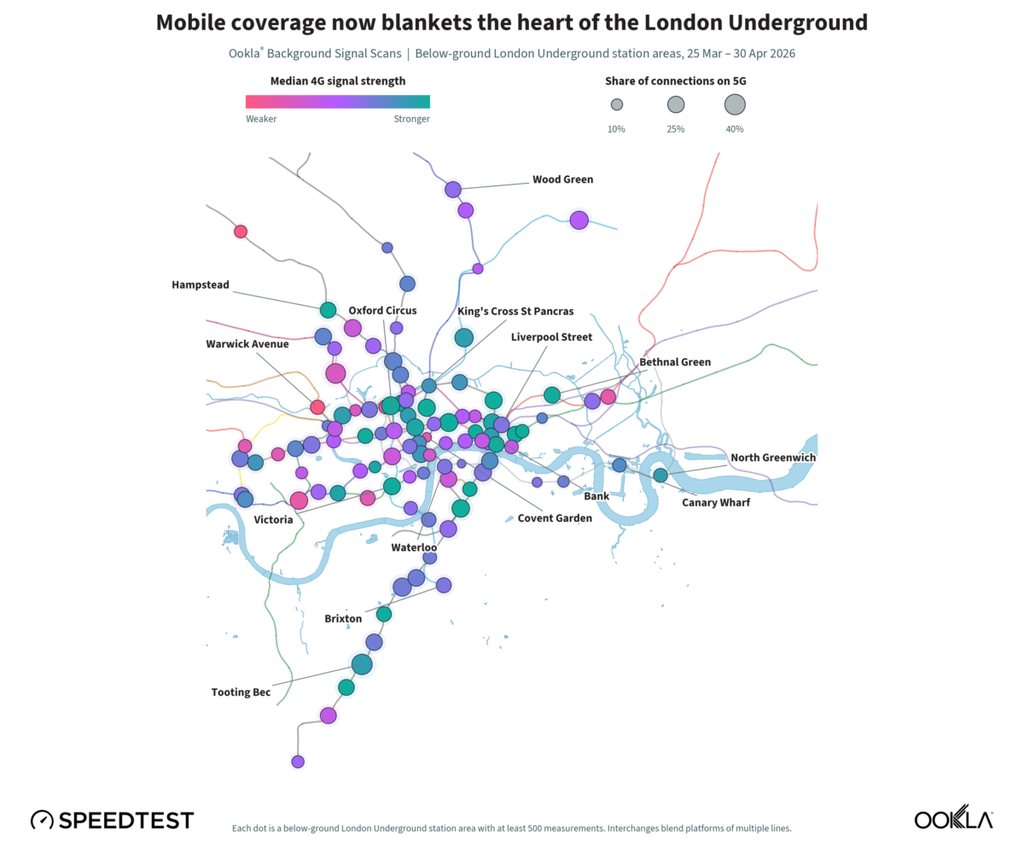
Chancery Lane on the Central line recorded the strongest median 4G signal of any station area at -80 dBm.
Hampstead on the Northern line, the deepest station on the network at around 58 metres, still delivered a median of -82 dBm.
Warwick Avenue on the Bakerloo line sat at the other end at -105 dBm, marking where the build had yet to reach during the measurement window. TfL named Warwick Avenue in January as one of the next stations due to go live.
Across more than 100 station areas with at least 500 measurements each, the strongest readings clustered in central London, particularly in and around the City. Ookla said each station area’s measurements swelled through the morning peak and quietened after the last trains, matching the pattern of real passenger use.
Depth made little difference to signal once antennas were installed on the platform. Median 4G readings held between -94 and -96 dBm across the first 30 metres of estimated depth, dropping to -101 dBm beyond that, with usable connectivity measured at estimated depths beyond 20 metres around Canary Wharf, Moorgate and Liverpool Street.
Which lines have 5G?
The Jubilee line remains the only line still running 4G-only through its 2020 pilot section between Westminster and Canning Town.
Ookla measured a below-ground 5G share of just 4.2% at Southwark, 6.7% at Bermondsey and 10.4% at Canada Water, all far below the 19.8% network-wide figure.
The 5G share fell with depth, from 21% of connections in the shallowest band to 14% in the deepest. Where 5G was present below ground, the median reading was -93 dBm, stronger than London’s above-ground 5G median of -98 dBm.
Ookla also picked up usable signal at more station areas than TfL’s official coverage map lists as live.
The firm said the shallow, cut-and-cover stations of the Circle and Metropolitan lines accounted for much of the difference, where the street network bleeds through from above, and it treated this spillover as background rather than part of the rollout.
The Northern, Bakerloo and Metropolitan line tunnels are due to be completed through summer 2026, with full network coverage targeted for the end of the year.
Coverage on the Central line first expanded beyond the Jubilee pilot in December 2022 at Holland Park, Notting Hill Gate and Queensway, alongside Archway, Tufnell Park and Kentish Town on the Northern line.
How each operator performs underground
Below-ground connections split EE 33%, Three 24%, Vodafone 21% and O2 20%, with the remaining 2% on MVNOs such as Sky and international visitors roaming onto UK networks.
Every operator recorded a below-ground 5G share at or above its above-ground figure, ranging from 12.8% on Three to 26.5% on O2. Vodafone and Three completed their merger in May 2025 but still operate as separate radio networks under the tunnels, and Ookla said any consolidation would cut the network’s four tenants to three.
Deep Tube running tunnels are barely 3.6 metres across, and all installation takes place in a roughly four-hour overnight window, with around 400 engineers working nightly to thread what will eventually exceed 2,000 kilometres of cabling through Victorian-era tunnels.
Radiating coaxial cable runs at train-window height through the tunnels, doubled up for capacity and resilience, while stations carry distributed antenna systems fed from nine base station hotels around the city where each operator installs its own radio equipment. Tottenham Court Road alone needed 18 equipment cabinets.
The original contract was due to complete by the end of 2024, a two-year slip against the current end-2026 target.
The same infrastructure will carry the Emergency Services Network for police, fire and ambulance crews, and Boldyn was confirmed in April 2026 as the neutral host for ESN across 137 underground Tube, DLR and Overground stations.
TfL receives a fixed annual fee from Boldyn, rising from £1.5 million to £5 million by the fifth year of the concession, alongside a share of revenues. Boldyn has described the wider Connected London programme as an investment of more than £1 billion.
Ookla said signal strength measured coverage rather than speed, and because every scan came from a phone with a working connection, the data showed where coverage existed and how strong it was, not where it was absent.