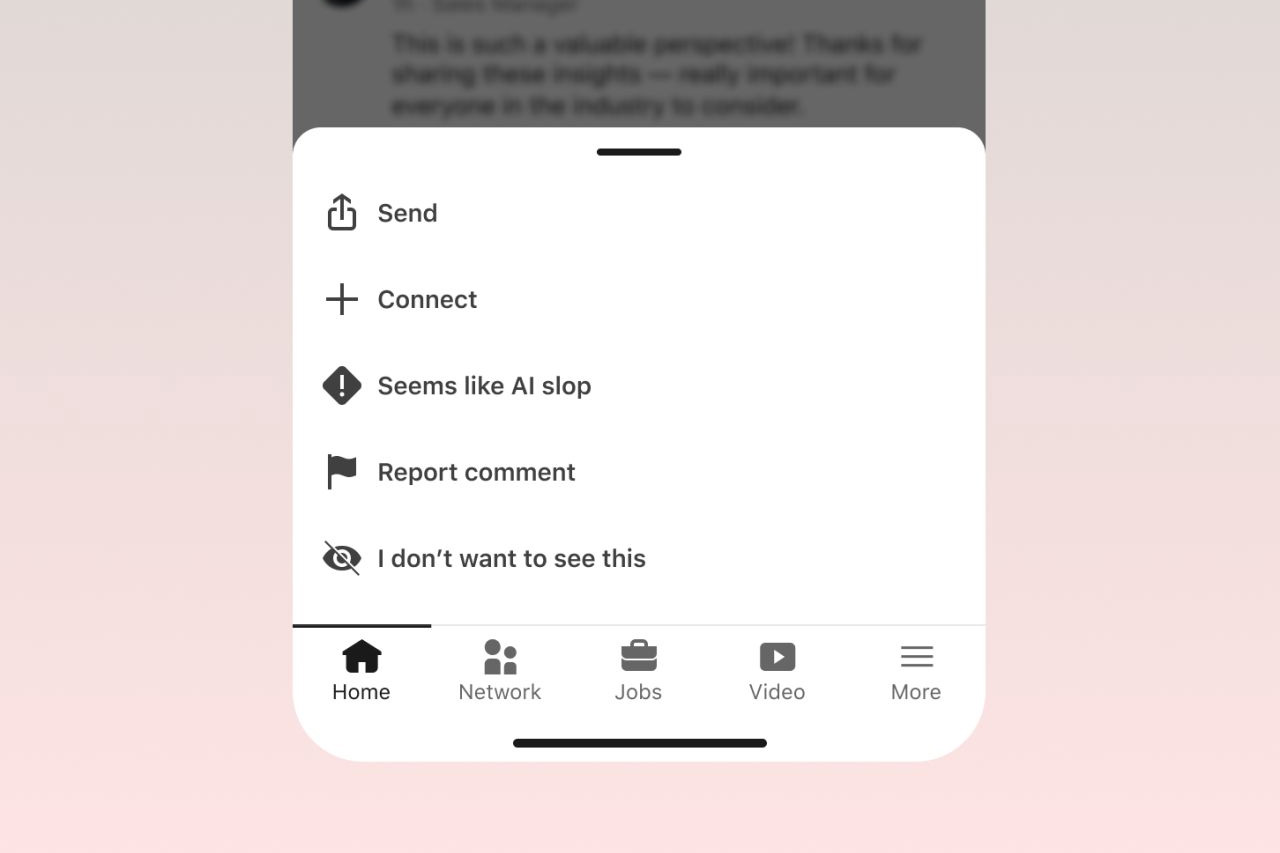
People have already clicked LinkedIn’s “seems like AI slop” button over 1 million times

Key Points
- LinkedIn's button to flag content as AI slop has gone down well with users, being pressed more than 1 million times in a few weeks.
- The button, alongside more automated measures to crack down on AI content, has helped reduce the amount of AI slop appearing on most feeds.
- LinkedIn has joined a growing number of platforms in pushing back on the flood of LLM-generated content online, providing ways for people to curate their feed as a defence against the proliferation of AI posts.
- AI detection service Pangram found that LinkedIn was among the platforms most riddled with AI content, together with X and Medium.
LinkedIn recently gave its users the ability to report AI slop on the platform, and the feature has already been used more than 1 million times.
Amidst a growing global backlash to the proliferation of completely AI-generated posts on social media, LinkedIn recently gave its users a “Seems like AI slop” button to flag content that seemed to be almost entirely generated by an LLM, not written by a human.
The button has proven wildly popular with LinkedIn users, who are presumably growing increasingly frustrated with the amount of obviously AI-generated content appearing on their social media feeds.
Since the button was made available, it has been pressed more than 1 million times, and the resulting feedback has helped the platform to curb the amount of AI-generated content users are seeing in their feeds.
The company’s Chief Product Officer, Hari Srinivasan said in a post this week that the platform would now also flag posts that users said seemed like AI slop to their creators, allowing them to adapt their content going forward.
“If a post receives enough community feedback, you may see a message in your Post Analytics to help you understand how your content is being received,” Srinivasan said.
“We approached this assuming good intent; I know I’m increasingly conscious on how to not sound like AI and the goal is to provide helpful feedback.”
Additionally, Srinivasan noted that since the AI slop button was introduced and countermeasures were hardened, users are now experiencing around 40% less views on AI slop content, although he said that everyone’s feed and network would differ.
When the company first began to clamp down on AI slop, it also expanded its automated filters to help automatically reduce the amount of low-quality AI-generated content on the platform.
It also removed its own ‘enhance your voice’ AI writing feature and replaced it with functionality that proof-read but did not adjust the poster’s tone.
As the AI industry continues to boom and more platforms and products are integrated with features powered by LLMs, the general public is growing measurably more frustrated with the ubiquity of AI and fatigued with encountering an endless tide of AI-generated posts on social media platforms.
A 2022 study from Europol’s Innovation Lab predicted that 90% of all content on the internet would be AI-generated by this year, and some have estimated that up to half of the content on platforms like LinkedIn is generated by an LLM.
Pangram, the AI detection platform, has found that longform, openly available content is more likely to be AI-generated, with platforms like X, Medium, and LinkedIn more likely to be flooded with AI slop than Reddit or Substack.