Satellite launches to shield UK from £9 billion solar threat

Key Points
- SMILE (Solar wind Magnetosphere Ionosphere Link Explorer) launched on a Vega-C rocket from French Guiana on Tuesday 19 May 2026
- Joint ESA and Chinese Academy of Sciences mission, with £15 million in UK Space Agency funding
- UK-built Soft X-ray Imager will deliver the first ever X-ray images of Earth's magnetic shield
- Mission aims to improve forecasting of solar storms that could cost the UK economy £9 billion, per Met Office 2022 risk assessment
- UCL Mullard Space Science Laboratory and University of Leicester lead the UK science contribution
A British-backed space mission has launched to forecast solar storms that could cost the UK economy £9 billion.
The Solar wind Magnetosphere Ionosphere Link Explorer, known as SMILE, lifted off on a Vega-C rocket from Europe’s Spaceport in French Guiana on Tuesday (19 May), with the UK Space Agency contributing £15 million to a joint mission between the European Space Agency and the Chinese Academy of Sciences.
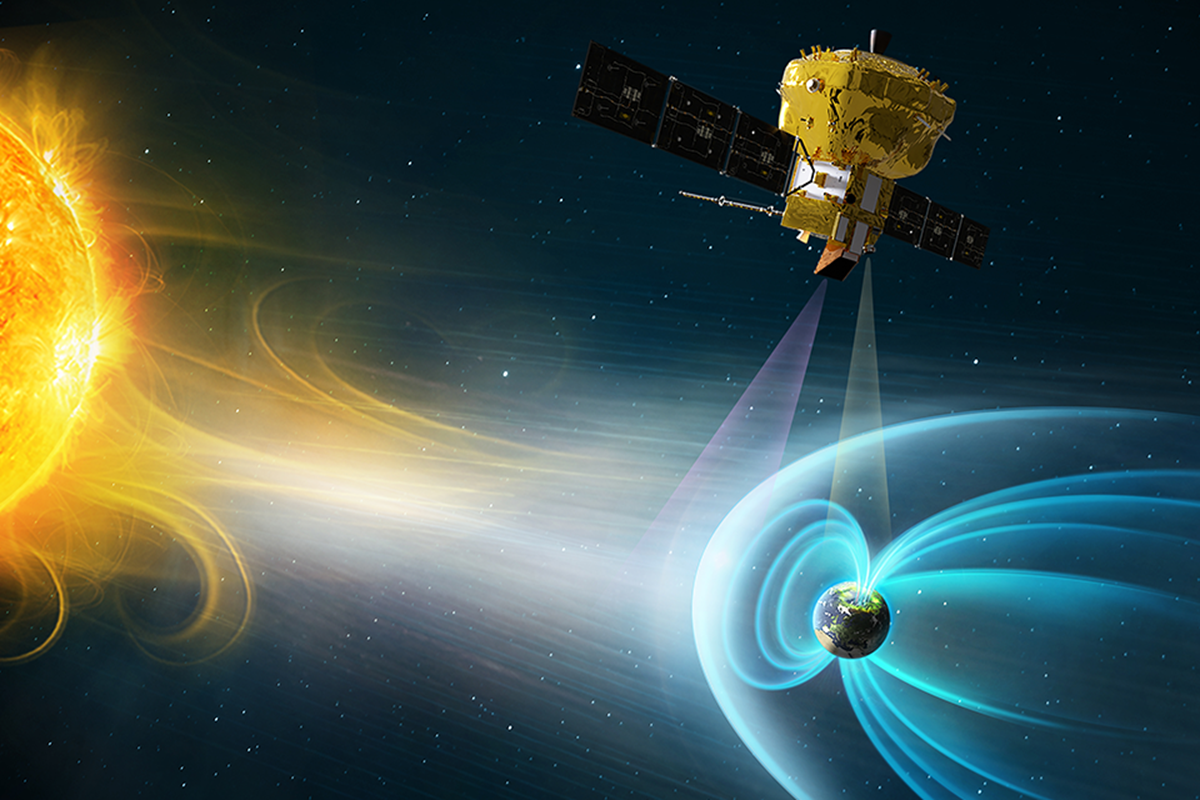
The spacecraft will give scientists their first complete picture of how Earth’s magnetic field reacts to the constant stream of charged particles flowing from the Sun.
When the solar wind intensifies into storms, the consequences can often be felt on earth. GPS systems fail, shortwave radio communications cut out, and in extreme cases, power grids buckle. The Met Office put the potential economic hit to the UK at around £9 billion in its 2022 risk assessment, ranking space weather alongside flooding and pandemics on the National Risk Register.
UK researchers run the SMILE science at the highest level. Colin Forsyth of University College London’s Mullard Space Science Laboratory serves as Co-Principal Investigator for the mission, while the University of Leicester leads the European consortium behind one of the four onboard instruments.
That instrument, the Soft X-ray Imager, makes SMILE the first space telescope to view Earth’s magnetic field in X-rays.
Built using lobster-eye micropore optics developed at Leicester, it will reveal precisely where and how the solar wind collides with the magnetic shield surrounding the planet. The imager is also the first instrument delivered out of the university’s Space Park Leicester facility.
“With SMILE, we will be able to see how our magnetic bubble changes its shape, whether it does this smoothly or in steps, and how it gets squeezed down as eruptions from the Sun pass Earth,” said Colin Forsyth, Co-Principal Investigator at Mullard Space Science Laboratory. “We have lots of models and theoretical frameworks but now we get to see what’s going on.”
Built British
British industry supplied critical hardware throughout the spacecraft. Teledyne e2v in Chelmsford produced the largest charge-coupled device detectors ever flown for X-ray detection, under an approximately £1.50 million contract with ESA.
The Open University’s Centre for Electronic Imaging worked alongside Teledyne to harden the detectors against space radiation.
Photek assembled the detector system for the Ultraviolet Imager, which will record the northern lights continuously for up to 45 hours at a time, a first in space science.
Axon’ Cable supplied the wiring carrying data between the four instruments at rates of up to 3 GB per second, while CGI in Bristol developed the embedded software that controls the payload and manages science data on board.
The instrument went through launch and space environment testing at the Science and Technology Facilities Council’s RAL Space.
“It has been an honour to lead the development of the Soft X-ray Imager and work with an incredibly talented and motivated team,” said Steven Sembay, Principal Investigator at the University of Leicester.
“Now we will soon move from the engineering challenges of delivering the hardware to the data analysis challenges of providing the scientific community with the data products that should be transformative in the study of the Sun-Earth interaction. Exciting times ahead!”
The mission feeds a wider UK push to protect the country against space weather, alongside the Met Office Space Weather Operations Centre, one of only a handful of 24/7 facilities of its kind globally, and a £300 million stake in Vigil, an ESA satellite mission aiming to deliver faster and more accurate solar storm warnings.
The UK SMILE team is already working with the Met Office to fold the satellite’s data into national forecasting.
SMILE will fire its engines 11 times over 25 days to reach its final orbit, reaching 121,000 km above the North Pole and dipping to 5,000 km above the South Pole.
ESA expects the first X-ray and ultraviolet images about three months after launch, with the mission designed to operate for three years.