Why your phone’s internet slows by 44% at 8pm in the UK


Key Points
- UK 4G users face 904ms loaded latency during evening peak hours (7pm to 9pm), compared to 507ms for 5G users on the same networks.
- The 44% latency advantage of 5G over 4G at evening peak is the largest recorded across 30 European markets in Ookla's Q1 2026 Speedtest Intelligence analysis.
- Evening peak congestion is a structural feature of shared mobile radio spectrum and affects every market studied, not just the UK.
- UK evening peak speeds improved 18% year-on-year in Q1 2026, partly linked to network integration following the Vodafone and Three merger.
- Consumers on 5G plans experience meaningfully better performance during peak hours, making network generation a practical consideration for everyday use between 7pm and 9pm.
New data from Ookla shows UK mobile networks hit their daily performance trough between 19h00 and 21h00, with 4G users experiencing loaded latency nearly double that of 5G users during the evening peak.
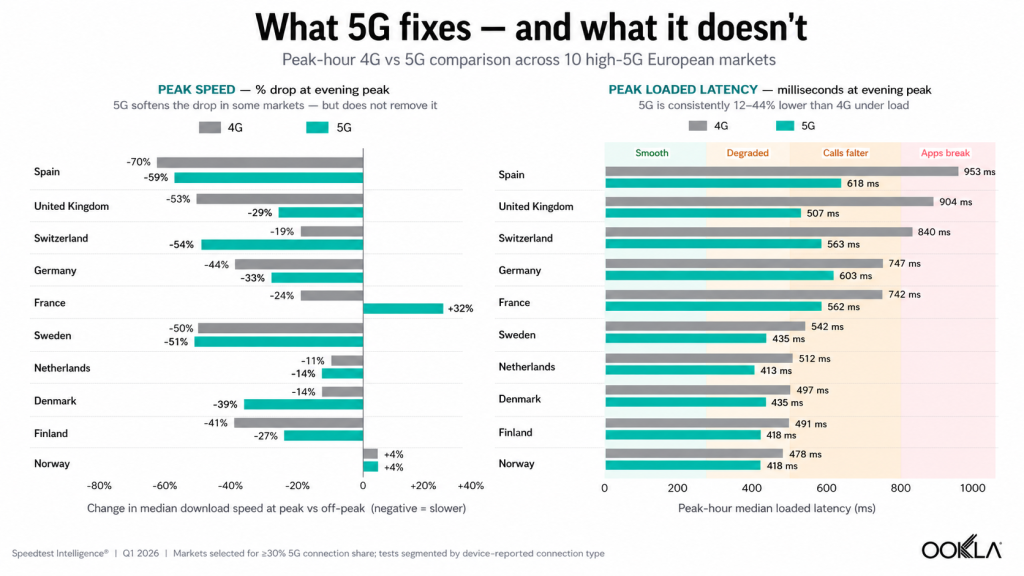
The data shows that UK 4G users face loaded latency of 904ms during evening peak hours, compared to 507ms for 5G users on the same networks.
Ookla’s analysis of Q1 2026 Speedtest data across 30 European markets identifies that 44% latency gap is the widest 5G advantage recorded anywhere in Europe.
That figure matters because loaded latency, not headline download speed, determines how video calls drop, how pages stall, and how apps respond when millions of people are simultaneously online.
Why 8pm is the crunch point
Mobile networks operate over shared radio spectrum, and every device connected to a cell sector draws from the same pool of resources.
When simultaneous demand pushes those resources to their limits, performance falls for everyone in that sector at the same time.
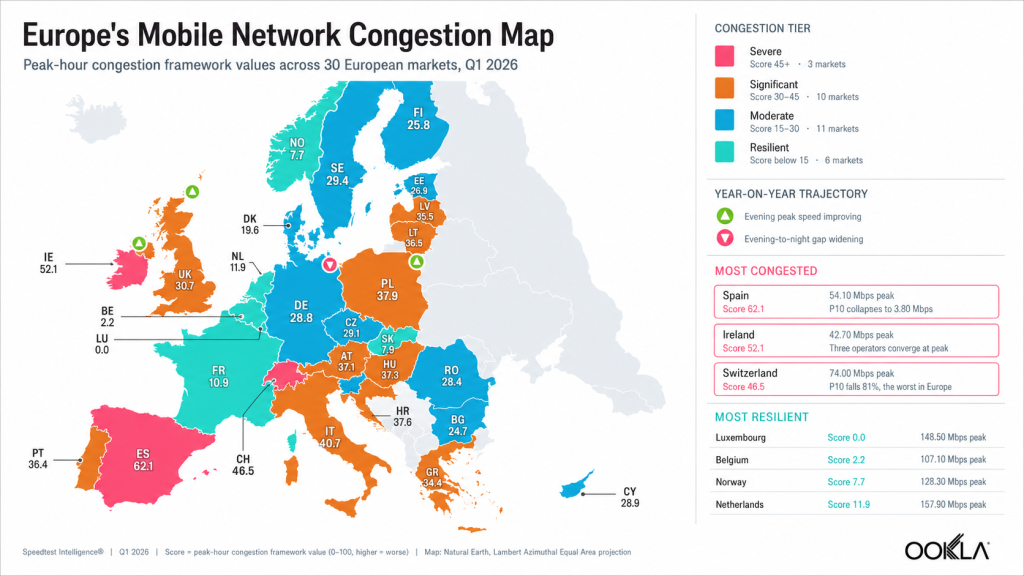
Ookla’s research identifies 19h00 to 21h00 local time as the consistent performance trough across all 30 markets studied, confirmed by examining full 24-hour performance profiles.
The study measures off-peak performance between 02h00 and 05h00 as a low-load baseline, and the gap between those two windows reveals how much capacity the network retains when demand is highest.
5G helps, but it does not solve the problem
Across the 10 European markets with significant 5G adoption, average download speeds still fall 27% at evening peak for 5G users, compared with 32% for 4G users.
The proportional drop is smaller, but it still happens. What 5G consistently delivers under congestion is lower latency: in every market Ookla tested, 5G loaded latency at evening peak is lower than 4G, ranging from a 12% improvement in Denmark to 44% in the UK.
For British consumers, a video call on a congested 4G connection at 904ms latency is close to unusable. At 507ms, 5G remains functional, if noticeably slower than normal.
The UK is improving, but the gap persists
UK evening peak speeds rose 18% year-on-year between Q1 2025 and Q1 2026, a trend Ookla links in part to early network integration following the Vodafone and Three merger, which completed on 31 May 2025.
Despite that improvement, the underlying congestion dynamic has not gone away.
The evening peak window still concentrates demand in a way that degrades the experience for all users, and the 4G to 5G latency gap at that peak remains the widest in Europe.
The takeaway from Ookla’s data is not that UK networks are failing. Evening peak congestion is a structural feature of shared mobile infrastructure, present to some degree across all 30 markets.
But the UK’s 44% 5G latency advantage at peak makes a stronger case for 5G than headline speed comparisons alone. For anyone who relies on their phone for video calls, gaming, or streaming between 19h00 and 21h00, the generation of network they are connected to makes a measurable difference.