

The escalating conflict in the Middle East, now involving direct US and Israeli military actions against Iran, has sent shockwaves through global energy markets – and it’s putting fresh pressure on the Bank of England’s plans for monetary policy easing.
In a new analysis published on Wednesday (4 March), the National Institute of Economic and Social Research (NIESR) warned that sustained disruptions to oil and gas supplies could drive UK inflation higher and force the central bank to raise interest rates by as much as 0.8 percentage points this year, pushing the base rate back above 4% from its current 3.75%.
The BoE has held rates at 3.75% since early 2026, with markets previously pricing in potential cuts as inflation cooled toward the 2% target. But the rapid intensification of the war – including Iranian threats to block the Strait of Hormuz and attacks impacting LNG production in Qatar – has upended that outlook.
Brent crude has surged about 15% since the weekend to around $84 per barrel, while UK natural gas prices have jumped 78% to 139p per therm.
NIESR’s modeling, based on its Winter 2026 forecast baseline and simulations using the NiGEM global macroeconomic model, outlines two key scenarios for how the energy price shock could play out.
Two possible scenarios
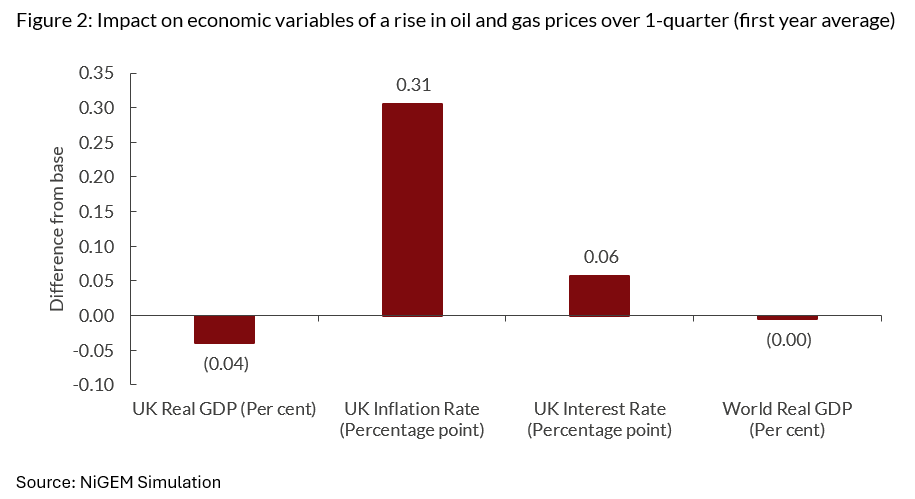
In the first, a transitory shock in which prices spike but normalise after one quarter – UK CPI inflation would rise by about 0.3 percentage points in 2026, with a negligible hit to GDP (a roughly 0.04% drag for the year).
If policymakers “look through” the temporary blip, rates would only edge up modestly (by around 0.06pp). But if they react more aggressively, the growth impact could double while inflation effects stay similar.
The more concerning case is the persistent shock lasting a full year, with oil prices averaging 30% higher (equivalent to Brent holding around $100 per barrel) and gas prices up 50%. Here, NIESR projects UK inflation climbing 0.7pp in 2026 (and 0.5pp in 2027) relative to baseline forecasts.
That would trigger a tighter monetary response, with interest rates rising approximately 0.8pp higher than otherwise in 2026 — enough to lift the base rate above 4% and potentially as high as 4.5% or more depending on the exact path.
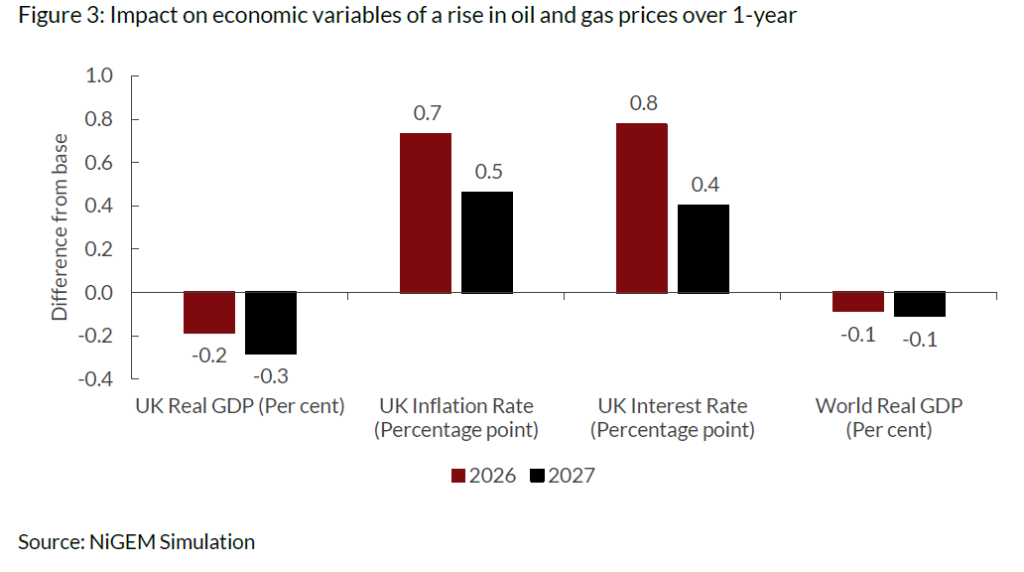
Such a move would dampen economic activity, shaving 0.2% off UK GDP in 2026 and 0.3% in 2027, as higher borrowing costs and supply-chain disruptions bite. Globally, world GDP could dip by about 0.1% due to the energy squeeze.
“The conflict in the Middle East will have material implications for the economic outlook,” said NIESR economist Ed Cornforth in comments accompanying the release.
The think tank noted that the duration of the disruption, tied directly to how long the war drags on, is the critical factor determining whether the BoE can continue its cautious easing path or must pivot to hikes to combat resurgent inflation.
The warnings come as markets have already shifted dramatically. Traders have slashed bets on a BoE rate cut at the 19 March meeting, with probabilities dropping sharply since the conflict escalated. Other analysts, including those from the Institute for Fiscal Studies and City firms like Rabobank, have echoed concerns that persistent higher energy costs could “feed through quickly” to inflation and derail expected reductions.
For Chancellor Rachel Reeves, the timing is particularly unwelcome, as the government navigates fiscal pressures and seeks to support growth amid an already sluggish economy.
Leave a Reply