Approval of Starmer’s response to cost of living hits its lowest level since 2022


Keir Starmer has dictated that the government’s message for all of this week will be on the cost of living, with prime ministerial visits across the country aiming to highlight recent policies the government has introduced to help.
But a new YouGov survey shows that the Prime Minister will have a lot of work to do to turn the tide of public opinion against him. The group’s long-running ‘top issues facing the country’ tracker finds the cost of living comes top, being picked by 54% of Britons as one of up to three main national priorities.
This represents a small increase since the last time this particular question variant was used in March 2025, with immigration following in second place on 49%, and health and the NHS in third on 43%.
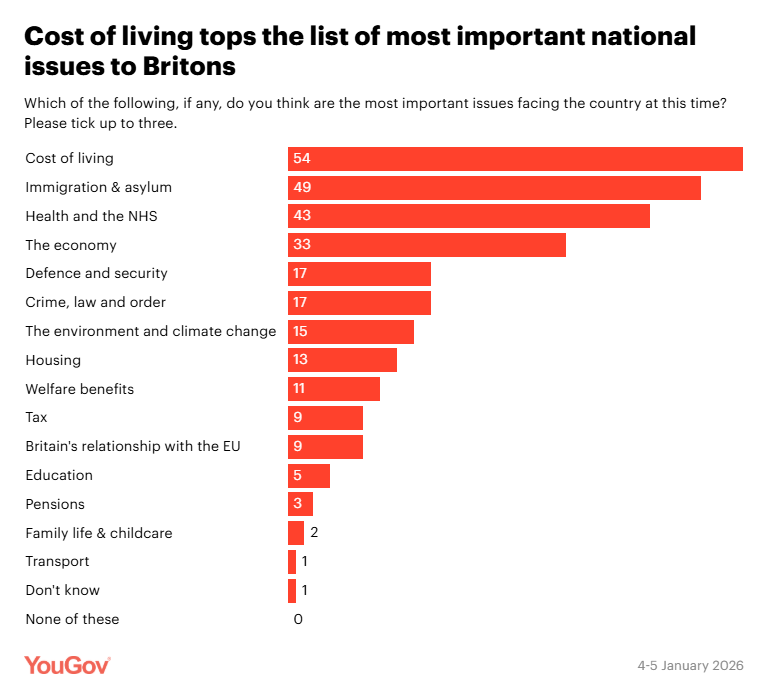
The cost of living is most common top issue given by 2024 Green, Labour and Lib Dem voters, while placing second for Reform UK voters and a close fourth among Tories.
In less positive news for Keir Starmer, a mere 8% of Britons say the government is handling the cost of living well, compared to 85% who say it is handling it badly. This represents the lowest net score (-77) since YouGov began tracking in late 2022.
When it comes to who is to blame for the cost of living crisis, the public are split. One in four (24%) Britons say the current Labour government are most responsible for the current state of the cost of living in the UK, while slightly more (29%) lay the blame primarily at the door of the previous Conservative governments since 2010. A further third (34%) say both are equally to blame.
And it is now the failure of government to act that Britons are most likely to see as a driver of rising costs.
In September 2022, YouGov asked the public what factors they believed were behind the rising cost of living. At that time the top answer was the war in Ukraine, then only a little over half a year old, at 74%. This has since fallen by 30pts to 44%, putting it close to the bottom of the list of factors we asked about, on an identical score to the coronavirus pandemic (itself down 12pts from 56%).
Instead, “government failure to take strong action” now tops the list, at 65% – a figure that has remained steadfast over the intervening period, having been 62% in 2022.
Approximately half of Britons (51%) blame Brexit for the cost of living (largely the same as the 54% in 2022), as well as companies profiteering (53%, down from 67%).
Reform seen as a change – but not for cost of living
With Reform UK continuing to lead in the voting intention polls, a morsel of good news for Keir Starmer is that Britons are more likely to think that a Labour government led by himself would be better for tackling the cost of living than a Reform UK government led by Nigel Farage, by 35% to 27%.
However, in less good news for the prime minister, he falls slightly behind on this measure when compared against Conservative alternative Kemi Badenoch, at 25% vs 29%.
More than four in ten Britons (44%) say they have struggled to pay for food in the past three months, with 37% saying the same of their energy bills.
Almost half of Britons (49%) say their household finances became worse in the last 12 months, while only 9% say they improved; 40% say they have remained about the same.
There is little optimism for 2026, however, with just 12% expecting an improvement in their financial situation this year. Fully 44% expect deterioration, while 37% think things will get neither better nor worse for them.