New polls show how Starmer lost the UK’s support in 2025


By the start of this year, attitudes towards the then freshly elected government had already turned negative, but things would only get worse for Prime Minister Keir Starmer.
Data from YouGov shows 2025 has not been any easier for the government, leading to a situation where Labour MPs are already talking about replacing Keir Starmer as prime minister. But just how much has political opinion shifted since January?
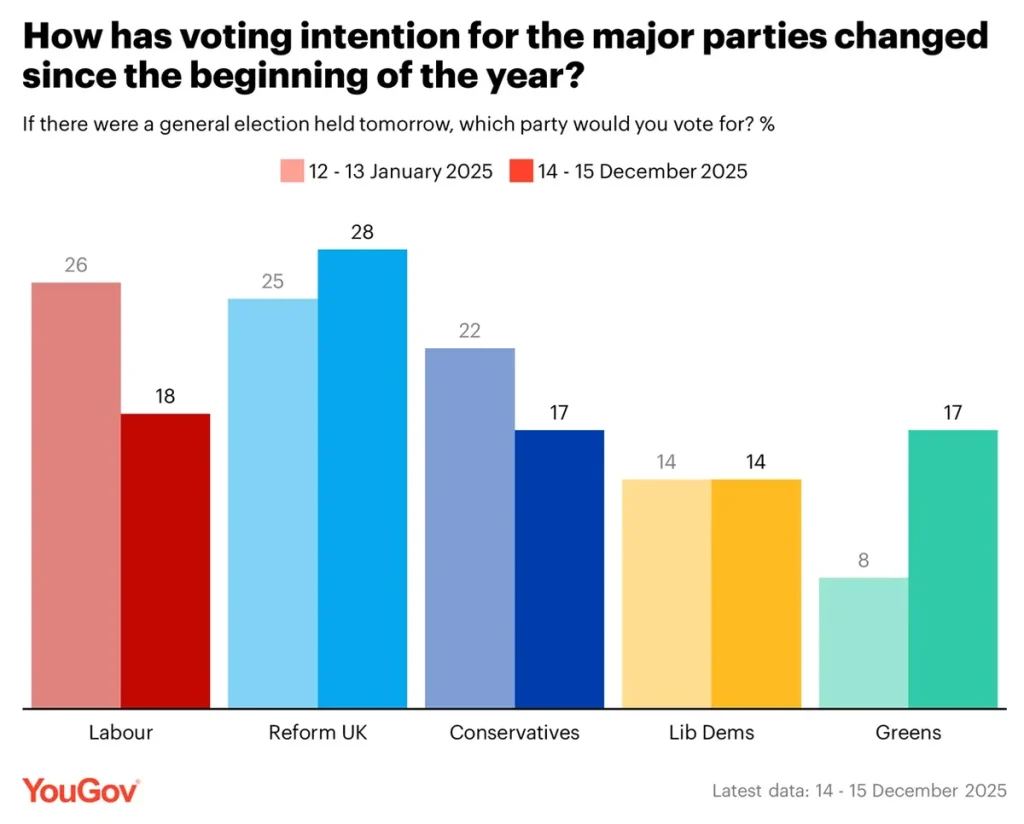
Since the group’s first voting intention poll in January, Labour has fallen a further eight points, to 18% in our latest results, having previously recorded its lowest ever figure (17%) with YouGov in October.
While polls at the start of the year pointed to a close race between parties, Reform UK has since opened a clear lead over other parties, currently standing at 10 points. This is without their vote share growing a huge amount, with Reform UK’s current 28% of the vote relative to 25% at the start of the year.
The biggest gainers over 2025 have instead been the Greens, who are on a record-equalling 17% share in our latest poll, roughly double the 8% they recorded in January.
Labour has not been alone in slipping in the polls, with the Conservatives falling five points from 22% in January to 17% today. On several occasions this year, they recorded shares of 16%, the lowest ever recorded by YouGov for the party.
The Lib Dems have consistently polled between 13-17% in voting intention over 2025, with their latest figure of 14% equal to that recorded in our first poll in January.
While approval in the government was hardly high at the start of 2025, it has fallen further over the course of the year. Today, just 12% of Britons approve of the government’s record to date, down four points since January, against 69% disapproving of its time in office, up six points.
This leaves the Labour government with a current net approval rating of -57, in a similar territory to the final -56 rating of the Conservative government before the last election.
At the start of the year, 2024 Labour voters were divided 36% to 40% on the government’s record. Now, the government has a clearly negative net approval rating among Labour voters of -30, with just 24% supportive of their government’s time in office, while a majority (54%) disapprove of its record in power.
Disapproval of the government has also risen significantly among Lib Dem and Green voters, to 65% and 76% respectively, while remaining largely static and higher among Conservative (89%) and Reform UK voters (93%).
What Brits care about
At the beginning of the year, there were three issues that Britons were most likely to see as one of the top issues facing the country: the economy, immigration and health.
These are still the top three today, by a clear margin, though the proportion of Britons seeing health as one of the important issues facing the country has fallen ten points from 45% to 35%. By contrast, the number seeing immigration as a top concern has risen six points to 51%, placing it on a more similar standing to the economy, which 54% of the public see as a top issue.
The importance of welfare benefits has also increased over the course of 2025, with 17% of the public now seeing it as one of the most pressing concerns in Britain, up seven points since the start of January. Belief housing or pensions are one of the biggest issues facing the country has each fallen five points over the year, to 16% and 5% respectively.
Disapproval of the government’s record is not consistent across policy areas. Of the 15 issues polled, it is highest on immigration, the economy and taxation, with eight in ten Britons (79-80%) believing the government is handling these issues badly. It is lowest on defence (47%) and terrorism (40%), the only two issues polled where less than half of Britons are critical of the government’s performance.
In all but one policy area we track, transport being the exception, this belief has increased since the start of the year, though this has not been even. The increase has been greatest on unemployment (up 13 points, to 67%), taxation (up 11, to 79%) and welfare benefits (up 10, to 72%), with eight-point increases when it comes to crime, the economy and immigration.