UK’s tax gap hits £46.8 billion


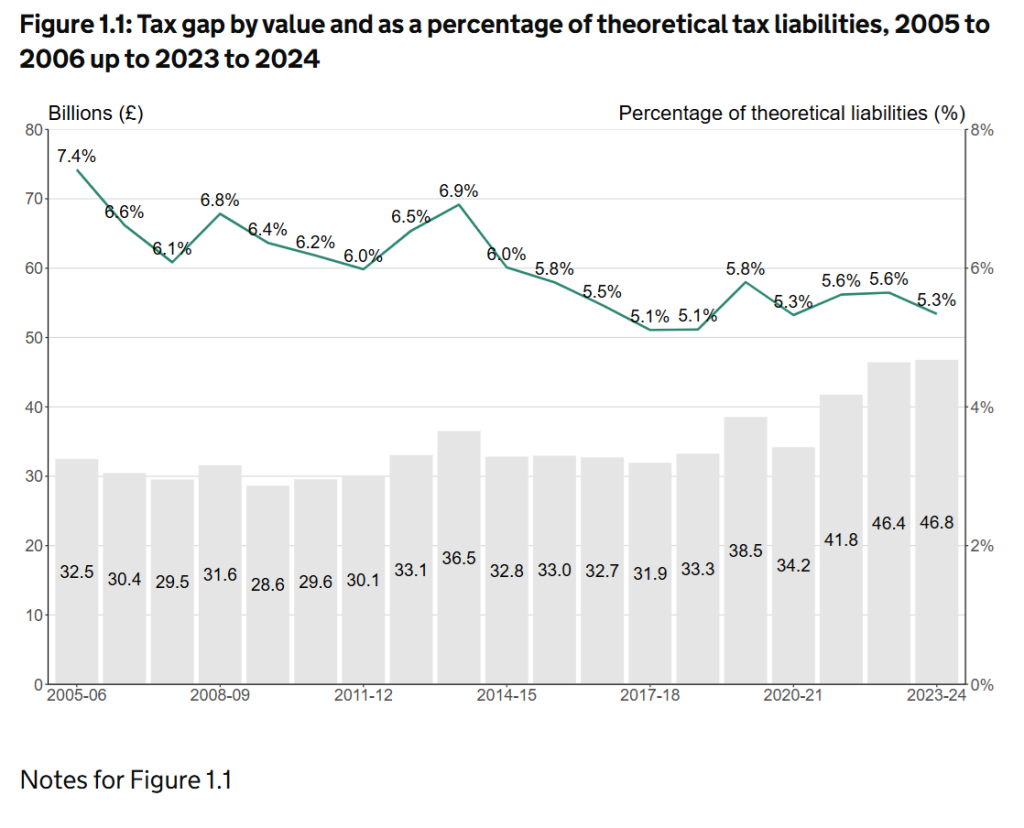
The tax gap estimate – the difference between what tax is expected to be paid and actually paid – was 5.3% for the 2023 to 2024 tax year, figures published on Thursday (19 June) show.
While £46.8 billion was unpaid in the 2023 to 2024 tax year, HM Revenue and Customs (HMRC) collected £829.2 billion, representing 94.7% of all tax due.
Every year, the HMRC estimates the tax gap using the most up-to-date information available, though figures may be revised as more data becomes available.
In line with standard practice, previous years’ tax gap estimates have been amended as part of today’s announcement, including the tax gap for the 2022 to 2023 tax year, which has been revised upwards from 4.8% (£39.8 billion) to 5.6% (£46.4 billion).
This is due to improvements in data quality, the availability of more up-to-date information and methodology changes.
Some of the key findings from this year’s calculations show:
- Small businesses represent the largest proportion of the tax gap (60%);
- Corporation Tax accounts for 40% of the total tax gap;
- Failure to take reasonable care (31%), error (15%) and evasion (14%) are among the main behavioural reasons for the overall tax gap.
“Every pound of tax uncollected puts a greater burden on honest taxpayers and deprives our public services of vital funding,” said Exchequer Secretary to the Treasury James Murray
“In our first year in office, we have set out plans to raise an extra £7.5 billion through the most ambitious ever package to close the tax gap. We are determined to go further and faster to make sure everyone pays their fair share, and help to deliver our Government’s Plan for Change.”
Accounting for the shortfall
The largest component of the tax gap by tax type is the Corporation Tax gap at a 40% share, followed by the Income tax, National Insurance contributions and Capital Gains Tax gap with a 31% share and the VAT gap with a 19% share of the overall tax gap
The tax gap from small businesses is the largest component of the tax gap by customer group, at a 60% share in 2023 to 2024; the tax gap from the wealthy makes up the lowest proportion of the tax gap at 5% in 2023 to 2024.
The tax gap estimate has fallen from 7.4% in 2005 to 2006 to 5.3% in 2023 to 2024. There were further peaks at 6.8% in 2008 to 2009 and at 6.9% in 2013 to 2014. The tax gap reached a low in 2017 to 2018 and 2018 to 2019 of 5.1%.