UK’s childcare entitlements far more popular and expensive than expected


At the 2023 Spring Budget, then-Chancellor Jeremy Hunt announced the largest-ever expansion of publicly funded childcare entitlements, offering new entitlements for working families with children aged two and younger.
By September 2025, families where all adults are in paid work will be entitled to the equivalent of 30 hours a week of term-time childcare for all children between nine months and the start of school.
However, the entitlements are proving to be much more expensive than originally forecast, says the Institute for Financial Studies.
Based on the costings in the 2023 Budget, the group had forecast that total spending on the free entitlement in 2026–27 would be almost 85% higher in real terms than in 2018–19, after the last big expansion (and more than four times as high as in 2009–10).
The share of that spending targeted at working families was also set to double, from 30% in 2018–19 to almost 60% in 2026–27.
“But spending so far has ended up much higher than those initial allocations – and, if take-up stays near its current levels, the additional spending needed will rise further next year,” it said.
“Spending from next year onwards could easily end up £1 billion higher than had been anticipated at the March 2023 Budget.”
A boost to funding announced in last week’s Spending Review will go some way to filling this gap, with about £640 million of additional funding. But that could still leave substantial pressure from higher-than-expected take-up, the group said.
More popular than expected
The take-up numbers reported in March 2025 were 26% higher than the initial estimate from December 2023, the IFS said.
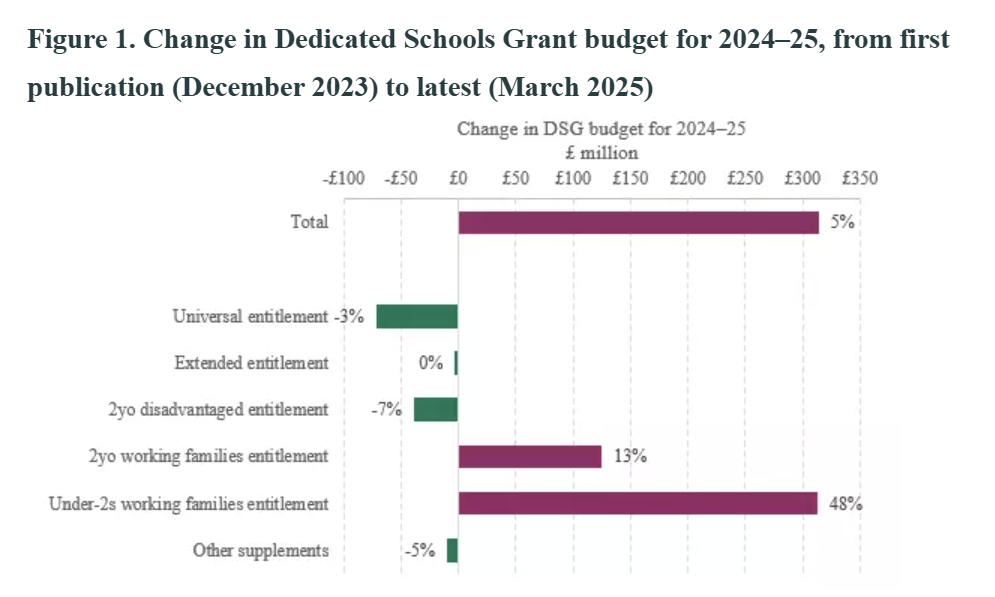
This meant that spending on the new entitlements last year was almost £440 million, 28% higher than had been budgeted for, driven mostly by an almost 50% increase in planned spending on the entitlements for under-2s.
Slight underspends in other areas meant that the total early years block came in £315 million (5%) higher than had been originally predicted.
Six local authorities – Leicestershire, Cambridgeshire, Dorset, Bath and North East Somerset, Westminster, and North Somerset – revised their expected take-up by more than 50%.
Within London, there is a different story at play. Of the nine local authorities where expected take-up fell between December 2023 and March 2025, seven are in London. London also has the lowest share of eligibility codes validated – 84% of families who had applied for and been issued a childcare code in Summer 2025 had successfully secured a childcare place, compared with a national average of 90%.
“While higher-than-expected take-up of the new entitlements across most of the country drives up the costs of the policy, it might also have a silver lining. If high take-up reflects more parents moving into paid work, that will be good news for the government’s growth mission.
“But it is still too early to tell how much of this higher take-up is driven by higher employment, and how much comes from parents who were already working choosing to use more (formal) childcare,” the IFS said.