What to expect from Rachel Reeves’s Spending Review this week


The 2025 spending review is a key moment for the Labour government and will reveal a lot about Keir Starmer’s priorities and Rachel Reeves’s spending choices.
This is the view of the Institute for Government (IfG), which has outlined six key issues Reeves will need to address when she delivers her Spending Review on Wednesday, 11 June. This includes:
- What has the government chosen to prioritise?
- Has the government allocated enough money to improve public services?
- Has the government laid out a coherent public service reform agenda?
- How will the government allocate larger capital budgets, and what will we learn about its longer-term plans?
- Is this a mission-driven spending review?
- What does this spending review mean for local government?
What has the government chosen to prioritise?
The government will have no choice but to prioritise where the money goes at this spending review, meaning some departments will be left disappointed.
Day-to-day spending is only set to increase by 1.2% per year in real terms, which implies a 1.3% cut on average for many areas after taking into account likely above-average settlements for health, childcare and defence, the IfG said.
It adds that investment spending will be much higher than in previous years but there will still not be enough public funding to meet the long list of departments’ demands – especially as the government’s ambitions to tackle NHS waiting lists, accelerate the decarbonisation of the grid, and support growth all require sufficient well-targeted public spending.
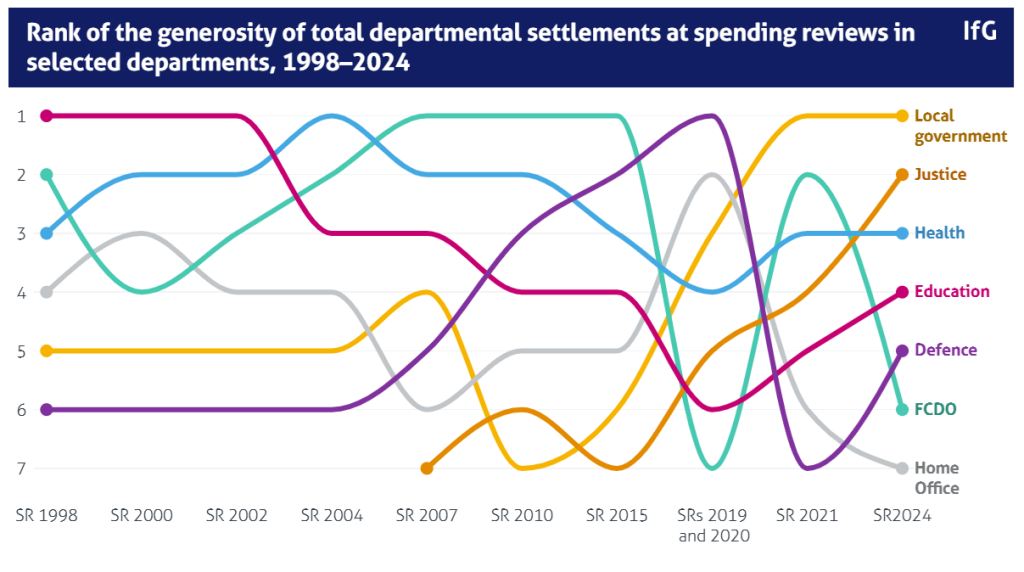
“Several departments have consistently fared better than average – in particular, health, aid and (under New Labour) education. Others – in particular local government, justice and defence – have often received below-average settlements. The government has already confirmed a generous settlement for defence alongside cuts to overseas aid.”
Has the government allocated enough money to improve public services?
Public service areas that the government has not yet made any firm commitment to protecting – and which therefore face real-terms budget cuts – include local government (which provides adult and children’s social care, housing services, and waste collection, among others), the police, criminal courts, and prisons.
None of those services is performing as well as they were before the pandemic. Cutting their budgets will likely result in even worse performance, said the IfG.
Improving productivity in services would make the government’s trade-offs easier, allowing the government to grow spending less quickly while still achieving improved performance, the group said.
Has the government laid out a coherent public service reform agenda?
The government has repeatedly argued that it will improve services through a reform programme. There have also been indications that it wants to move away from the approach – outsourcing, competition, league tables, among others – that governments have tended to use to drive service improvements over the last 40 years.
So far, however, there has been little detail about what a coherent, cross-service reform programme would look like. Instead, we have had a range of approaches across different departments.

How will the government allocate larger capital budgets, and what will we learn about its longer-term plans?
One of the big choices that Reeves made in her first budget was to increase significantly planned capital spending. In total, over the next three years (2026/27 to 2028/29), the previous government had been planning to spend £340 billion (in today’s prices) over that whole period. Reeves’s plan is instead to spend £415 billion, an additional £75 billion.
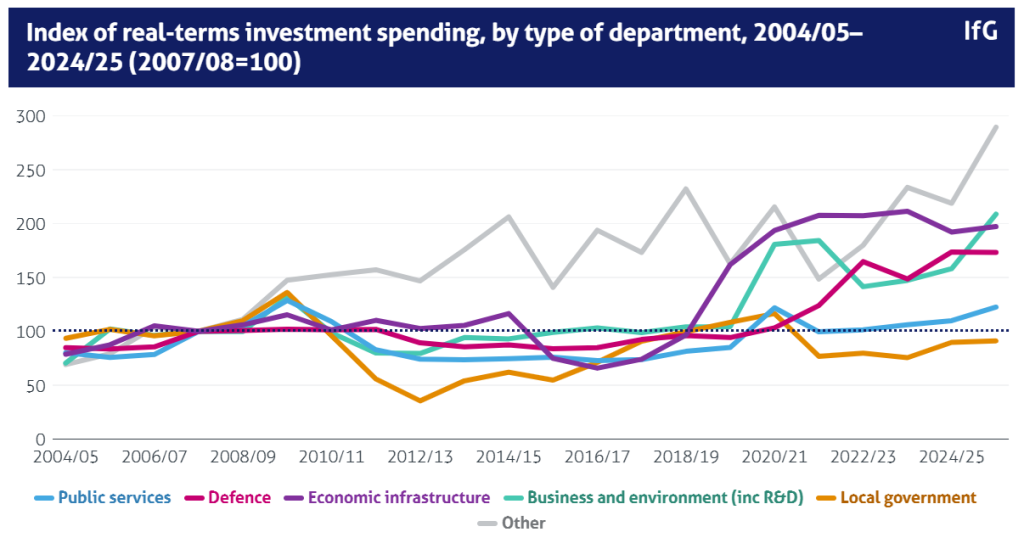
“This means that the average level of departmental capital spending over the next four years, which is the period for which the spending review will set out firm plans, is expected to be around 18% higher in real terms than in 2024/25. The spending review will confirm where this sizeable uplift is focused,” the IfG said.
Is this a mission-driven spending review?
In December, the chancellor set out the ambition of “totally rewiring how the government spends money” through a reformed spending review process.
The aim was to find savings and drive a focus on the government’s five missions. The announcements on 11 June will provide some important signs of whether the government is still serious about its missions, and whether it has taken a new approach to how it allocates spending.
“This spending review is the best opportunity of this parliament to make trade-offs within the fiscal constraints the government faces comprehensively,” the IfG said.
“The key test on 11 June will be whether the so-called ‘zero-based’ review has helped government take tough choices in identifying specific activity it will stop, and setting clear plans for exactly where and how it will make efficiency savings – or whether Reeves has followed a familiar pattern from her predecessors in making broad-brush unrealistic cuts, while postponing difficult decisions about where exactly they will fall.”
What does this spending review mean for local government?
Local authorities across the country have been grappling with significant financial pressures combined with rising demand in areas such as social care, special educational needs and disabilities, and homelessness services leaving many councils in a precarious financial position, the IfG said.
“The government could use the spending review to lay out a path for reform. It launched a consultation on local government finance reform at the end of last year,” it said.
“Since then, it has been very quiet about any further plans. Time is ticking in this parliament, and it would be better for the government to publish its response to that consultation and start the process of reform sooner rather than later. “