Watch: UK military turns a real Russian standoff into a board game

Key Points
- Dstl has turned the 2021 HMS Defender incident off Crimea into a boxed board game called Defending Defender
- The game teaches strategic communications, not combat, to two to eight players over 45 minutes
- JIAG trialled a prototype with around 1,500 users before the boxed version was developed
- It is rolling out across the MOD, 15 NATO nations and institutions in Australia
- No wargaming or communications experience is needed to pla
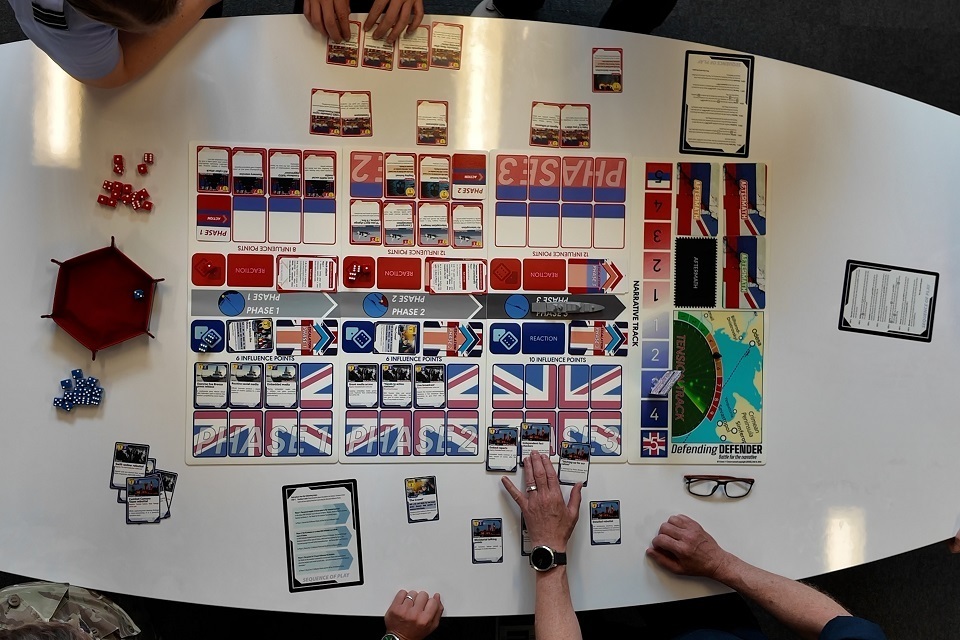
The Defence Science and Technology Laboratory (Dstl) has turned a 2021 confrontation between HMS Defender and Russian forces off Crimea into a boxed board game now rolling out across the Ministry of Defence, 15 NATO nations and institutions in Australia.
Dstl announced the game, called Defending Defender – Battle for the narrative, on Tuesday (8 September) and said it teaches players the principles of strategic communications rather than combat.
The game is based on the incident of June 2021, when the Royal Navy destroyer HMS Defender sailed through waters off Crimea that the UK regards as Ukrainian territory.
Russia claimed its forces fired warning shots and dropped bombs in the ship’s path, while the UK said no shots were fired at the vessel and that Russian aircraft flew low over it.
Dstl co-designed the game with the Joint Information Activities Group (JIAG), part of the MOD’s Defence Academy, which trialled an early prototype with around 1,500 users on its training courses.
The lab said the success of that trial led to a boxed version that can be played without a facilitator so it can reach a far wider audience.
Between two and eight players take the roles of the UK and Russia, with different challenges for each side, across three phases lasting around 45 minutes in total.
Dstl said the pace forces players to make decisions under time pressure, shows that real-world actors play by different rules, and demonstrates the risk of unintended consequences.
Players need no prior experience of wargaming or strategic communications.
“Influence in conflict can be as important as physical force, so by developing impactful, value-for-money wargames that factor in influence effects, such as strategic communications, we will help our warfighters to achieve mission success,” said Colin, Dstl’s Chief Wargamer and Head of the Defence Wargaming Centre.
Dstl said it employs the largest number of professional wargamers in the MOD and has used wargaming to prepare thousands of armed forces personnel for operational decisions.
“It can be challenging for students to grasp the principles of effective strategic communications with just a lecture in the classroom,” said Lieutenant Colonel Faye Johnson, commanding officer of JIAG.
“It gets across the principles of strategic communications in a simple but memorable fashion which makes it a powerful tool in the classroom,” she added.
Captain Vince Owen, who commanded HMS Defender during the 2021 incident, said the episode showed that modern competition plays out at the tactical, operational and strategic levels at the same time.
“The Defending Defender wargame provides a unique opportunity to explore how military actions, communications and decision-making combine to influence outcomes in an era where owning the narrative can be as important as events themselves,” Owen said.
Over the past 12 months, Dstl said its wargamers have delivered exercises for UK forces and allies covering crisis and operations support, national security, future force structure testing for the Defence Investment Plan, counter-drone systems, developing uncrewed systems, coalition maritime capability, integrating new technologies and deterrence analysis.