New rules lead to fewer rent hikes for tenants in England


Key Points
- Following the implementation of the Renters' Rights Act, tenants in England have already seen fewer rent increases than previous years.
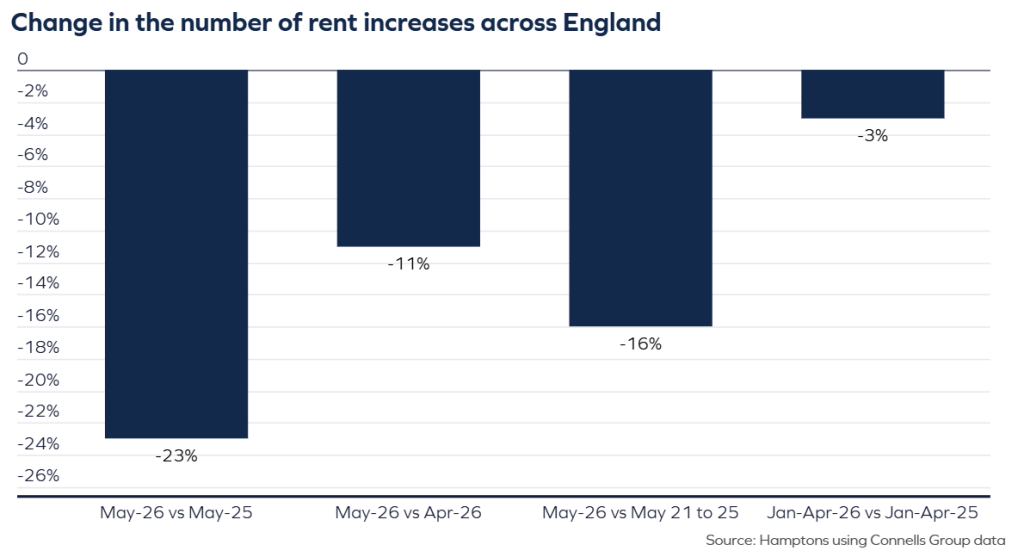
- The number of rent increases fell by 23% in May 2026 compared to the year before, and by 16% compared to the five-year average.
- Rental price growth is slowing in general, but this data suggests a material impact on landlord behaviour as a result of the new rental regulations.
- The price of new lets in Great Britain has remained relatively stable, with the average rent paid by a new tenant now sitting at £1,382 per month
Following the Renters’ Rights Act coming into effect from 1 May 2026, tenants in England have already seen fewer rent increases than previous years.
This is according to an analysis by property firm Hamptons, which found that in May this year, there were 23% fewer tenants who saw their rent increase compared with May 2025. The figure for May 2026 was also 16% lower than the average number of increases in May across each of the last five years.
The Renters’ Rights Act was introduced by the Labour government to provide tenants with better protection against rogue landlords and unfair rent increases, as well as to provide more stability to renters by scrapping no-fault evictions.
Under the new renting rules, all residential tenancies have become rolling, assured tenancies without fixed terms, with renters able to give two months’ notice to leave at any time, and landlords unable to evict without sufficient cause, such as selling the property or taking residency themselves.
Hamptons noted that while growth in rental prices is slowing in general, this significant decline in May 2026 suggests that as a result of the Renters’ Rights Act, landlords have become less likely to increase rents.
Under the previous system, tenants would usually be subject to rent increases when they signed a contract at the end of their fixed-term tenancy. However, now that fixed-term tenancies are abolished, landlords have less opportunity to hike rents, as they are only able to do so once per year.
More than just a cooling market
If this trend holds true for the rest of the year, Hamptons estimates that only 31% of tenants would see their rent rise when landlords are able to do so. Last year, 40% of tenants could expect to see a hike in their rent.
“This change reflects more than just a cooling market,” said Hamptons lead analyst David Fell.
“It points to a structural shift in how rents are adjusted. Under the previous system, rents were often reviewed when a tenancy renewed, allowing for more frequent, incremental increases.”
“Under the new rules, landlords look more likely to space out increases over longer periods,” he said.
Analysis by Hamptons suggests that England’s rental market may follow the path of Scotland’s, where periodic tenancies have been in place since 2017. There, tenants have seen fewer adjustments to their rent, but those adjustments have been higher on average.
It is important to note, however, that landlords aiming to increase rents disproportionately could face a challenge from tenants through the new Private Rented Sector Landlord Ombudsman. which will aim to provide quick, fair, impartial and binding resolutions for tenants’ complaints about their landlord.
The data also shows that the average price of newly agreed lets in Great Britain have remained relatively constant, growing year-on-year by 1.1%.
Currently, the average rent paid by a tenant moving into a property in Great Britain is £1,382 per month. In London, the average rent currently stands at £2,294 per month.