Burnham can nationalise almost everything – but Brits want one sector to stay private


Key Points
- Britons back public ownership of water (82%), energy (70%) and rail (76%), but not telecoms.
- Only 38% want broadband and phone providers nationalised, against 47% who would keep them private.
- The dividing line is leverage: you can leave your broadband provider, you cannot leave your water company.
- Telecoms is among the most resented sectors on price, yet the one the public trusts to the market.
- A National Audit Office report this summer will examine water, energy and broadband regulation together.
Andy Burnham, the Mayor of Greater Manchester, has spent recent weeks making the case that water and energy should be taken back into public hands, an idea he says would sit at the heart of his programme for government were he ever to replace Keir Starmer in Downing Street.
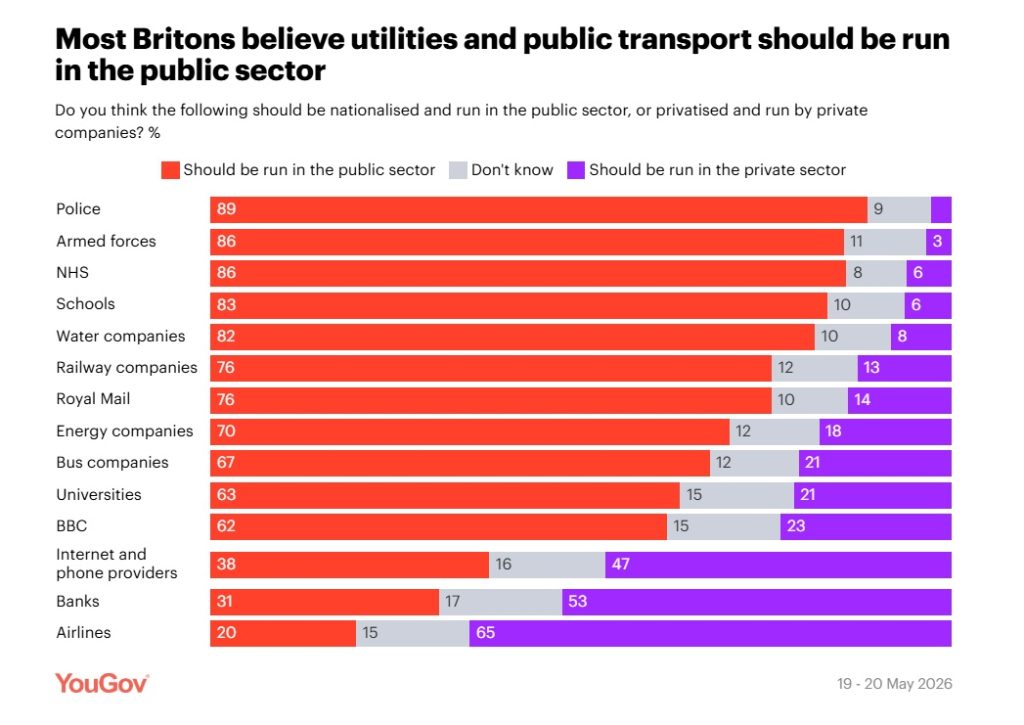
On the evidence of the latest YouGov polling, the public is already there waiting for him. More than eight in ten Britons believe water companies should be run in the public sector, and 70% say the same of energy, figures that put two private industries on roughly the same footing as the NHS and the police in the public mind.
There is one striking exception – Brits do not want their broadband and mobile networks nationalised.
Only 38% backed public ownership of internet and phone providers, while 47% said the sector should stay in private hands, the sole consumer service in the survey where the public actively prefers the market to the state.
Rail, which 76% want renationalised, does not divide opinion like this. Nor does the Royal Mail, nor buses. Telecoms stands alone.
What makes the result genuinely interesting is that it cannot be explained by contentment. This is not necessarily a sector people feel warmly towards. It is the one whose pricing practices have drawn open intervention from the regulator, repeated warnings from consumer campaigners, and most recently a government instruction to take another look.
So why, at the precise moment public anger at privatised monopolies is cresting, does the public draw the line at the router?
The thing you can walk away from
The honest answer is competition, or more precisely, the ability to leave. You cannot choose your water company. The pipe into your home is fed by a regional monopoly, and no amount of dissatisfaction changes the supplier. E
nergy offers the appearance of choice but a single wholesale market and a price cap that moves everyone together.
Telecoms is different in the one respect that matters to a frustrated customer: when the price rises, you can switch.
The presence of VodafoneThree, Sky, EE, BT and a long tail of challenger providers means the discipline the public wants nationalisation to impose already exists, however imperfectly, in the form of a rival willing to undercut.
People reach for public ownership when they feel trapped. Water and energy trap them. Broadband, for all its faults, does not. The complaint about telecoms is rarely that the market does not exist. It is that the market does not always behave.
The sector nobody trusts but everyone keeps
From 17 January 2025, Ofcom banned providers from writing inflation-linked, percentage-based price rises into new contracts, requiring instead that any increase be set out upfront in pounds and pence, a rule introduced precisely because around six in ten broadband and mobile customers had been signed onto contracts subject to inflation-plus-3.9% rises they could not predict or budget for.
This was the regulator stepping in to stop a pricing model the industry had adopted almost in unison. And the fight did not end there.
Last autumn O2 introduced a flat-fee mid-contract increase that, because it was not linked to inflation, slipped through the letter of the new rules while plainly testing their spirit.
Ofcom said it was disappointed, the government ordered a review, and Martin Lewis, the MoneySavingExpert founder, warned the move could add hundreds of pounds to household bills if rivals copied it.
This is a sector under active suspicion, scrutinised by the regulator and the Treasury at once. It is also, according to YouGov, the one the public would least like the state to run.
Westminster is treating all three as one problem
The National Audit Office is due to publish a report this summer examining the regulation of water, energy and broadband together, on the premise that all three are essential services where consumers need protecting.
Westminster, in other words, is increasingly inclined to file broadband alongside the very utilities the public wants nationalised. The public is doing the opposite, pulling broadband out of that category and leaving it on the private side of the ledger.
y. The political class is moving towards treating connectivity as a public good on a par with water. The electorate, asked directly, declines to follow. For a Labour leadership contender building a platform on public ownership, it is a useful signal about where the appetite stops.
Nationalise the water and the energy and the trains, the public seems to be saying, and we will cheer.
Come for the broadband, and you will find we are oddly attached to the one utility we are allowed to leave.