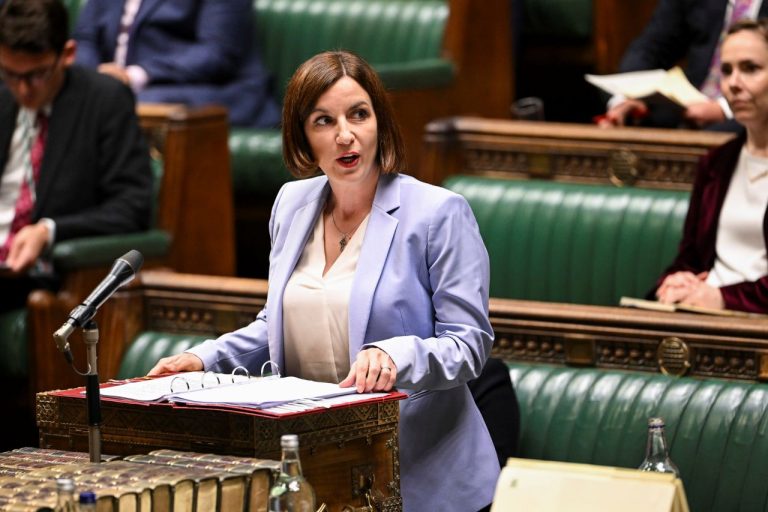
The government says it’s ‘monitoring the situation’ on UK jobs being lost to AI


Key Points
- The government said it is monitoring AI's impact on UK jobs and investing in retraining, in response to a written question from Labour MP Catherine West.
- Minister Kate Dearden said DBT is working with DSIT and the AI Economics Institute on jobs and skills, but set out no new employment protections.
- The AI Economics Institute, announced by Chancellor Rachel Reeves in March 2026 with a £500 million fund, is tasked with monitoring AI's effect on productivity and jobs.
- Accenture research found around half of UK executives now expect net job losses from AI, with entry-level roles most exposed.
- ONS data shows 32% of UK workers fear AI could cost them their job, with entry-level job postings down nearly a third since late 2022.
The government says it is monitoring the impact of AI on UK jobs and investing in retraining, after an MP asked whether employment protections are adequate for a future in which the technology replaces some roles.
Catherine West, Labour MP for Hornsey and Friern Barnet, used a written parliamentary question tabled on Tuesday (19 May) to ask the Secretary of State for Business and Trade what steps were being taken to ensure employment protections are adequate as AI develops the potential to replace some job roles.
Answering for the Department for Business and Trade on Thursday (28 May), Kate Dearden, Labour MP for Halifax, said the department is working with the Department for Science, Innovation and Technology and the AI Economics Institute to monitor the impact on jobs and skills.
The answer pointed to investment in training and lifelong learning to help people adapt to future jobs, and it set out no new employment protections.
Chancellor Rachel Reeves announced the AI Economics Institute at the Mais Lecture in March 2026, alongside a £500 million fund, as part of an ambition for the UK to have the fastest AI adoption in the G7.
Reeves said the institute would focus on monitoring the technology’s impact on the country’s productivity and job markets.
The written answer confirms it is now working alongside the two departments on jobs and skills, giving the body a clearer operational role than when it was first set out.
Concern rising across the UK workforce
The exchange comes as business surveys point to mounting concern over AI and employment.
Half of UK employers say making staff redundant because of AI would be a straightforward or positive step for their organisation.
The finding comes from a new tracker by the Policy Institute at King’s College London, with fieldwork conducted by Opinium between 20 and 29 April 2026.
The research surveyed 506 senior decision-makers at UK businesses with 11 or more employees, sampled to ensure broad representation across business size, sector and region.
The same survey found that half of UK parents with children under 30 are worried about how AI will affect their child’s future career.
50% said they were fairly or very worried about how AI might affect their child’s future career, against just 15% who said they felt excited and 29% who felt neither worried nor excited. One in five (20%) parents described themselves as very worried.
On the other side of the spectrum, demand for AI Engineer roles in the UK has jumped 81% in the past year, according to new figures from global talent firm Robert Half.
AI Product Manager listings rose 80% over the same period and Data Governance Manager postings climbed 79%, based on Robert Half’s analysis of more than 256,800 technology and IT job postings across the UK between January 2025 and March 2026.
Machine Learning Engineer roles grew at a more moderate 24% across the same window.
Demand for Digital Transformation Manager positions also rose 29%, pointing to fresh appetite for senior staff who can fold artificial intelligence into wider business operations rather than treat it as a standalone project.