For the third year running, Britain has just bossed the G7 in Q1


Key Points
- UK GDP grew 0.6% in Q1 2026, the fastest of any G7 economy
- Third consecutive year that Britain has topped the G7 in Q1 before fading later in the year
- Chancellor Rachel Reeves gets a rare headline win after the IMF cut her 2026 growth forecast to 0.8% in April
- Services led with 0.8% growth, motor vehicle manufacturing bounced 10.9% on a base effect from a 2025 cyber attack
- Iran war broke out 28 February 2026, meaning Q1 captures only one month of the conflict and Q2 looks far weaker
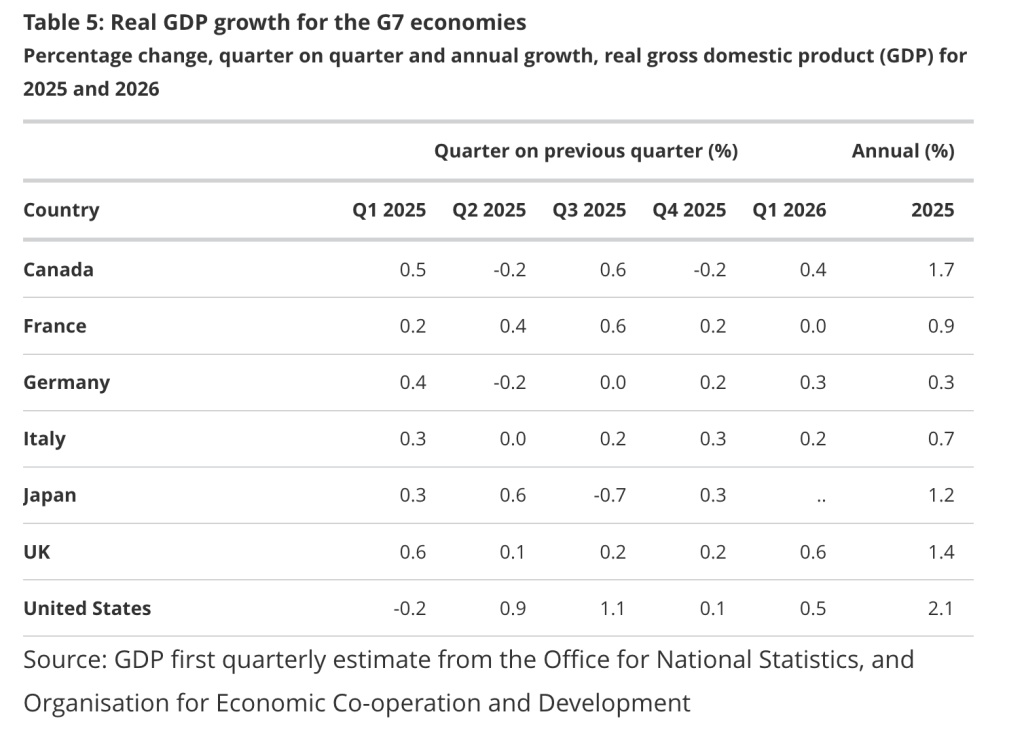
The Office for National Statistics this morning put UK growth in the first three months of 2026 at 0.6%, ahead of America’s 0.5%, Canada’s 0.4%, Germany’s 0.3%, and a France that managed exactly zero.
That US figure is the same 2% growth the BEA reported a fortnight ago, just stripped of the annualised conversion American statisticians use and put on the same quarter-on-quarter basis as everybody else.
On the like-for-like comparison, the OECD and ONS use to rank the G7, Britain wins.
Chancellor Rachel Reeves now has the only number she has been able to brag about since the IMF handed her the biggest growth downgrade in the G7 last month.
It is also, by now, a pattern. Q1 2024 came in at 0.9% on first estimate. Q1 2025 came in at 0.7%. Q1 2026 comes in at 0.6%. And every year, the wheels come off the moment Easter is over.
In 2025, Britain went from 0.6% in Q1 to a flat 0.1% in Q2, then 0.2%, then 0.2% as Westminster panicked about a Reeves Budget that had to plug a hole the size of a small country.
A mystery for statisticians
As a Bloomberg analysis noted last week, UK GDP growth between 2022 and 2025 averaged 0.5% in Q1, 0.3% in Q2, then collapsed to roughly nothing in the second half of the year. Every single year.
The Bank of England has privately flagged that the GDP data may be sending false signals.
The ONS itself has admitted seasonal adjustment issues and started publishing unadjusted figures alongside the main ones, which is what a statistician says when they mean the main figures might be wrong.
But the ONS is sticking to its line. Today’s bulletin runs a long defence of its methods, leaning on academics at the University of Southampton and the United States Bureau of Economic Analysis.
Its conclusion: there is no statistically significant residual seasonality in any of its aggregate outputs going back to 1995. The data, in other words, is fine. The pattern is in your head.
Where the growth actually came from
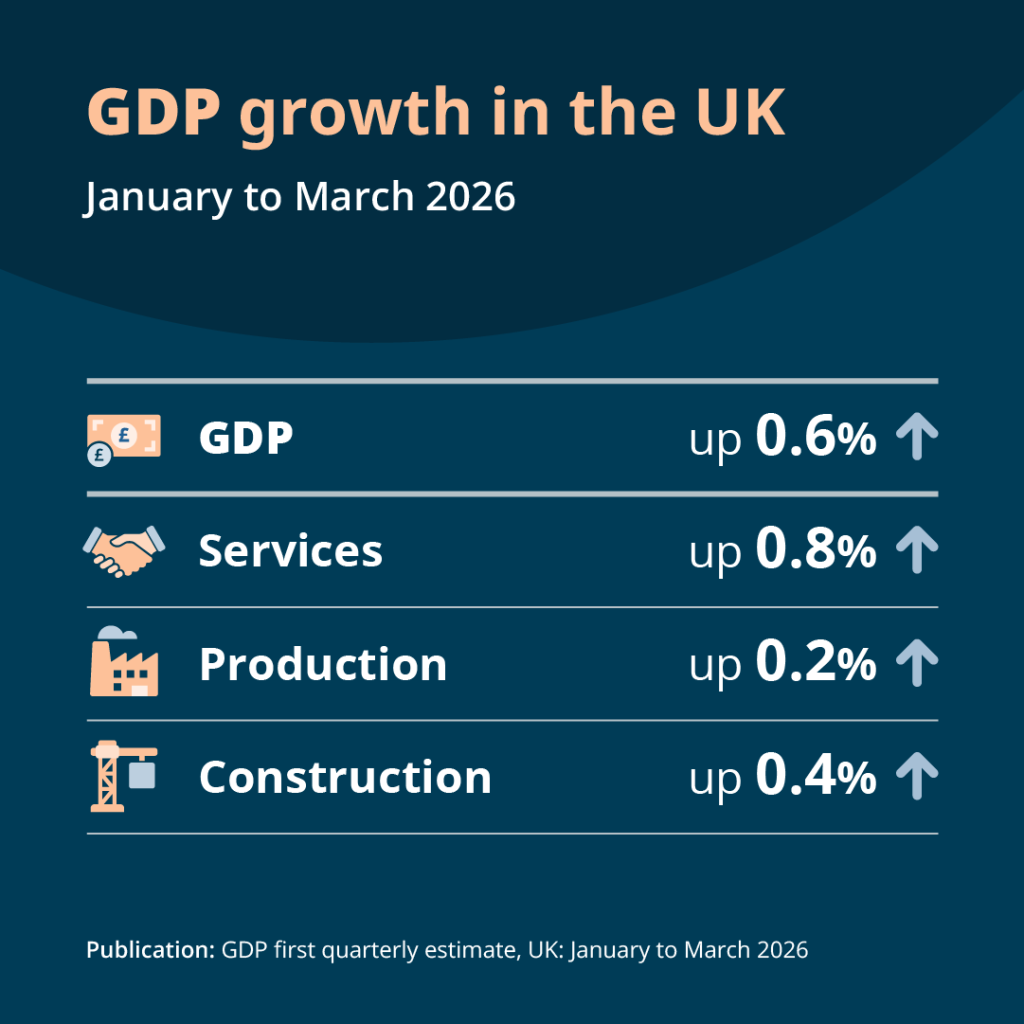
Services did the heavy lifting at 0.8%. Construction managed 0.4%. Production crept up 0.2%. Eleven of fourteen services subsectors grew.
Wholesale and retail jumped 2.0%. Motor vehicle manufacturing exploded 10.9%, a base effect because the sector was still recovering at the end of last year from a cyber attack that knocked out British car production in August 2025. So a chunk of Britain’s G7 win in Q1 is, technically, the fading shadow of a hack.
Household consumption rose 0.6%, government consumption 0.4%, and compensation of employees jumped 1.7%, which means wages and salaries up 1.3% and a stonking 3.2% rise in employers’ national insurance contributions, the very thing British business has spent eighteen months complaining about.
The cost of the Reeves Budget is now visibly inflating the GDP print.
Business investment told a different story. Up 0.7% in Q1, but still 1.8% lower than the same quarter a year ago. Gross fixed capital formation fell 0.6% overall. Not exactly a roaring vote of confidence in Britain.
The Iran war is the elephant
This is also data from before the world fell apart. The Iran war broke out on 28 February 2026. Q1 captures roughly one month of it. Brent crude is north of $110. Inflation hit 3.3% in March.
The Bank of England’s adverse scenario sees inflation peaking somewhere between 3.5% and 6.2%, with rates back up at 5.25% by 2027 in the worst case.
The April Monetary Policy Committee vote was 8 to 1 to hold rates at 3.75%, with the BoE’s chief economist the lone dissenter calling for a hike.
The IMF has already cut UK growth for the year to 0.8% from 1.3%, citing Britain’s heavier reliance on imported gas. The Treasury’s April survey of independent forecasters now puts UK 2026 growth at 0.6%, down from 0.9%.
So this is a 0.6% print in a year forecast to grow at 0.6% total. If the pattern holds, Britain has just done all its growing for the year in three months. The rest will be a slow grind into Reeves’s autumn Budget.
Reeves should take the win
She will not care about any of that today. The Chancellor went into this print needing a headline and she got one. Britain top of the G7. Wages up. Spending up. Services humming. The kind of number that quiets bond markets for a fortnight.
The party will end. It always does. Around July, you can expect the first revisions to start nibbling at the figure. Around October, the Q2 estimate will land with a thud.
By Christmas, the OBR will have updated its books and the conversation will have moved back to where the money is coming from.
For now, though, for the third year running, Britain has bossed the G7 in Q1. Enjoy it while it lasts.