Half of Brits think Reform UK is about to have a massive local elections night – here’s what the polls say


With just over two weeks until voters head to the polls on 7 May 2026, a new Ipsos survey reveals widespread expectations of a strong showing for Reform UK and the Green Party in England’s local elections, at the expense of the governing Labour Party and the Conservatives.
The poll, conducted online among a representative sample of 1,089 Great Britain adults aged 18-75 between 27 and 30 March 2026, asked respondents how they thought the main parties would fare in terms of councillor numbers after the elections.
These cover around 5,014 seats across 136 councils in England, including all seats in London boroughs, several metropolitan districts, county councils, and unitary authorities, plus six mayoral contests.
Public expectations point to a night of insurgent gains
- 50% of Britons expect Reform UK to end up with more councillors than it currently holds. The party starts from a low base — it held just 67 seats before recent gains and has been contesting many wards for the first time.
- 42% expect the Greens to gain more councillors (with only 13% anticipating losses).
- By comparison, 56% expect Labour to have fewer councillors, while 43% foresee losses for the Conservatives.
- Views on the Liberal Democrats were more mixed: 21% expect gains, 22% losses, and 27% roughly the same number.
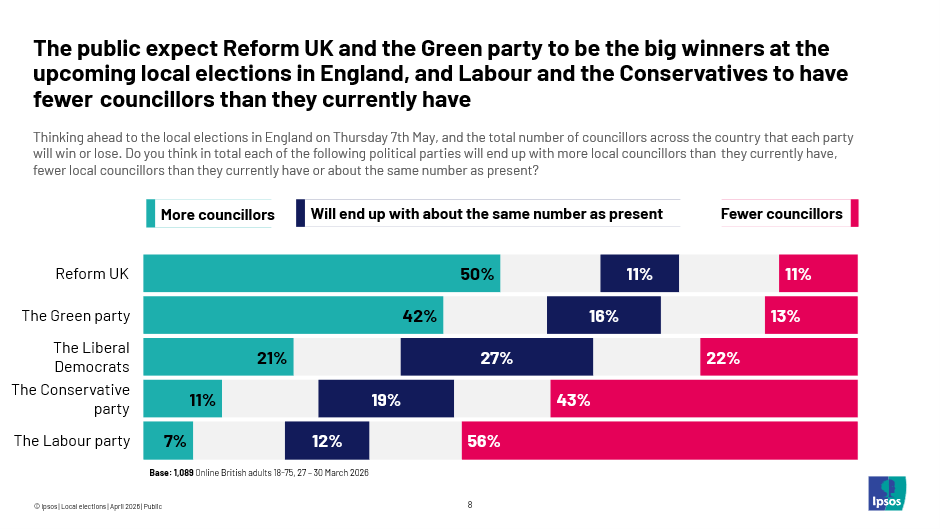
Ipsos Director of Politics Keiran Pedley said the findings align with “conventional wisdom” that the elections will prove difficult for the two main parties.
“A mix of local and national issues are at play but what is clear is a large number of voters are dissatisfied with the pace of change in Britain and many are looking to insurgent political parties for answers,” Pedley said.
“A significant increase in councillors will provide Reform UK and the Greens with a platform to target parliamentary seats in the future – but will also bring local scrutiny too if those councillors are unable to deliver.”
What the actual polls and projections suggest
Public expectations track closely with broader voting intention trends and expert projections for the 7 May contests.
Recent national polls show Reform UK leading or near the top with support in the mid-20s percent range, followed by a fragmented field where Labour and the Conservatives hover in the high teens, and the Greens have surged.
This marks a dramatic shift from the 2022 locals, when many of these seats were last contested and Labour performed strongly.
Seat projection models paint a picture of heavy losses for the major parties:
- Labour is defending seats won in more favourable conditions and could lose around 1,000–2,000 councillors, with particular pain in northern “Red Wall” areas where Reform is surging.
- The Conservatives are also projected to shed hundreds of seats.
- Reform UK is tipped for major gains, potentially over 1,000 net seats in some models, which could see it take control of councils in places like Essex, Norfolk, and Suffolk, and make inroads even in parts of outer London.
- The Greens are expected to add hundreds of seats, especially in urban and progressive areas.
Analysts describe this as potential “unprecedented territory” or a “great realignment,” with Reform benefiting from dissatisfaction on issues like the cost of living, immigration, and the economy, while the Greens capitalise on environmental and progressive concerns.
Voters care about both local delivery and national mood
The Ipsos poll also highlights what will drive votes. Top influences include:
- Party policies on national issues (38%)
- How well the local council has run things recently (34%)
- Specific local promises (33%)
Key concerns cited were the cost of living (54%), the NHS (45%), the UK economy (39%), and the condition of local streets, roads, and pavements (38%).
Perceptions of local public services remain lukewarm: 48% say they are in a good state (unchanged from a year ago), while 46% view them as poor. Slightly more (51%) see the local economy as poor rather than good.
Notably, the public lacks strong confidence that councillors from any of the main parties are best placed to deliver on core local priorities like listening to residents or improving services.