Surprise good news for UK jobs


The UK’s jobs market delivered a small surprise on Tuesday (21 April) as official figures showed payrolled employment largely stabilised in March 2026, bucking some expectations of continued weakness amid rising unemployment and economic headwinds.
Unemployment fell to 4.9% in the three months to February, despite predictions it would remain unchanged at 5.2%. The fall appears to reflect a slight rise in the number of people no longer looking for work, largely among students, who are not included in the unemployment figures.
ONS data shows that the number of payrolled employees stood at 30.3 million in March 2026. This marked a negligible month-on-month decrease of just 11,000 (0.0%) from February – a far smaller drop than some analysts had feared following recent downward revisions to prior months’ data.
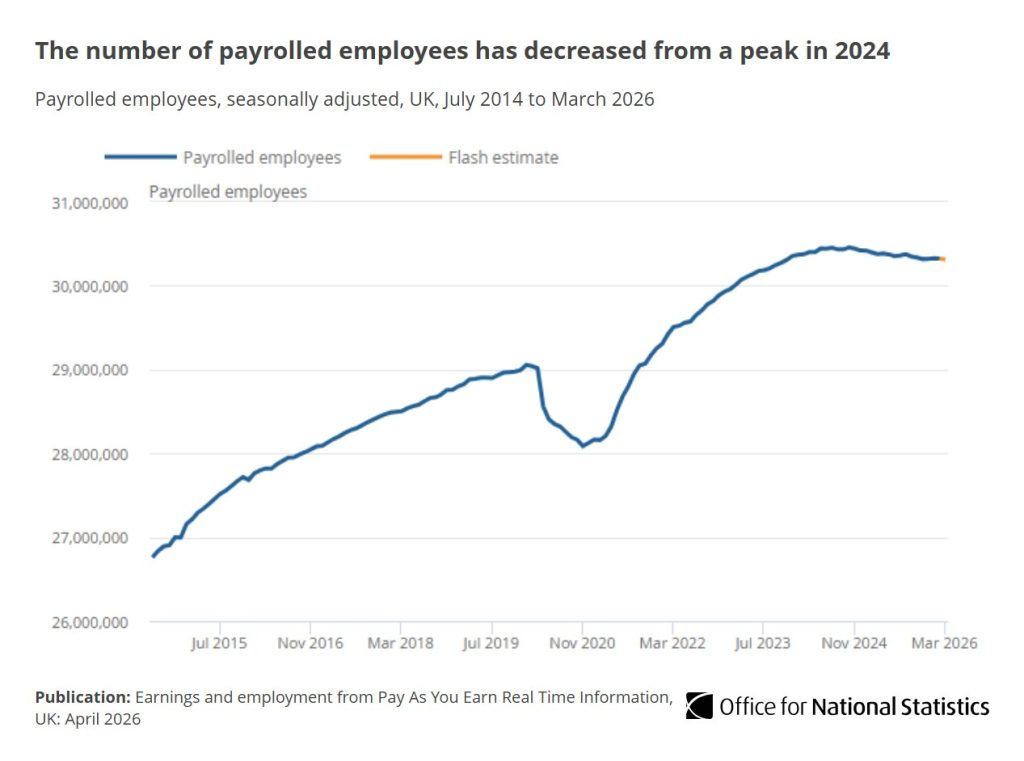
Year-on-year, the figure was down 0.2%, or 65,000 employees, compared with March 2025. While still representing the first sustained annual decline in payrolled employment since at least mid-2016, the pace of contraction appears to be slowing relative to earlier estimates in the series.
February’s previously reported gain of 20,000 was revised downward to a fall of 6,000 after incorporating additional real-time submissions, highlighting the provisional nature of early estimates.
Wage growth
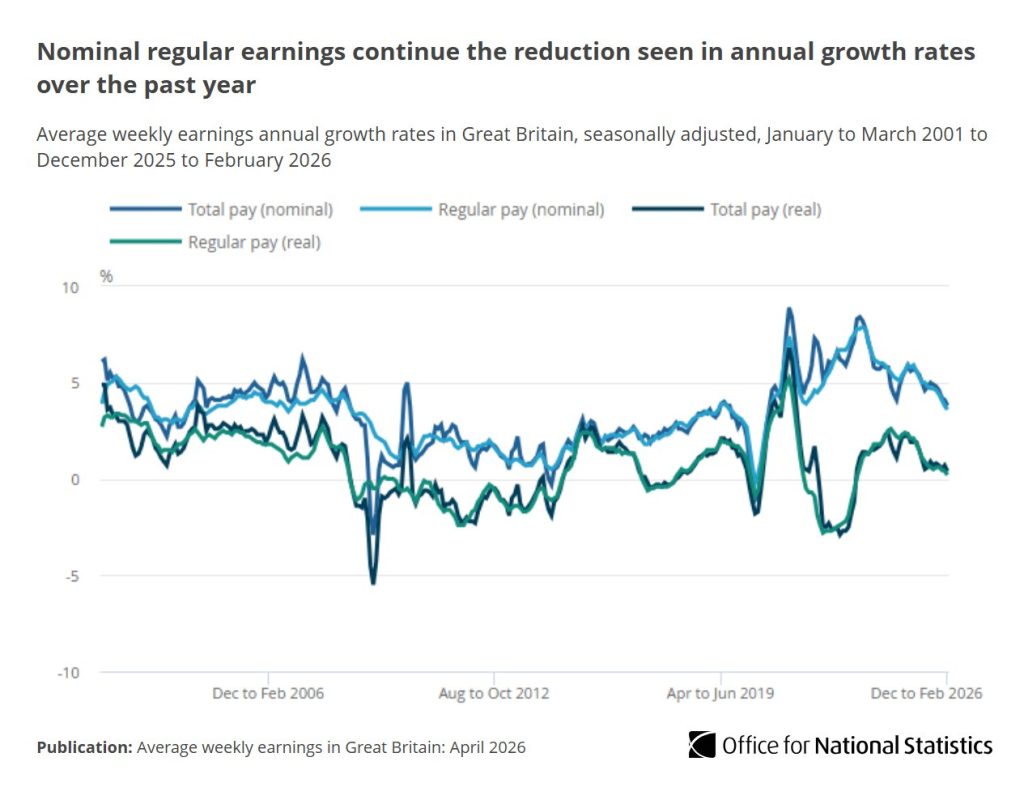
On the pay front, the data offered clearer good news. Median monthly pay rose to £2,599 in March 2026, up 4.3% on the year. While this represents a slowdown from the roughly 6% rates seen in 2024-2025, it remains relatively resilient given the cooling labour market.
There continues to be a bi difference between sectors. Public administration and defence saw the strongest annual pay growth at 7.5%, while professional, scientific, and technical activities recorded the weakest at 2.9%.
Employment shifts across sectors showed a mixed picture. Health and social work continued to add jobs (+41,000 year-on-year), acting as a key support, while wholesale and retail trade saw the largest decline (-57,000).
Longer term concerns
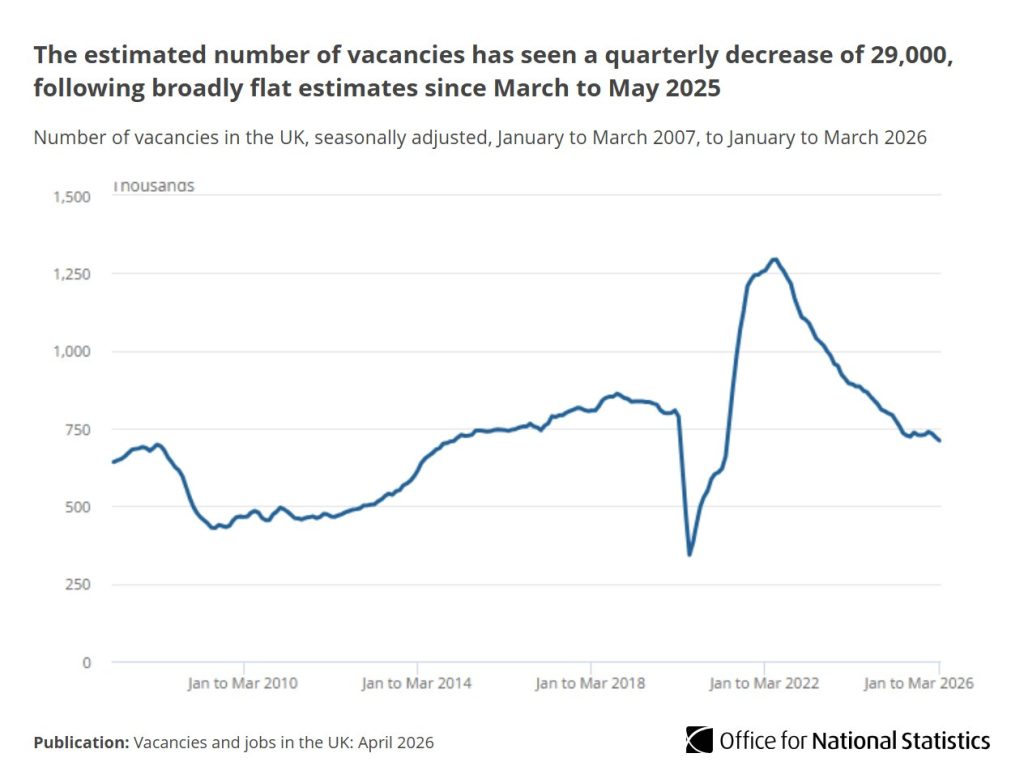
The release comes against a broader backdrop of labour market softening. Recent labour market overview data had shown the unemployment rate rising to 5.2% in late 2025, with payrolled employment trends pointing to net losses over the past year and vacancies continuing to trend lower.
Economists had generally expected further moderation in both employment and wage pressures as the economy navigates subdued growth, higher employer National Insurance contributions, and external shocks.
The relatively stable March payroll figure, and the fact that cumulative job losses since mid-2024 now appear smaller than initially feared due to revisions, could be interpreted as a tentative sign that the worst of the contraction may be easing.
However, the ONS notes a longer-term downward trend in employee growth since around 2019, exacerbated by the pandemic and only partially recovered afterward. Self-employment has also faced challenges, contributing to overall workforce job declines in some recent estimates.
The full impact of the war of the Middle East is also yet to be felt.
For the Bank of England, which has been monitoring wage growth closely in its inflation-targeting framework, the 4.3% median pay rise offers some reassurance that earnings pressures are not reigniting aggressively.
Combined with slowing regular pay growth in earlier quarterly data, this could support arguments for measured interest rate decisions amid other global uncertainties.
Businesses, meanwhile, face a more complex environment. Cooling demand for labour in some sectors, April payroll changes, and the need to manage costs carefully.