Most Brits think they are richer than they actually are – especially compared to Americans


Summary
- Q: Where do most Brits think the UK ranks in average income per person (GDP per capita) among major economies?
- A: 5th – ahead of the United States, Germany, Australia and much of Western Europe.
- Q: Where does the UK actually rank?
- A: 21st globally. UK GDP per capita is around $57,000 — far behind Switzerland ($118,000), Singapore ($99,000), the US ($93,000), Australia ($69,000) and Germany ($64,000).
- Q: How do Brits think the UK compares to the 50 US states?
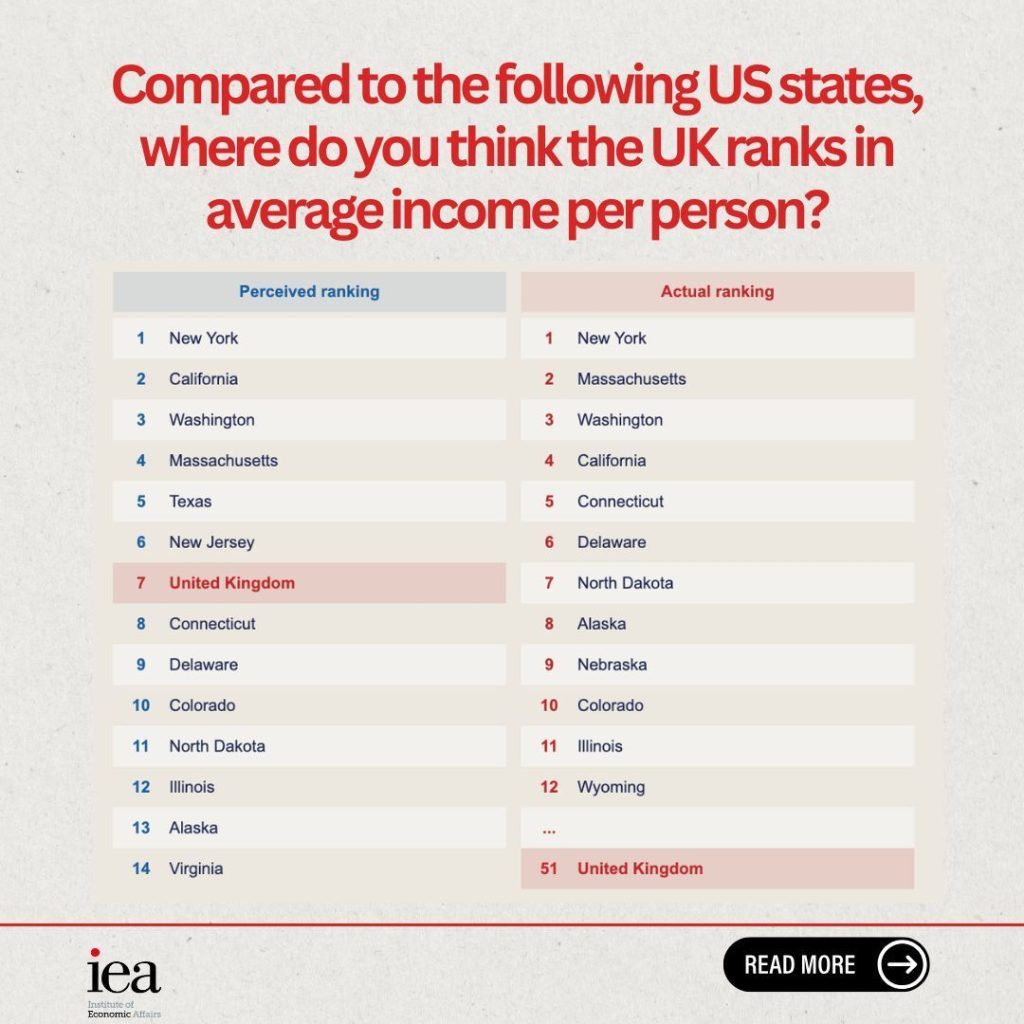
- A: They rank it 7th richest on average (richer than 43 states). In reality, the UK is poorer than every single US state – dead last.
Article
New polling from the Institute of Economic Affairs shows Britons dramatically overestimate the UK’s economic standing relative to peer nations and even most US states.
Britain is in the midst of a prolonged period of economic stagnation. Real average earnings have barely budged since the financial crisis, productivity growth has collapsed to one-third of pre-2008 levels, and per capita GDP is roughly £11,000 lower than it would have been if earlier trends had continued.
Yet according to a major new survey of 3,001 UK voters conducted in January 2026 by Freshwater Strategy for the Institute of Economic Affairs (IEA), most people have little idea just how far the country has fallen behind.
A big perception gap
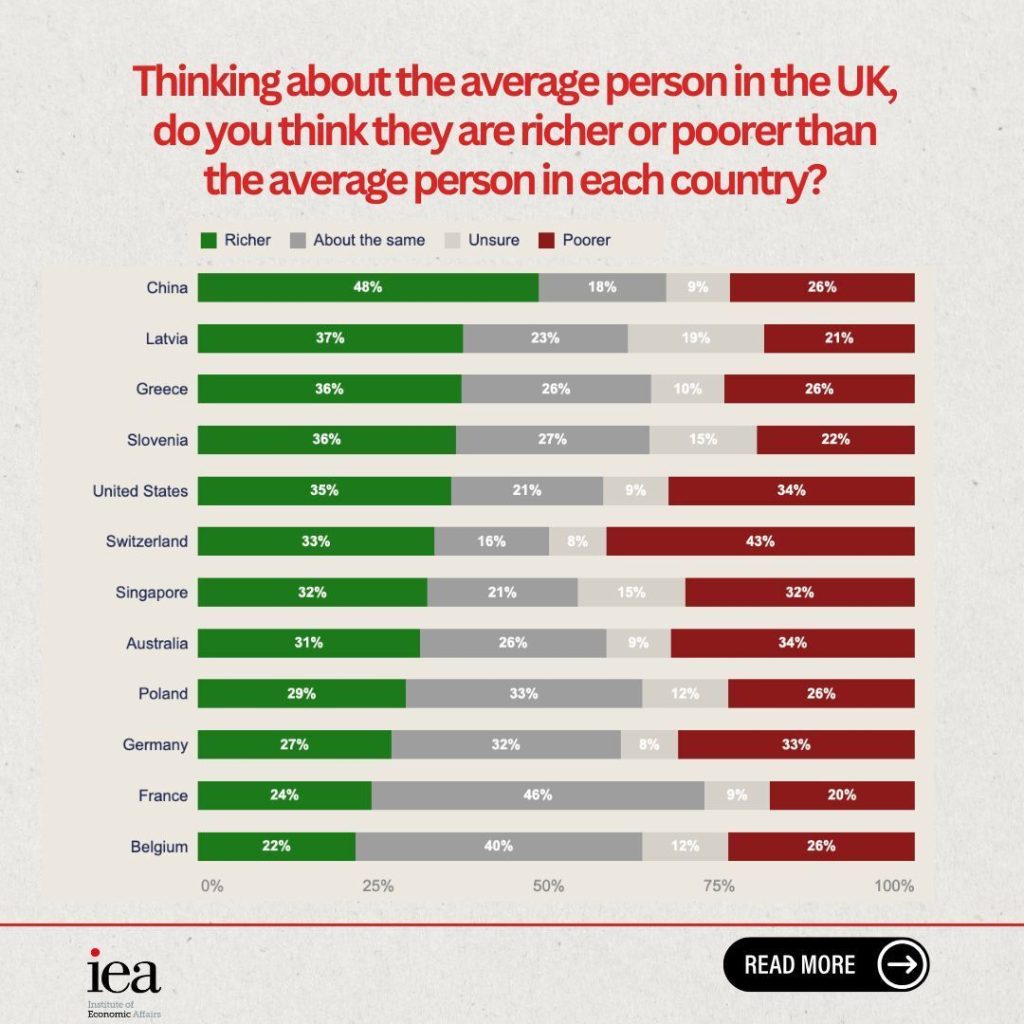
A majority of Brits wrongly believe the average person in the UK is as rich as, or richer than, the average person in the United States, Switzerland, Singapore, Germany, Australia, and much of Western Europe.
In reality, UK GDP per capita (around $57,000 according to IMF projections) lags well behind Switzerland ($118,000), Singapore ($99,000), the US ($93,000), Australia ($69,000), and Germany ($64,000). The UK ranks 21st globally.
When asked to rank the UK by average income per person among major economies, respondents placed it 5th on average. When asked to compare it to the 50 US states (excluding Washington, DC), they ranked the UK 7th – richer than 43 American states. In truth, the UK sits dead last behind every single one.
A shock to the system
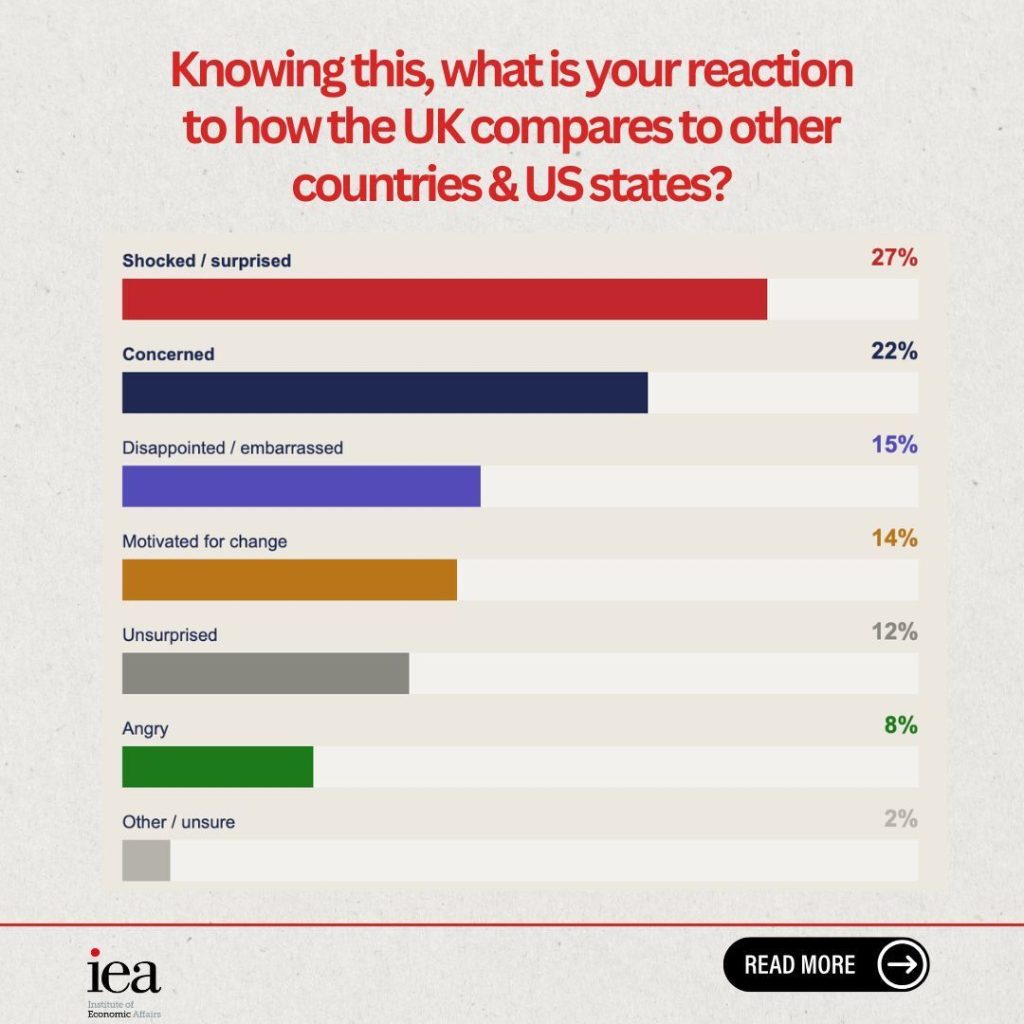
Presenting the actual data produces an immediate and visceral reaction. In the poll, 27% of respondents said they felt “shocked” upon learning the truth, while another 15% reported disappointment or embarrassment.
Focus groups conducted in February 2026 with young voters and Reform UK supporters echoed the sentiment. Participants expressed shock when told the UK would rank below states like Alabama, Mississippi, and Arkansas on GDP per capita.
“It’s kind of shocking to think actually we’re quite (a lot) lower down than expected,” said one young female participant.
“It’s shocking to find out we are at the bottom. I wouldn’t have said we were anywhere near the bottom at all,” added an older Reform voter.
The report’s authors, Matthew Lesh and Dr Michael Turner, argue this “concern to shock” dynamic creates a powerful “burning platform” for reform. Once voters grasp the scale of Britain’s relative decline, they become noticeably more open to fundamental economic change.
Broad support for growth – but deep misunderstanding
The polling shows overwhelming support for prioritising economic growth. 87% of Brits say the UK should focus more on growth rather than conclude the country is already wealthy enough. This view cuts across age groups, income levels, regions, and party lines.
Yet understanding of what growth actually means remains weak. When asked unprompted what comes to mind with “economic growth,” many respondents struggled to connect it to productivity, business investment, or rising living standards. Younger voters in particular often defaulted to vague ideas like “more government spending” or “more taxes.”
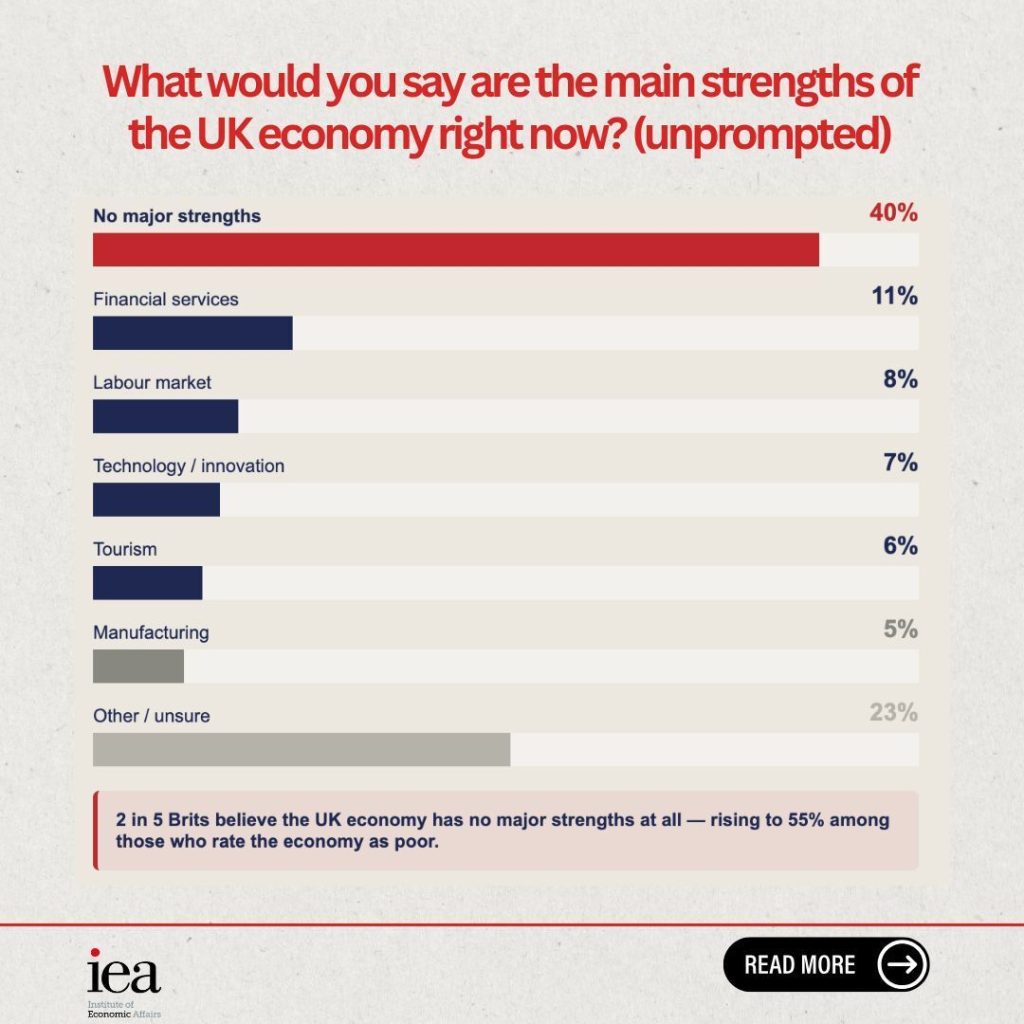
Two in five Brits (40%) believe the UK economy currently has “no major economic strengths.” Almost half think living standards have worsened in the past year, and 46% believe the economy is contracting.
Scepticism about who benefits – and contradictory policy views
Even among those who support growth in principle, there is widespread scepticism about who actually gains. More people believe “the government” (81%) and “large corporations” (81%) benefit from growth than “my family” (55%) or “me personally” (52%).
Voters also hold seemingly contradictory views on how to achieve growth. They blame high taxes, red tape, and energy costs for stagnation – yet simultaneously endorse more government intervention and spending as solutions.
The report describes this as a “kitchen sink” mindset. People distrust politicians and blame them for decline, yet instinctively look to the state for fixes.
A practical case for reform
Despite the confusion, the polling reveals openness to pro-growth policies when framed around tangible benefits – lower bills, higher wages, more homes, and better public services.
The biggest barriers are perceptions of fairness. Anti-growth arguments resonate when people fear the gains will flow mainly to the wealthy or big business while ordinary families bear the costs or risks.
Lesh and Turner conclude that the case for growth must be practical rather than abstract. Britain’s stagnation is not inevitable; it is the result of policy choices that can be reversed.
Correcting misperceptions about the UK’s true economic position may be one of the most effective ways to build a durable public mandate for the changes needed to get the economy moving again.