Companies House fees jump in 2026: Current UK business costs explained


The UK government agency Companies House has implemented significant fee increases for key services, marking the latest adjustment in a series of hikes aimed at funding enhanced regulatory powers and anti-fraud measures.
The changes, announced in late 2025 and now in effect, come amid broader reforms under the Economic Crime and Corporate Transparency Act (ECCTA).
These include mandatory identity verification for directors and persons with significant control (which began in late 2025), expanded powers to query and remove false information, and increased enforcement efforts to combat economic crime and shell companies.
Companies House reviews fees annually to align them with the actual costs of delivering services, which now encompass not only basic registration and public data publication but also sophisticated fraud detection, investigations by the Insolvency Service (including director disqualifications and prosecutions), and overall modernization of digital systems.
Key fee changes effective 2026
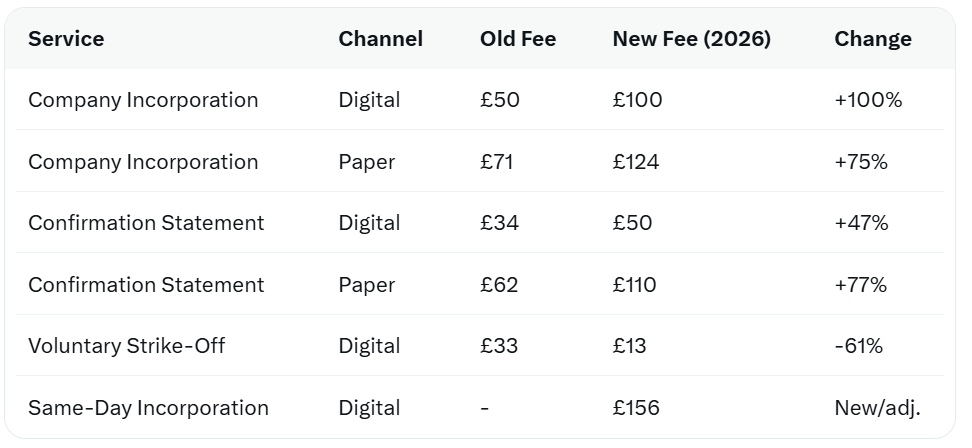
The most noticeable jumps affect new company formations and annual compliance filings, with digital submissions (encouraged for efficiency) seeing substantial rises:
- Company incorporation (digital filing): Now £100, up from £50 (a 100% increase). Paper filings have risen from £71 to £124.
- Annual confirmation statement (digital filing): Now £50, up from £34. Paper versions have increased to £110 from £62.
- Voluntary strike-off (dissolution of a non-trading company, digital): Reduced to £13 from £33 (digital) or £44 (paper), now £18 for paper in some cases, one of the few decreases, possibly to encourage removal of inactive entities.
- Same-day incorporation (software/digital): £156.
- Other related fees, such as registering UK establishments of overseas companies or certain LLP registrations, have seen similar upward adjustments (e.g., paper filings often £124+).
These represent the second major round of increases in recent years – the confirmation statement fee, for instance, had already risen from £13 to £34 in May 2024.
Businesses and formation agents note that the hikes add pressure on startups and small companies, where even modest annual costs can accumulate.
Why the increases?
Companies House notes that fee revenue is reinvested directly into improving the UK’s corporate register.
The agency argues that the changes support a more transparent marketplace, boost economic confidence, make it easier for legitimate businesses to access credit and raise capital, and disrupt criminal misuse of UK entities.
Officials maintain that even with the rises, UK fees remain “low by international standards.”
The funding supports:
- Enhanced fraud prevention and enforcement teams.
- New digital tools and identity checks.
- Public access to accurate company data.
For most limited companies, whether active, dormant, large, or small, the higher costs apply to core maintenance tasks like the annual confirmation statement, which all registered entities must file.
The official GOV.UK fee list can be found here.
The full list of changes are available in more detail here.