The best and worst mobile networks in the UK – the winner is clear


Two major independent studies have crowned the same champion of Britain’s mobile networks, with one network dominating the competition while rivals battle for the remaining podium positions.
The testing covered voice quality, data speeds, coverage, reliability, and real-world performance metrics including video streaming, gaming latency, and upload speeds – providing the most comprehensive picture yet of how Britain’s mobile networks actually perform in daily use.
EE’s continued supremacy
EE has cemented its position as the UK’s best mobile network for the eleventh consecutive year, according to testing by RootMetrics and Umlaut Connect. The BT-owned operator achieved a ‘very good’ rating and scored an impressive 112 points ahead of its nearest rival.
The dominance was echoed by RootMetrics, which awarded EE its 25th consecutive UK Overall RootScore Award – recognizing it as the country’s top network for over 12 years running.
EE’s success stems from exceptional performance across all key metrics. The operator delivered median download speeds of 114.1 Mbps nationwide – more than double its closest competitor – and maintained its lead in voice quality, data performance, and network reliability.
In major cities, EE posted median speeds above 100 Mbps in nearly every location tested, with particularly strong results in Manchester and Leeds where it achieved “outstanding” ratings.
The operator’s aggressive use of four-band and five-carrier 4G aggregation creates what analysts describe as a “robust capacity floor” that ensures consistent performance even when 5G coverage drops.
The battle for second place
Behind EE, the competition tightens considerably. Vodafone secured second place in the Umlaut testing with a ‘good’ rating, though it saw its performance rankings decline in several categories during the second half of 2025.
The operator maintained strong results in Wales and Scotland, with median download speeds above 50 Mbps in 11 of 16 tested cities.
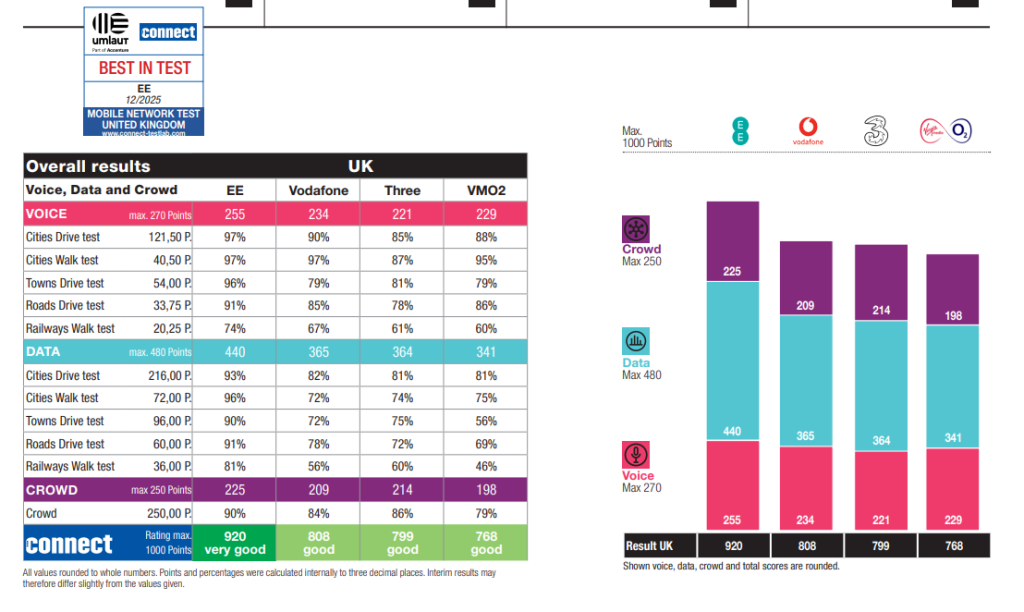
Three showed the most dramatic improvement, jumping 34 points compared to the previous year – the highest improvement of any operator in the current benchmarking season. The operator commands the largest contiguous 3.5 GHz spectrum holdings in the UK, enabling configurations up to 140 MHz bandwidth that deliver exceptional peak speeds exceeding 1.6 Gbps in cities like London.
Three ranked second in crowdsourcing results and posted median speeds above 50 Mbps in all 16 tested metropolitan areas.
Virgin Media O2 (VMO2) achieved the biggest score improvement overall, gaining 39 points year-on-year. The operator improved from fourth to second place in UK-wide reliability rankings and nearly doubled its metropolitan awards total.
VMO2’s median 5G download speeds in London jumped 21% between the first and second half of 2025, driven by wider spectrum deployments.
London performance
In the capital, EE maintained its lead with Vodafone achieving ‘very good’ results in second place. VMO2 and Three both earned ‘good’ ratings, with VMO2 showing particularly strong improvement in data speeds.
The testing involved extensive real-world measurements: umlaut/connect’s drive tests covered approximately 10,170 kilometers across 16 cities and 24 smaller towns, with walk tests conducted in ten cities and on trains. RootMetrics performed over 600,000 tests between July and December 2025.
What it means for consumers
For mobile users, the results suggest EE offers the most consistent experience nationwide, though you’ll pay a premium for it. Three represents good value with improving performance, particularly in urban areas where its wide spectrum holdings deliver impressive peak speeds.
VMO2 shows promising momentum with rapid improvements, while Vodafone maintains solid performance, especially in Wales and Scotland.
The testing covered voice quality, data speeds, coverage, reliability, and real-world performance metrics including video streaming, gaming latency, and upload speeds – providing the most comprehensive picture yet of how Britain’s mobile networks actually perform in daily use.