The most popular home renovations in the UK – and how much value they add


October saw a slight rise in the rate of annual house price growth in the UK to 2.4%, from 2.2% in September. Prices increased by 0.3% month on month, after taking account of seasonal effects, new data from Nationwide shows.
The housing market has remained broadly stable in recent months, with house prices rising at a modest pace and the number of mortgages approved for house purchase maintained at similar levels to those prevailing before the pandemic struck, says Robert Gardner, Nationwide’s Chief Economist.
“Against a backdrop of subdued consumer confidence and signs of weakening in the labour market, this performance indicates resilience, especially since mortgage rates are more than double the level they were before Covid struck and house prices are close to all-time highs,” he said.
“Looking forward, housing affordability is likely to improve modestly if income growth continues to outpace house price growth as we expect. Borrowing costs are also likely to moderate a little further if the Bank Rate is lowered again in the coming quarters.”
This should support buyer demand, especially since household balance sheets are strong – indeed, in aggregate the ratio of household debt to disposable income is at its lowest for two decades, he said.
The best renovations
Nationwide’s research found that kitchen and bathrooms renovations were the most popular amongst homeowners who have made improvements to their home in the last five years, with 71% undertaking either, or both, of these.
More than two in five (42%) added a bathroom or an ensuite, whilst 25% added an additional toilet. Of those undertaking work, around a third (34%) made green improvements to their property, with over half of these (56%) adding solar panels.
Solar panels are becoming an increasingly popular feature, with nearly 1.5 million dwellings in England having photovoltaic (PV) panels, equating to nearly 6% of total dwellings (up from less than 3% in 2013).
Younger homeowners appear to be most interested in greening their homes, with over two-thirds (69%) of those aged 25 to 34 who had renovated in the last five years making green improvements.
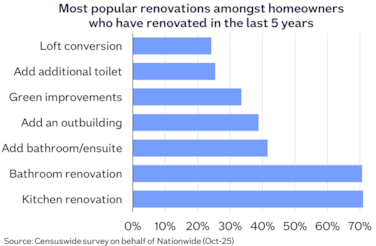
Older homeowners (those aged 55 or above) were least likely to have made green improvements (just 18%), with bathroom renovation being the most popular amongst this demographic (68% of those who had made improvements opted for this).
The most popular reason for renovating was to make the property look nicer (54%), while 35% were looking to boost the value of their property, with the latter being the most important factor for younger homeowners. 32% of those surveyed made improvements to modernise the property to make it habitable, while 26% were looking to add more space. Interestingly, just 7% were renovating in preparation for a sale.
What adds the most value?
Location remains key to house values, but other factors, such as the number of bedrooms, are also important to homebuyers. Home improvements that increase the size of the property, such as an extension or loft conversion, remain a compelling way to add value.
Having more usable space is generally thought to be consistent with better quality accommodation and people are prepared to pay for it. A 10% increase in floor space, all things equal, adds 5% to the price of a typical house.
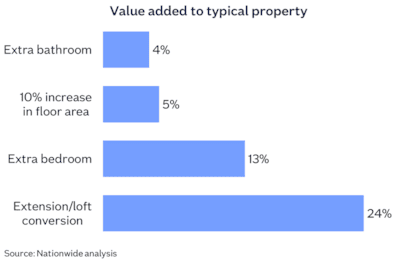
But Nationwide’s analysis suggests that it is additional bedrooms that are key to adding value. For example, adding space to create an additional double bedroom can add 13% to the value of an existing two-bedroom house.
Homeowners who add a loft conversion or extension, incorporating a large double bedroom and bathroom, can add as much as 24% to the value of a three-bedroom, one-bathroom house.