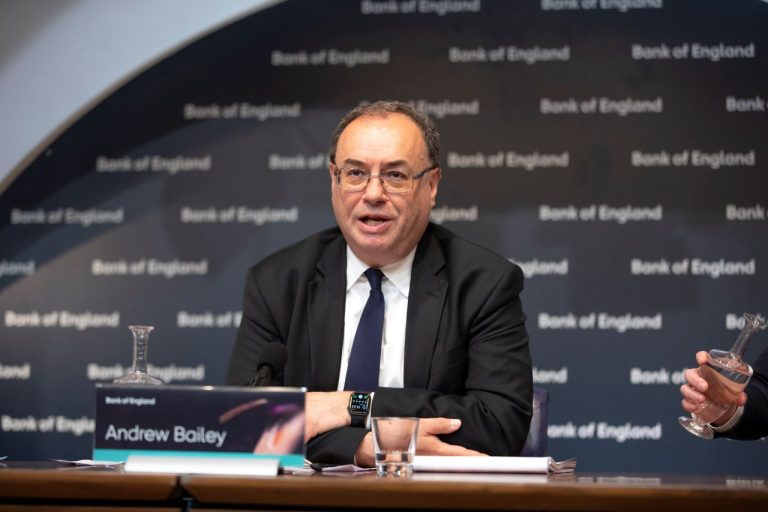
This is a dangerous road to go down: Bank of England Governor


Bank of England Governor Andrew Bailey has raised concerns about recent attacks on the independence of central banks.
Bailey pointed to US President Donald Trump’s push to remove the Governor of the US Federal Reserve, Jerome Powell, and how disruptive the move has been.
“This is a very serious situation and I am very concerned because the Federal Reserve is the central bank for the world’s strongest economy it has built up a very strong reputation for its independence and for its decision-making,” he said.
Bailey told MPs that central bank independence, alongside monetary stability and financial stability, underpins the foundations of policy that enables governments to make appropriate political decisions.
“I think what we’re now seeing is people saying we should be able to trade off the foundations for those other decisions, and I’m afraid I just think that is a very dangerous road to go down,” he said.
Bailey was in parliament to discuss the BoE’s August Monetary Policy Report and the decision to reduce the Bank Rate by 0.25 percentage points to 4%.

In an unprecedented situation, the MPC voted for a second time after the first ballot didn’t provide an outright majority. The result of the first vote was a split between four to keep Bank Rate unchanged at 4.25%, four preferring to cut by 0.25% to 4% and one voting for a 0.5% cut to 3.75%.
The Governor proposed a second ballot on a forced choice between holding the current Bank Rate or a 0.25% cut, with the latter gaining Professor Taylor’s vote for a majority of five. This is the first time that a second vote has taken place.
As well as Andrew Bailey, the Deputy Governor for Monetary Policy, Clare Lombardelli, and two External Members, Megan Greene and Professor Alan Taylor, gave evidence to the Committee. This means each vote preference was represented at the session.
Including its vote in August 2024, the MPC has voted to cut the Bank Rate five times in the last year, to its current level of 4%.