Here’s how much time Brits spend on YouTube each day


YouTube is leading the charge in the streaming takeover of TV sets, with the service now the first place younger viewers go as soon as they switch on, according to Ofcom’s annual report on the nation’s media habits
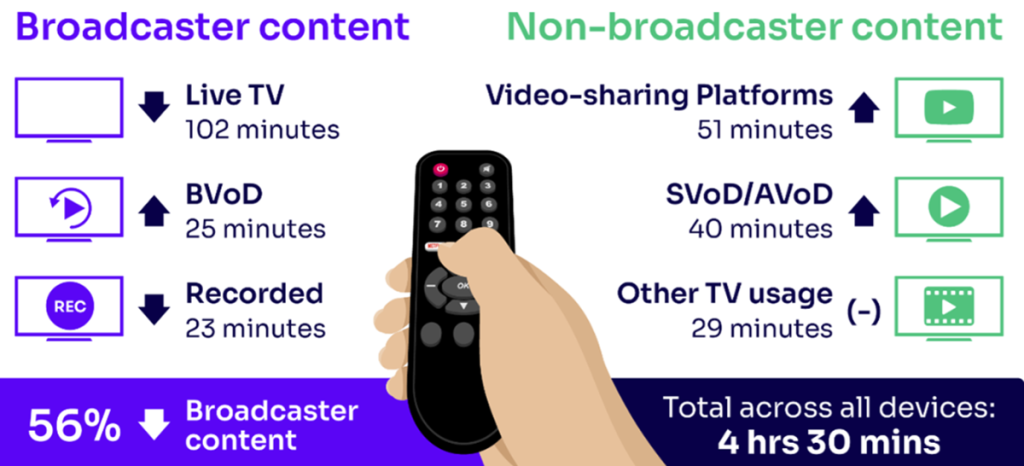
The data shows that people spent an average of 4 hours 30 minutes per day watching TV and video content at home in 2024. And while broadcast TV still accounts for the majority of in-home viewing (56%), audiences are increasingly turning to YouTube. The platform is now the second most-watched service in the UK, behind the BBC and ahead of ITV.
At home, people spent 39 minutes on YouTube per day in 2024, with 16 minutes of this via the household’s TV set. Younger adults aged 16-34 are driving this trend, watching 18 minutes of YouTube a day on TV, while one in five (20%) children aged 4-15 head straight to the app as soon as they turn the set on.
But it’s not just Gen Z and Alpha driving this trend, Ofcom said. Over 55s are now watching nearly double the amount of YouTube content on their TVs compared to the previous year (11 minutes per day in December 2024, up from just 6 minutes in January 2023). Last year, 42% of all YouTube viewing by this age group was on a TV set (up from 33% in 2023).
Evolving content
Ofcom noted that the content audiences are watching on YouTube has evolved too. Half of the platform’s top-trending videos now more closely resemble traditional TV, including long-form interviews and game shows. This shift positions YouTube as a direct competitor to ad-supported TV services, while offering broadcasters a way to reach wider and younger audiences.
Some broadcasters are increasingly offering their own programmes on YouTube, for example, ITV and Channel 4 make full length programming available on their channels, retaining control over adverts. Ofcom has identified these sorts of partnerships, making public service content available and prominent on online platforms, as critical to sustain the future of public service media in its recent report, Transmission Critical.
Public service broadcasters (PSBs) are seeing success with their online services, especially the BBC. For the first time, people are watching more online programmes from broadcasters than they are recorded programmes.
“Scheduled TV is increasingly alien to younger viewers, with YouTube the first port of call for many when they pick up the TV remote. But we’re also seeing signs that older adults are turning to the platform as part of their daily media diet too,” said Ed Leighton (Ofcom’s Interim Group Director for Strategy and Research).
“Public service broadcasters are recognising this shift – moving to meet audiences in the online spaces where they increasingly spend their time. But we need to see even more ambition in this respect to ensure that public service media that audiences value survives long into the future.”