Rejoining the EU could reverse most of Brexit’s GDP hit – here’s the catch


Key Points
- A 2026 UKICE report finds rejoining the EU could reverse most of Brexit's 2-6% GDP hit.
- Full membership would require accepting all EU treaties, losing the budget rebate, and a euro commitment.
- In return, the UK would regain full voting rights over EU law.
- The report ranks seven options on a "staircase," from the current TCA up to full membership.
- Each step trades more legal alignment for greater economic gains.
Rejoining the European Union could reverse most of the economic damage caused by Brexit, which has knocked between 2% and 6% off UK GDP, according to a new report from the think tank UK in a Changing Europe (UKICE).
But full membership would come with conditions the UK spent years negotiating its way out of – including the loss of its budget rebate and a commitment, at least on paper, to adopt the euro.
The report, published to mark ten years since the 2016 referendum, lays out a “staircase” of seven options for the UK’s future relationship with the bloc. Each step up requires closer alignment with EU law, and in return promises a bigger economic payoff.
At the bottom sits the status quo: the Trade and Cooperation Agreement (TCA) negotiated by Boris Johnson, which delivers tariff-free trade but adds paperwork, customs checks and regulatory costs.
The consensus, the report says, is that it has reduced UK GDP by 2-6%, broadly in line with pre-Brexit forecasts.
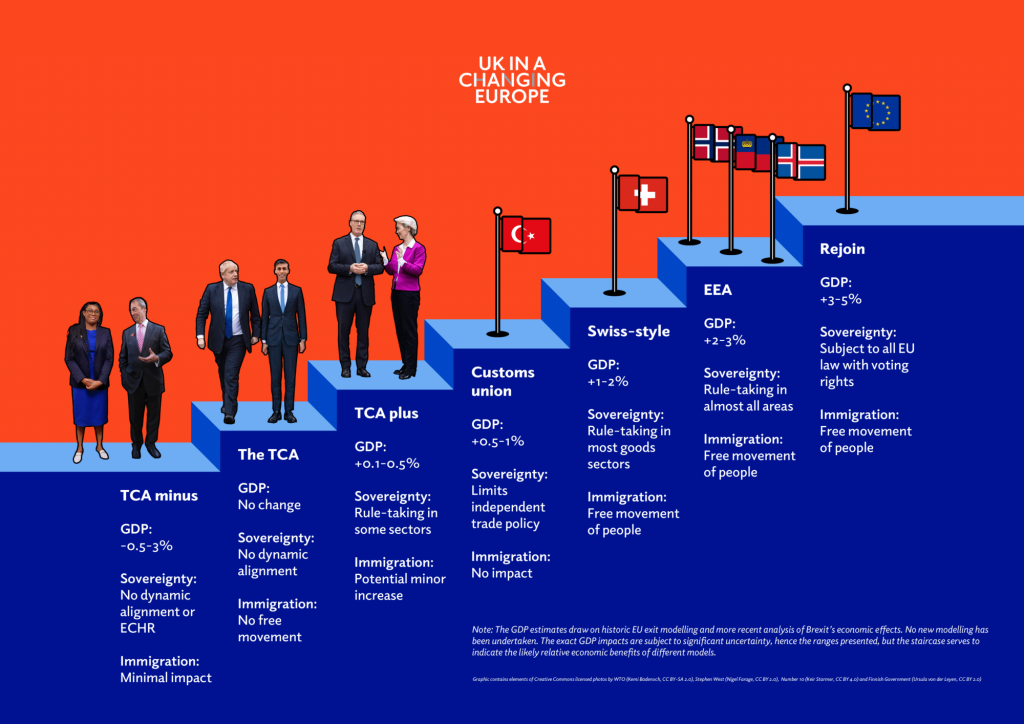
By comparison, a “TCA plus” package of supplementary deals could add up to half a percent to GDP by 2040.
A customs union could add 0.5-1%, with manufacturing the biggest winner. A Swiss-style arrangement could deliver 1-2%, and joining the European Economic Area – full single market participation – an estimated 2-3%.
Rejoining the EU outright sits at the top. The report states it is “reasonable to think” full membership would reverse most of the economic damage Brexit has done.
Here’s the catch
Unlike the lower steps, rejoining means accepting the full rulebook.
The UK would be bound by all EU treaties, would likely lose the budget rebate it previously enjoyed, and would have to make an at least rhetorical commitment to join the euro.
The trade-off cuts the other way too. Where Swiss and EEA-style deals force the UK to follow EU rules with no formal say, full membership would restore decision-making power – including full voting rights over the laws Britain is subject to.
It is also the option voters like most. The report notes that rejoining, put to a referendum, is the most popular of all the future-relationship models among the public.
Where the politics sit
Recent comments show Prime Miniter Keir Starmer and Chancellor Rachel Reeves are pushing for closer “alignment” rather than re-entry. The Liberal Democrats and Greens back a customs union.
Pulling in the opposite direction, Reform leader Nigel Farage and Conservative leader Kemi Badenoch have both said they would tear up Starmer’s EU “reset” and leave the European Convention on Human Rights – a move the report warns could push trade onto “no deal” terms and knock a further 3% off GDP.
Ten years on from the vote David Cameron promised would settle the question “once and for all,” the report’s authors conclude that few across the political spectrum are satisfied with where Britain has landed.