These UK ‘AI winners’ lost everything. Here’s why investors got it wrong


A wave of UK-listed stocks once celebrated as the biggest beneficiaries of the AI boom have seen their post-ChatGPT gains completely erased, and in some cases turned into outright losses, just as the technology they were supposed to ride to new heights began to eat their lunch instead.
A new analysis by investment platform AJ Bell shows that the reversal, which accelerated sharply in early February 2026, has left investors nursing painful paper losses and forced a painful rethink of one of the market’s most crowded trades.
The hype cycle that promised easy money
When OpenAI unleashed ChatGPT in late 2022, investors rushed to identify companies sitting on hard-to-replicate, high-value datasets.
The narrative was simple and seductive: these firms would supercharge their offerings with AI, charge premium prices, and enjoy durable competitive moats.
Leading the pack were several FTSE 100 and FTSE 250 names:
- RELX (legal and regulatory data for law firms)
- Sage (accounting software)
- Auto Trader and Rightmove (online marketplaces for cars and homes)
- Experian (credit and consumer data)
- London Stock Exchange Group (financial data and analytics).
A number of non-UK names were caught in the same frenzy – Thomson Reuters, Pearson, and Salesforce – rode the same wave.
Between late 2022 and mid-2025, the group posted strong gains as analysts pencilled in higher growth and expanding margins. Forward price-to-earnings multiples climbed as high as 26 times on average.
Then came the February bloodbath
The turning point arrived in the first week of February 2026. Anthropic’s Claude AI rolled out a specialised legal-industry tool that could instantly pull case law, citations, and regulatory updates – the exact premium service RELX and Thomson Reuters had long sold at high margins.
Within days, Claude expanded the offering into full enterprise AI “agents” capable of handling marketing campaigns, sales pipelines, and even wealth-management advice.

The market reacted quickly. If AI can replicate the core value these companies provide, why pay for the wrapper?
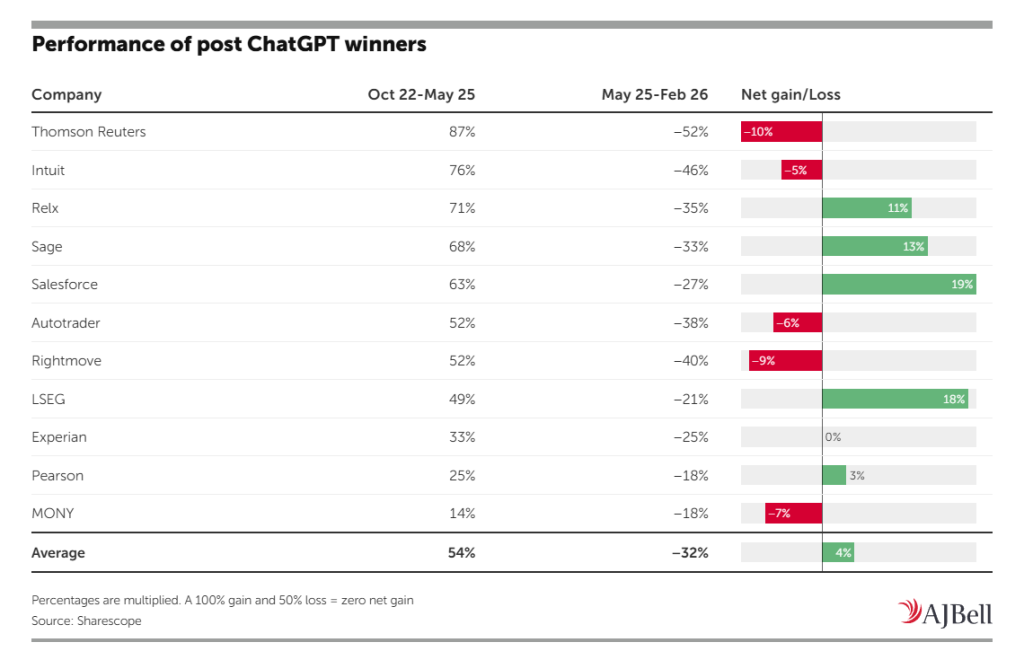
Share prices that had already been drifting lower reversed hard. By the end of February, most of the 2022–2025 gains had vanished:
- Auto Trader, Rightmove, Experian, and RELX were trading below their October 2022 levels.
- Sage clung to a sliver of positive territory but saw its valuation collapse.
- Even Salesforce, which is still up roughly 20% overall since late 2022, watched its forward P/E crater 60% to just 14.6 times.
The average forward P/E across the basket dropped from 26 times to 16 times in the space of a few months.
Why investors completely misread the story
AJ Bell investment analyst Martin Gamble, who tracked the saga, noted that investors had not reckoned on the speed of AI’s progress with enhanced capabilities appearing every few weeks.
The warning signs were there. Alphabet’s Gemini 3 model, launched in late 2025, had already started bridging the gap from clever chatbot to digital personal assistant.
But the market chose to ignore the pace of iteration. Instead, it clung to the comforting story that “data moats” would protect these businesses forever. They didn’t.
The same AI that was supposed to help these companies became the weapon that could replace them. And because AI models improve exponentially, the disruption arrived faster than almost anyone modelled.
“Companies which can adapt and incorporate AI while still offering a distinctive service or dataset which cannot be replicated by a machine should be best placed to withstand any changes,” Gamble said.