UK falls to new low in global corruption index

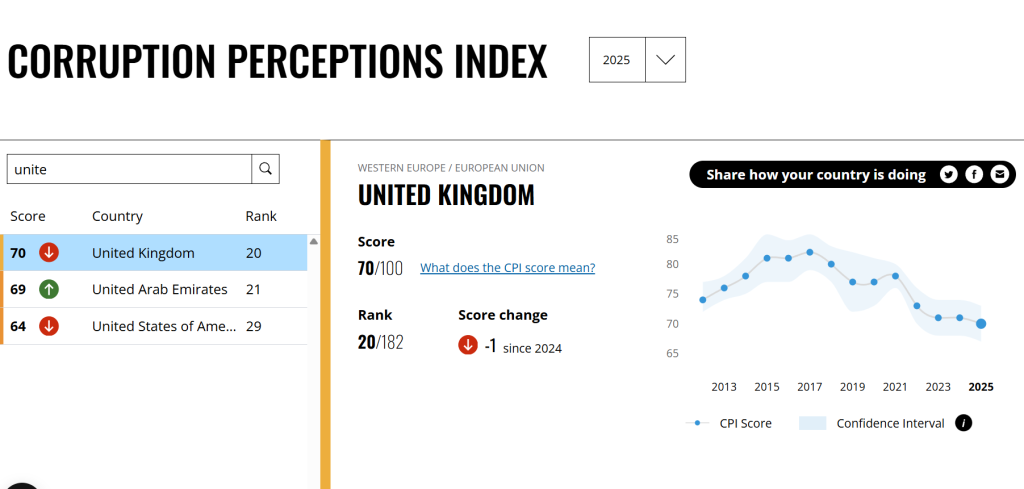
The United Kingdom has plummeted to its lowest ever score in Transparency International’s Corruption Perceptions Index (CPI). The index, which was published on Tuesday (10 February), paints a troubling picture of perceived public sector corruption, with the UK scoring just 70 out of 100 – a drop from 71 in 2024.
This marks the UK’s poorest performance since the CPI’s methodology was overhauled in 2012, signaling a decade-long slide that experts warn could become the “new normal” if not addressed.
The CPI, which ranks 182 countries and territories based on expert and business perceptions of public sector corruption, places the UK at 20th position globally for the third year running.
That’s a far cry from its top-10 status in 2017, and an even steeper fall from seventh place in 2015. Over the past decade, the UK’s score has declined by 11 points, reflecting ongoing issues that have eroded public trust.
What’s behind the decline
Transparency International attributes the UK’s downward trajectory to systemic failures in upholding ethical standards among ministers, lawmakers, and government officials.
Key concerns include the influence of political donations, “cash for access” scandals, and the state’s targeting of campaigners and journalists, which are seen as undermining democratic institutions.
Duncan Hames, Director of Policy and Programmes at Transparency International UK, stated that “corruption concerns risk becoming the new normal,” emphasising that business-as-usual approaches won’t suffice to reverse the trend.
This isn’t an isolated issue; the report highlights a broader “worrying trend” in established democracies where anti-corruption efforts have stalled. The UK joins the United States (now at 29th with a score of 64), Canada, and Sweden in experiencing notable drops, amid global frustrations with unaccountable leadership.
How does the UK stack up globally?
At the top of the index, Denmark leads with a score of 89, followed closely by Finland at 88 and Singapore at 84, showcasing robust anti-corruption frameworks.
Western Europe dominates the upper ranks, with nine of the top ten spots, but even here, stagnation is evident as the regional average hovers without improvement.
By comparison, the bottom of the list is occupied by nations like South Sudan and Somalia, both scoring a dismal 9, and Venezuela at 10, where corruption is perceived as rampant. Globally, the average score dipped to 42, with over two-thirds of countries scoring below 50, underscoring a pervasive challenge.
As the CPI reveals, even nations with historically strong institutions aren’t immune to backsliding. For the UK, this latest low serves as a critical juncture: either tackle the root causes head-on or risk entrenching corruption as an accepted part of public life. With public demand for reform growing, the coming years will test whether leaders can restore the nation’s standing on the global stage.