Bad news for unemployment in the UK


The UK’s job situation is not expected to improve significantly in the coming year and could actually worsen as tax increases bite and labour market participation dwindles.
New data by the think tank, the Resolution Foundation, shows that young people in the country are bearing the brunt of this downturn.
The increase in employer NICs and the minimum wage changes introduced in April 2025 both served to raise the labour costs of younger workers relative to older workers, the group said. The employer NICs increase affected the cost of employing young workers aged 21 and above (employers do not need to pay NICs on the salaries of workers aged under 21) because it had a bigger impact on low than high earners, and young people earn less than older workers.
The labour costs of workers aged below 21 weren’t affected by the employer NICs increase, but they were by the big youth minimum wage increases. In April, the minimum wage rose by 16 per cent for 18-20-year-olds (and by 18%for 16-17-year-olds), compared to a 7% increase in the adult rate.
Looking forward
“The good news is that, if the NICs increase is the main cause of the recent increase in unemployment, we’d expect the impact to fade over time as employers are able to pass on more of the tax increase to workers in the form of lower earnings,” the group said.
“In November, some businesses told the Bank of England’s agents that “much of the adjustment” has taken place. But of course, that’s not true of the minimum wage increases – there are further rises coming in April, especially for workers aged 18-20, for whom the wage floor is rising by 8.5%.”
However, the UK’s two main official forecasters – the OBR and the Bank of England – certainly don’t take the view that rising unemployment is a brief response to a one-off tax change, and both think that unemployment will remain elevated for some time.
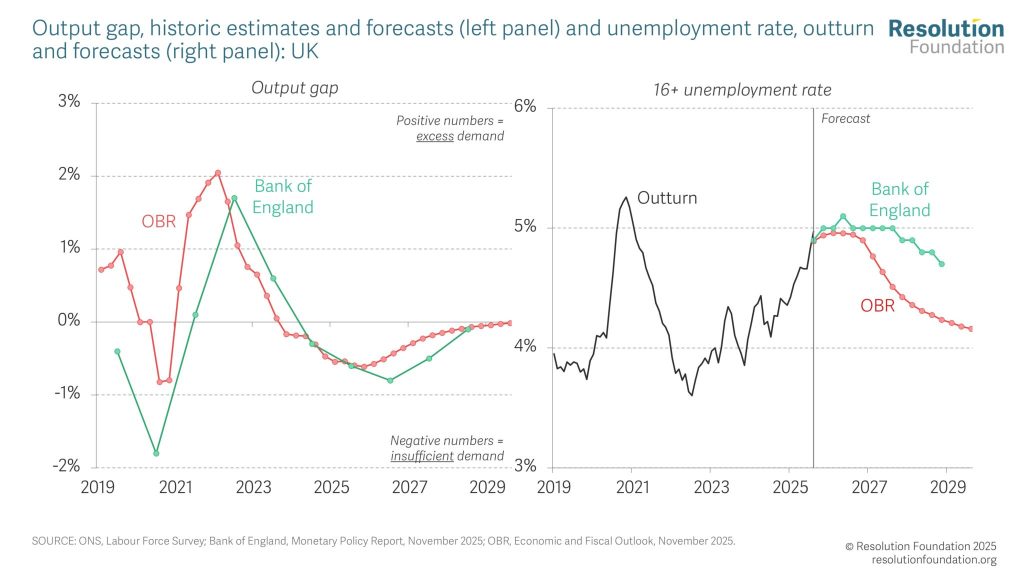
The Bank of England expects unemployment to remain at 5% for the next two years. The OBR is somewhat more optimistic – it has unemployment hovering just below 5% throughout 2026, but falling from early 2027.
In both cases, the main reason for expecting unemployment to remain high in the coming years is that they think the economy will be operating substantially below capacity.
Holding out for a hope
But there is some hope that the Bank’s forecast is overly pessimistic, the Resolution Foundation said.
“What happens next to the unemployment rate will depend on what this higher rate is doing to inflation. The best-case scenario is that stronger competition for jobs pushes down on wages.
“In that case, firms’ costs will fall, inflation will come down, the Bank of England will cut interest rates, that will stimulate spending, and employers will boost hiring to meet the extra demand,” it said.
The alternative, less appealing scenario is that wage growth and price inflation settle at stubbornly high rates in the face of this higher unemployment rate. There are several reasons why that might turn out to be the case, the group said.
“First, it could be that the mix of jobseekers looks very different from the mix of jobs available, and so firms still struggle to hire and high unemployment does not push down on wages so much. In that situation economists would say the ‘structural unemployment rate’ had risen. There is not currently much evidence for that, though.
“The UK’s current position on the ‘Beveridge curve’ suggests the relationship between vacancies and unemployment is normal. So the problem isn’t that the job vacancies are of the wrong kind, but that there just aren’t enough of them – a problem of the overall level of labour demand, not mismatched demand.”
Second, it could be that workers expect large wage increases to compensate for high past or expected price inflation.
This would reflect an increase in the ‘non-accelerating inflation rate of unemployment’ (NAIRU), and in this scenario, as with unemployment increases stemming from efficiency problems, the Bank would have less space to cut rates and bring unemployment back down again, the Resolution Foundation said.
“The Bank of England discussed this possibility in its latest Monetary Policy Report but did not reach a firm conclusion. There does not yet seem to be strong evidence of this having happened. During the cost of living crisis, the level of wage growth (a key driver of inflation) was indeed high relative to unemployment based on the historic relationship between the two.
“But in recent months, wage growth has slowed, so currently the pace of wage growth is roughly what we would expect given the level of unemployment. This bodes well for the ability of the Bank of England to boost labour demand with lower interest rates.”