Big changes for Hybrid workers in the UK


New data from jobs website Indeed shows that Hybrid work patterns are shifting as UK employers tighten office attendance requirements.
More than a quarter of UK adults had access to hybrid work during Q1, a lasting workplace legacy of the pandemic that has survived several high-profile return-to-office calls.
The share of UK postings mentioning remote and/or hybrid work has remained fairly stable at around 15% for several months, near all-time highs.
However, employers are tightening these hybrid arrangements, requiring more frequent office attendance than before. Just 15% of hybrid job postings asking for a specific number of days in office specified a minimum of one day per week in 2025 (through August), down from roughly one-third in 2023.
The most common arrangement is two days (56%, up from 43% two years ago).
One-quarter of postings now indicate a minimum of three days a week in the office, up from 20% in 2023. And only 4% of postings offering some form of remote or hybrid work ask for a minimum of four days a week in the office.
More time in the office
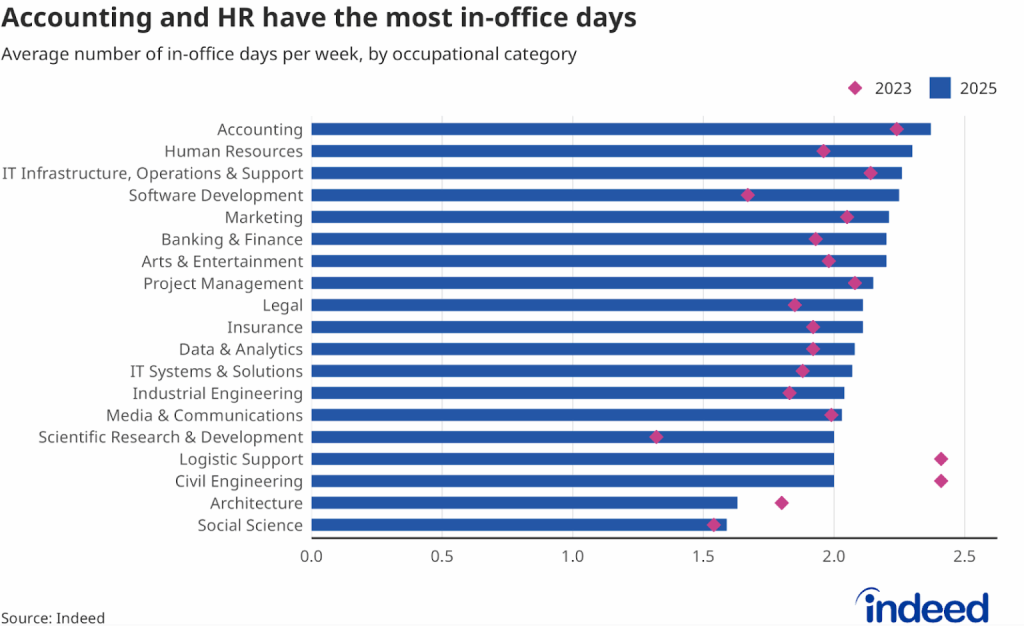
On average in 2025, the occupation with the highest number of required office days is accounting (2.4), followed by human resources (2.3) and IT infrastructure, operations & support (2.3).
Perhaps surprisingly, in an industry known for being relatively remote-friendly, the typical hybrid software development job requires 2.3 days in office, up 0.6 percentage points over the past two years to go from fourth-lowest to fourth-highest in this list. That was the second-largest increase behind scientific research & development (0.7ppts).
Almost half (48%) of UK software development jobs mention remote and/or hybrid work, the highest of all occupations tracked by Indeed.
The increase in required office days could reflect employers wielding more leverage in a subdued market for tech talent, and/or wanting to promote greater in-person collaboration.
Occupations with fewer in-office days (on average) include social science and architecture (both 1.6). The latter is one of only three occupations to have seen a decline in the average number of in-office days, alongside civil engineering and logistic support.
Surveys of UK workers commonly suggest that 1-2 days a week in the office is their most favoured arrangement. The current balance, therefore, appears slightly higher than what employees desire, though not drastically so.
While some employer surveys suggest companies would like to further boost office attendance, there have also been warnings that some employees would consider leaving if forced back to the office.