Ranked: The 50 best cities to live and work in the UK – outside of London


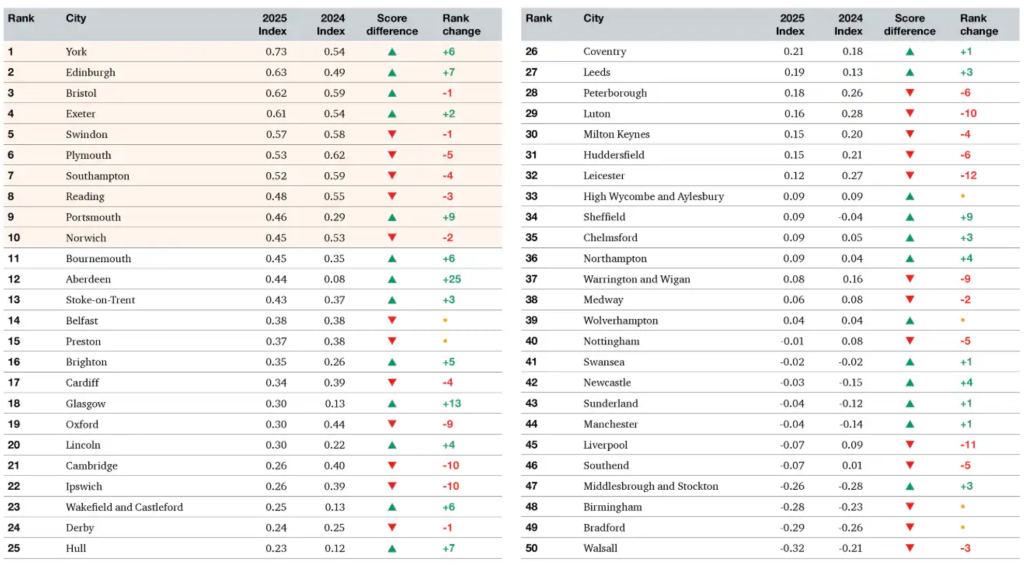
Professional services firm PwC has published its annual Good Growth for Cities Index, ranking the UK’s top cities outside of London.
The ranking is based on both the public’s assessment and the actual performance of 12 economic measures.
These measures include jobs, health, income, safety and skills, as well as work-life balance, housing, transport, income equality, high street and shops, environment, and business startups.
The ranking shows York is the highest performing city in the annual index, with Edinburgh rising to second place and Bristol in third place.
These cities scored highly across high streets, skills, and jobs, which are key indicators of prosperity that the public increasingly values. York ranked among the top three cities for both high street and jobs.
Cities across the South West region continue to perform well with Bristol (3rd), Exeter (4th) and Swindon (5th) all in the top five highest performing cities.
All three cities score significantly above the UK average on jobs and high streets, and Swindon and Exeter both performed well in skills.
Scottish cities have also performed well this year. Edinburgh secured the second overall position, while Aberdeen was this year’s most improved city, jumping 25 spots to 12th place.
Glasgow also showed considerable progress, climbing 13 places to rank 18th, making it the third most improved city of the year.
Aberdeen has climbed up the rankings due to significant improvements in jobs and income distribution and Glasgow with stronger performances in skills, safety, and work-life balance.
A shift in priorities
PwC’s research shows a convergence in the public’s priorities this year, with financial considerations becoming less dominant in favour of tangible, local, and essential concerns such as high streets and shops, skills, housing, and transport.
Although income and income distribution remain key priorities and are still the public’s most cited factors for economic success, they have seen the most significant year-on-year decline.
However, three of the biggest fallers in this year’s Index, Cambridge, Leicester and Liverpool, have seen large declines in their performance in the jobs metric.
However, it is unlikely that this shift reflects a renewed sense of optimism around household finances.
PwC’s recent Consumer Sentiment Survey reveals that concerns around inflation and job security have deepened across all demographics, particularly among younger people and those on lower incomes.
Even the top three cities in the Index, York, Edinburgh and Bristol face challenges around affordability as despite low unemployment figures, all three have more moderate scores on income.
Some UK cities to see above average growth
Although economic activity grew fast in the first half of the year, it is anticipated to decelerate in the second half. With this national backdrop, Brighton, Edinburgh, Manchester, and Liverpool are expected to outpace the UK average growth rate of around 1.2% this year.
These cities have successfully merged economic diversification with investments in infrastructure and innovation. Manchester and Liverpool demonstrate how strategic public and private investments, backed by devolution and targeted sector strategies, can enhance long-term growth potential.
However, other cities face tougher challenges. Despite scoring highly on the Index, Plymouth and York have weaker growth forecasts due to their reliance on slower-growing sectors such as manufacturing.
Sunderland, where this sector accounts for over a fifth of the economy, is anticipated to grow more slowly than other cities in the Index, impacted by global volatility and delays in essential infrastructure projects such as electrification.
Economic growth can be driven by either expanding the workforce or by utilising labour and capital more efficiently. Certain cities, like Norwich, are expected to grow primarily through population increases, which in turn boost demand and workforce size.
However, this does not always translate to improved living standards or higher output per person.
Excluding population growth, cities such as Bournemouth and Birmingham climb up the Index due to strong productivity gains, supported by investments in digital infrastructure, knowledge-based sectors, and urban regeneration. This highlights the importance of prioritising investment-led growth over merely expanding in scale.